• The move to the new server is done. There are some software and database maintenance updates in process. This has us passing the hat around to help out. We appreciate any donations. Seriously, even a dollar helps. The payment page may be found here - https://www.audiokarma.org/support.html

Bozak Mystery

Steve Smiley, yup.

Schoon, on the FB you can certainly ask for local help. I would if I were local. It may not seem like it, but the batting replacement is non-optional. All that fiberglass is doing is making your cabinet smaller (less bass). The proper batting and swinging curtain addition is a remarkable upgrade. You got this.

Biggles
 
Thanks to @drbiggles for suggesting to get the backs off those things, as it goes a long way in providing you direction for action.

It looks to me like you have Bozak B-305 components in your speakers, as opposed to the Symphony components. If that is an accurate guess, the mid is probably a 16 ohm mid. I'm not very familiar with the B-305 crossover network, but the info is readily available.

The boxy thing is an enclosure that actually contains the capacitors. The doughnuts are the inductors. The inductors are good, the caps you will want to replace.

The fiberglass insulation is something you will want to replace with cotton batting. I know people have found a source for the batting but I haven't seen it posted. Hopefully someone can chime in. You will not get the performance you want with the infinite baffle design (that's Bozak) without the appropriate batting. You will also want to add the flower pot over the mid. When I get a chance, I can share a link to the Home Depot version to give you an idea.

You can replace all four of the B-200x with four B-200y for the same layout on your baffle.. Those are most likely set up on a series/parallel configuration so that it shows as a 16 ohm load...heck, you can just use one of them for that matter. A B-200y single is a 16 ohm load.

I would recommend you become an AK subscriber and then you can post a WTB for parts. It's only $25 for the year and a good resource. There is also a few online marketplaces. You should also join the Facebook Bozak group. There is good info and help there, knowledge and possible parts.

Thanks again to you and drbiggles. I've been looking at my Bozak literature, and yes these are basically B-305 components, with the exception that the tweeters are not mounted in the middle of the woofers (B-207A) but rather separately (and in an enclosed compartment of their own).

The literature I have seems to contemplate only one speaker (though there is a B-304 Stereo-Fantasy containing two separated B-302A speakers in one cabinet). I assume that you and most other contemporary users have two of each speaker in order to pay stereo. I wonder how that squares with Bozak's original conception of the sound? My two (basically B-305) speakers together have the components of one B-310. The original owners had then separated by (I think) three feet, but I have then separated by four feet (there's a circa 1959 German console in between). Much of the music I play is mono, but certainly not all. (I play 78s, 45s, LPs both stereo and mono, cassettes, CDs and streaming--lots of wires.)

I would really love to have some idea of what the "swinging curtain" looks like. Do you or drbiggles have any photos or diagrams?

Also, how do you affix the flowerpot used to cover the midrange speaaker?

Also, where can I find 1/2 inch thick cotton batting? I've been looking online, but no one mentions the thickness, and I think that cotton batting is generally much thinner.
 
Schoon,

Good on the mono and 78s, all the rest can take a flying leap as far as iam concerned. The swinging curtain is just that. Using your imagination, walk up and take down your window curtains using your right and left hands. Now walk over to the open backs of your speakers and slide those inside, at the top, halfway back. Now you've installed your swinging curtain, make sense? What that does is trick the backwave of your B199 woofer into thinking it's a much larger cabinet. If you do an A B test, you'll say DAMN, that's way cool!!!!!

Make sure the flower pot has a lip, affix with 4 screws. Then lay down some latex caulk. Pot gets lined and covered in 2" 100% upholstery cotton batting. Go to cloth store and ask. That 2" thick is a painfully loose translation, installation can get tricky trying to hold it in place.

Biggles
 
My visual and spacial imagination is terrible, so I don't think I understand. Is this essentially a piece of cloth hung from the top of the cabinet, from left to right across the entire width, and reaching to the bottom of the cabinet, halfway back? So it is fixed at the top but loose at the bottom and sides? Wouldn't that cut the size of the cabinet behind the speakers in half? Does it then get pushed backwards? I'd LOVE to see a photo or diagram.

Do you line the top, bottom , sides and back of the cabinet with the same material?

NEVER MIND. I just found a youtube video that explains all about the insulation and swing curtain.

It even shows where to order 2 inch acoustic cotton batting. A bit expensive though--6 24 x 48 inch pieces for $109. I'd need 12 pieces for two cabinets, so about $220.

On the subject of money, I added the cost of components from the original price list: $589. An inflation calculator told me that amount in 1959 would be $5,923.50 in 2022. Not including tax.
 
Last edited:
Schoon,

Yeah, that’s it. But don’t use that blue Jean cotton insulation. It costs too much and it makes even worse acoustic material than fiberglass for Bozaks. I spent over a hundred bucks on it and lined my Symphonies with it. My bass response was horrible, it disappeared. So, I tossed it all in the trash and bought 100% cotton upholstery batting 2” thick from a local store that sells cloth and sewing supplies.

Bozaks we’re a premium brand when they were new, yeah buddy.

Biggles
 
OR, you could sell what you’ve got and cut your losses now. Hold out until you find a later pair that’s already done. No harm in that either. In fact, that’s not such a bad idea. Let someone else fork out the cash, you probably won’t get that back out of them when you sell them anyway. I say, cut and run. The crossovers are going to cost you 200 to 300 bucks too. Run dude!

Biggles
 
You basically measure woofers from rim to rim, not the cone size. Your speaker enclosures are custom made and in an upgraded B-305 enclosure configuration. The problem is you have the old paper coned mids and tweeters. The mids don't hold up that well and the response of the paper cone tweeters drops off rapidly around 10 KHZ. You can call Audio Classics as they have the B-209 B and Bc and the B-200Y's with the Aluminum cones. But what you really want are the B-200 Zc tweeter with the thinner curvilinear cone which easily reaches above 20,000 HZ. I would guess your speakers like the original B-305 are 16 ohm. The two 8 ohm woofers our wired in series. The mid is 16 ohms and the tweeter pairs are 8 ohms wired in series, too, to yield 16 0hms. . You should upgrade your caps in the crossover, too. Changing the mid to woofer crossover frequency to 400 HZ from 800 HZ like the Symphony and Concert Grands. Join the Bozak Group on Facebook to learn everything about Bozaks. You can speak with Bob Bettes who was Mr Rudy Bozak's co-designer and in charge of production and helped develop that last upgrades to the drivers. Your woofers are rated at 18 watts RMS each. So I wouldn't want much more that 50 watts per channel at 16 ohms. That 100 watts for an amp rated for 8 ohms and is direct coupled SS design with out autoformers. . Some of Mcintosh Amps have 16 ohm out puts. The MC 2505 and MC 250 for instance rated at 50 watts. Tube amps would be the MC 240 and MC 225. The 275 would just be to strong as it puts out close to 100 watts before clipping. I used a MA 230 and then Image7-68.jpg I upgraded to MC 240's with a C-22 when I had my B-4000 Contemporary Symphonys back in the 60's. Your speakers are from the late 50's or very early 60's. Yes I bi-amped later on. There is a 302 system in the TV. This picture was taken in 65.
 
Last edited:
OR, you could sell what you’ve got and cut your losses now. Hold out until you find a later pair that’s already done. No harm in that either. In fact, that’s not such a bad idea. Let someone else fork out the cash, you probably won’t get that back out of them when you sell them anyway. I say, cut and run. The crossovers are going to cost you 200 to 300 bucks too. Run dude!

Biggles
You're joking, right? I like the speakers as they are. New capacitors, insulation and baffles won't be too expensive or too much work. And based on what you've told me that will make them sound much better. Losses? I paid $300. As for selling them, that can be done by whoever settles my estate.
 
Last edited:
No joke, not too late. I stand by our offer though, Facebook group as well. We can get them dialed in to perfection.

You’re going to need to confirm that you have 16 ohm mids, they will be labeled on the backs somewhere. Thankfully, the 16ohm versions should be less expensive. Ask for some on the FB group.

Biggles
 
IMHO, the B209 paper cone mid gets a worse reputation than it deserves, except in one area - it definitely doesn't have the power handling capabilities of the later aluminum cone versions.

One the other hand, the B200X tweeters are a good source of recyclable Alnico V.

Schoon,

Yeah, that’s it. But don’t use that blue Jean cotton insulation. It costs too much and it makes even worse acoustic material than fiberglass for Bozaks. I spent over a hundred bucks on it and lined my Symphonies with it. My bass response was horrible, it disappeared. So, I tossed it all in the trash and bought 100% cotton upholstery batting 2” thick from a local store that sells cloth and sewing supplies.

Having a box of that stuff in the garage to work on some speakers, and having looked at it compared to several different vintage speaker linings, I find that quite curious. I wonder why it behaved poorly.
 
Having a box of that stuff in the garage to work on some speakers, and having looked at it compared to several different vintage speaker linings, I find that quite curious. I wonder why it behaved poorly.

There’s no loft for the back waves to dissipate into, none. It was immediately apparent, and I mean immediately. Go pull some of it it out, pluck it. It’s too damn dense. It’s worthless for your walls and attic, it’s worthless for acoustic batting in your speaker cabinets. It’d be great on your walls to stop any reflections.

Biggles
 
There’s no loft for the back waves to dissipate into, none. It was immediately apparent, and I mean immediately. Go pull some of it it out, pluck it. It’s too damn dense. It’s worthless for your walls and attic, it’s worthless for acoustic batting in your speaker cabinets. It’d be great on your walls to stop any reflections.

Biggles

Huh. The original cotton batting in my Bozak cabinets is dense as hell. If anything, at first glance, the recycled denim stuff seemed more open and lofty.
 
Huh. The original cotton batting in my Bozak cabinets is dense as hell. If anything, at first glance, the recycled denim stuff seemed more open and lofty.
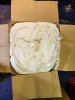
Another Audiokarma member who lives near me has some cotton batting available that s/he acquired from an upholstery place. It was sold as 2 inches thick but actually measures about one inch. I'm attaching a photo. Do you think this would be good to use?
 

Attachments

  • WestchesterCottonBatting.jpg
    WestchesterCottonBatting.jpg
    130.4 KB · Views: 34
Huh. The original cotton batting in my Bozak cabinets is dense as hell. If anything, at first glance, the recycled denim stuff seemed more open and lofty.

And yet, it works perfectly. Everyone is welcome to do as they see fit. I did A/B testing with Bozak B302As and Symphony's, multiple vintage EV products, vintage Wharfedales. I found the difference remarkable. I invite others to do the same and see, don't take my word for it.

Oh wait, I tried it on Altec Valencias too.

Biggles
 
Another Audiokarma member who lives near me has some cotton batting available that s/he acquired from an upholstery place. It was sold as 2 inches thick but actually measures about one inch. I'm attaching a photo. Do you think this would be good to use?

THAT'S it! You struck gold! Handle carefully, flimsy stuff.

Biggles
 
Another Audiokarma member who lives near me has some cotton batting available that s/he acquired from an upholstery place. It was sold as 2 inches thick but actually measures about one inch. I'm attaching a photo. Do you think this would be good to use?

And yet, it works perfectly. Everyone is welcome to do as they see fit. I did A/B testing with Bozak B302As and Symphony's, multiple vintage EV products, vintage Wharfedales. I found the difference remarkable. I invite others to do the same and see, don't take my word for it.

Oh wait, I tried it on Altec Valencias too.

Biggles

That has a much "fluffier" look than the original stuff in my B302A cabinets. You could just about use the stuff in the Bozaks for a mattress.

I'm not disagreeing with the findings of actual experimentation in any way, I just find it surprising.
 
That has a much "fluffier" look than the original stuff in my B302A cabinets. You could just about use the stuff in the Bozaks for a mattress.

I'm not disagreeing with the findings of actual experimentation in any way, I just find it surprising.

Yeah, and I don't think that original stuff has anything to do with cotton either.

I've had success with 4 loose 1/4" layers of cotton batting (stuff you line blankets wit). That was interesting too. I believe Bob Betts mentioned that wool would work, I did not have success with wool blankets.

Biggles
 
Yeah, and I don't think that original stuff has anything to do with cotton either.

I've had success with 4 loose 1/4" layers of cotton batting (stuff you line blankets wit). That was interesting too. I believe Bob Betts mentioned that wool would work, I did not have success with wool blankets.

Biggles

I've always heard that the yellow sheet stuff that Bozak used was some sort of cotton product. The other thing they used a lot was Kimsul, which breaks down over time.
 
Here is what I elsewhere wrote (slightly edited to remove extraneous material and for clarity) two years ago on the subject of Tufflex.

That yellow material is Tufflex, a reprocessed cellulose (industry names viscose or rayon), praised be its name.

Bozak originally used Tufflex for the lining and curtain, and when that product was discontinued in the late 1960s to early 1970s then switched to cotton batting, just as the upholsters were forced to switch materials.

Tufflex is cellulose made into a cotton-like material. Cellulose and cotton are near-identical from a chemical and materials standpoint, but not a physical one: processed cotton is 90% cellulose. The fact that they are chemically identical to a large extent does not, however, mean the fibers are physically identical, as they are not:
Cotton is constructed in concentric layers with different properties. This is hardly surprising given that it is a material made by a plant.

Cellulose fibers are made from wood pulp reprocessed in many steps to form long chains, i.e. a polymer, so they are mostly identical across the structure. The greater the crosslinking (polymerization) the greater the strength of the resulting fiber. Rayon is a tradename for a processed cellulose. The FTC forced manufacturers to stop calling cellulose from bamboo "regenerated fibers".​

Tufflex was a reprocessed cellulose fiber — variable source material, including plant fibers like cotton or cellulose derived from trees — designed in the 1950s and sold throughout the 1950s and 1960s to compete with cotton for padding in furniture and acoustic deadening. The exact properties are not easily discoverable, but we can proceed as if it was similar to that of rayon given the similar raw materials.

Kimsul, the earliest material used by Bozak, is the earlier Kimpak insulation — one inch of cellulose fibers between sheets of kraft paper — with an additional asphalt coating to reduce the otherwise considerable flammability. (Kraft is the German word for "strong".) The paper was required for strength, as the cellulose fibers were quite weak. Kimsul was created by Kimberly Clark in the 1930s. Other similar products were called "balsam wool". Flammability is greater than for cellulose (above described) alone.​

Cotton and cellulose do not have identical properties:
Cotton fiber retains strength when wet while cellulose fibers do not. Cotton fibers also have greater strength (twice that of cellulose) than cellulose fibers (about half that of cotton) which is why clothing can be made from cellulose (rayon, viscose, etc.) while rope cannot.

Cellulose fiber is not abrasion resistant, and it readily pills. And cellulose is very flammable, far more than cotton, so much so that in the 1950s the rayon sweaters were known as "torch sweaters", and children's clothing was also highly flammable. The Federal Flammable Fabrics Act (FFA) was a direct result of routine severe injuries when synthetic fibers rapidly went up in flames. (Some of the home fires resulted from cigarettes, which, as is well known, were engineered to encourage consumption by not self-extinguishing when not actively smoked. The unattended burning caused many home fires and the tobacco companies then blamed them on flammable upholstery and pushed for toxic chemicals to be added as a fire retardent rather than fix the cigarette issues.)
 
Steve Smiley, yup.

Schoon, on the FB you can certainly ask for local help. I would if I were local. It may not seem like it, but the batting replacement is non-optional. All that fiberglass is doing is making your cabinet smaller (less bass). The proper batting and swinging curtain addition is a remarkable upgrade. You got this.

Biggles

In a discussion last year you said to line the back of he swinging curtain with a "scrim" attached with 3M. What is the scrim made of?
 
Back
Top Bottom