• The move to the new server is done. There are some software and database maintenance updates in process. This has us passing the hat around to help out. We appreciate any donations. Seriously, even a dollar helps. The payment page may be found here - https://www.audiokarma.org/support.html

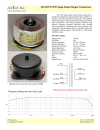
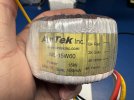
brainstorming building my first single ended tube amp (well, more like a test bed) with Antek MS-15W60 toroidal opt's

pac1085

AK Subscriber
Subscriber
A week ago I went over to a friends house and heard his 0.75w SET amp on his Klipschorn's and was impressed. It was my first time hearing a SET amp.

I've repaired quite a few amps and have gotten quite good at it, but never built my own. I have a huge stash of tubes (including plenty of oddball novar, compactrons, etc) and parts. I'll probably start out with single ended triode, but might mess with pentode and maybe ultra linear as well? I have a few pairs of efficient speakers that it should work well with. I don't have any specific goals in mind (other than <3w or so), this is really just a learning exercise for me.

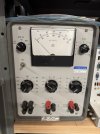
For now, power supply isn't a concern since I just want to get it going with my bench supply, a Fluke 407D, which can supply 555v @ 300mA (at <500uV noise) and has 10A of 6.3 or 12.6v. At some point I'll probably mess around with building a test equipment style regulated power supply with tubes, since I have a bunch of nice transformers and other things I scrapped from old HP and Tektronix gear. Totally unnecessary but should be fun to learn more about.
IMG_0721.jpeg

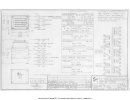
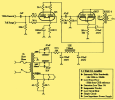
I was originally planning on using 6BX7GT's using this schematic that was shared by electra-print. It calls for a 2k primary OPT, which is part of the reason why I went with these specific Antek's since that's an option. The frequency response on them looks pretty good and they were cheap. I also haven't seen too many people use them, so it will be interesting to test the amp on my Rohde & Schwarz UPL when it's done for frequency response, etc.
IMG_0722.jpeg
1788269866071.png
This is the schematic for the parallel 6BX7GT amp that I found. Unfortunately I had one less 6BX7 in my stock, so will need to buy another if I go this route - or just use one tube for both channels for now.
1788268754004.png

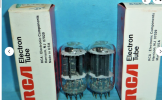
I then found that I have a nice pair of 6EM7 tubes so I suppose I could build the amp from diyaudioprojects:
1788271048773.png

I found a bunch of 6L6G's (not GC), so could use them as well. I want to use some of my oddball tubes, not the standard 6550/kt88/el34/etc.

Anyways, I'll post more when I get there.
 
Register to hide this ad
6L6, Still one of the best sounding vacuum tubes of all time!

They make every design better.

Also: I love 6BX7's and have a ton, I'll give you one just pay for shipping.

:music:
 
Kludged together this 6em7 single channel using the schematic from diyaudioprojects.

IMG_0732.jpeg

I need to go buy a cake pan or something to mount the transformers and sockets to :-)
 
Last edited:
this is fun, 6em7 tests

1khz tests:

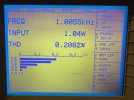
2.74w @ 0.818% THD+n into 8 ohm dummy load with the 6k tap on the transformer (100khz meas b/w)
1.66w @ 0.465% THD+N
1w @ 0.259% THD+N

109 dB s/n ratio @ 2.74w with dc filament supply and 200hz-20khz bandwidth, iec-a
92.74 dB s/n ratio @ 2.74w with dc filament supply and 0hz - 100khz bandwidth, no a weighting filter

I went to Walmart and bought a cake pan to mount everything to, so I can build the other channel tomorrow and get it quite a bit less sketchy :-)

Thd only (not +n)
IMG_0737.jpeg

Low frequency distortion is very poor, several %, maybe I need to increase that 100uf cap?
 
Last edited:
Haha, only two pieces. The hp 428b clip on current probe and the 34401a multimeter hiding in the background. The big tube power supply is Fluke and the dc power supply is a Kepco
 
Fellow Kepco user! I have an ATE25-10m and APH 500m, along with many other HP, Power Designs, and Lambda supplies. As a power electronics enthusiast I just love the build quality of vintage, USA-made benchtop power supplies
 
I think I'm gonna finish building this 6em7 amp into a dedicated chassis after seeing the promising results from last night and just buy some more transformers to build the next one (6bx7 or 6l6g). I want to play around with converting it to fixed bias as well.

That means I need to free up the bench power supply, so I started looking into how I want to build the power supply for the 6em7 amp.

Totally unnecessary(thats my thing) but I think I will do a regulated power supply with a 6gf7a (dissimilar dual triode so it can be the error amplifier and series pass in 1 socket) / 5651 and a 0a3 for the bias supply. I have all of this stuff so it's cheaper than buying a choke for a traditional unregulated supply, lol. Antek AS-1T250 power transformer.

I will probably buy 2 of the Antek MS-10W70 transformers for this and use the original transformers for the next build
1788350361622.png
 
A 6GF7 would also make a decent triode spud amp. They are pin-compatible* with a 6LR8 which is a triode-pentode. I'm planning a 6LR8 push-pull amp, but may pick up some 6GF7 to try it as a triode amp.

*obviously no screen connection on a triode, but that pin just doesn't have any connection on a 6GF7, so the socket can keep the screen voltage connected.
 
Yeah, I have A 6LR8 but only one. This caddy-o-tubes I got had a bunch of cool compactrons and novars but exactly one of each.

Regarding the power transformer, I think the main transformer from a Tektronix 575 curve tracer might work, and I have one kicking around so I can save $55 if it does.
Looks like I could get 150mA if I parallel the two 225v secondaries, which should be enough, I should only need around 100-110mA.

tek 575.jpg
That extra 140v secondary might be interesting to turn this into an integrated at some point (mainly riaa phono preamp stage) - more than enough current even if I have to use a voltage doubler

I'm going to harvest the ceramic terminal strips from the junk Tek stuff and use them for this amp as well.
 
Last edited:
A 6GF7 would also make a decent triode spud amp. They are pin-compatible* with a 6LR8 which is a triode-pentode. I'm planning a 6LR8 push-pull amp, but may pick up some 6GF7 to try it as a triode amp.

*obviously no screen connection on a triode, but that pin just doesn't have any connection on a 6GF7, so the socket can keep the screen voltage connected.
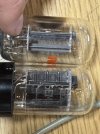
The 6gf7a looks so much less substantial inside compared to 6em7, interesting to think it’s capable of 1w more dissipation.
IMG_0741.jpeg
It turns out I do have 2 of these. And plenty of novar sockets. Compactron on the other hand, guess I won’t be using those after seeing how much the sockets sell for!
 
yea that does look a lot less substantial.

sometimes I wonder about tube ratings, some seem accurate, others seem extremely conservative.

compactron sockets are sort of annoying, they cost more than the tubes most of the time. PCB mount ones are cheap but those don't interest me. If there was some means of mounting them and just dealing with the pins vs a loop I can manage but unless they have the groove for a retaining ring I don't know what to do with them for chassis mount.

there are modern production ceramic ones, no idea how good orr bad they are though
 
6gf7a, otherwise the same circuit I was using last night with the 6em7. results were pretty much the same but this tube needed a little less voltage from the signal generator to make the same power as that specific 6em7. the small signal triode in the 6gf7a tested stronger at 6250umhos where as the 6em7 was 4870. it makes a bit more distortion at the higher end than the 6em7 (edit: this goes away if I bump the b+ ever so slightly, might just be a difference in the resistor I used)

1khz tests:

2.65w @ 1.033% THD+n into 8 ohm dummy load with the 6k tap on the transformer (100khz meas b/w)
1.62w @ 0.446% THD+N
0.99w @ 0.262% THD+N

(didn't expect any difference for these)
108 dB s/n ratio @ 2.74w with dc filament supply and 200hz-20khz bandwidth, iec-a
94 dB s/n ratio @ 2.74w with dc filament supply and 0hz - 100khz bandwidth, no a weighting filter
 
tickle in a bit of feedback and it should lower THD and make the gain difference insignificant. Can go global, but honestly just some plate to plate would likely be fine here.
 
regarding the 6gfa7, interestingly most of the ones im seeing on ebay look beefier like the 6em7, although I did find several like mine as well.

Screenshot 2026-09-02 at 10.43.42 PM.png

this puny one I have has been playing fine for a few hours and not red plating or anything. interesting.

Edit: after looking closer at the top label on mine they are clearly GE tubes that were re-labelled RCA, must be late production
 
Last edited:
tubelab has done some torture tests on assorted tubes and I know he's mentioned very different results from brand to brand. Some will handle quite a lot more abuse than others, and often they have different plate structures. This may be one of that sort, and the magic solution might be to seek out a specific brand to get beefier versions, especially if you had any thoughts on pushing them past their official limits.
 
Still have the 6gf7a in at the moment but converted it to fixed bias instead of cathode bias. grabbed a 301k grid leak resistor (I have to read more about the relevance of this and how the value affects things). it makes 4 watts at 0.85% THD+N before the waveform just starts clipping. 260v plate, 44mA cathode current under load

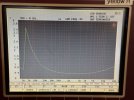
it has a weird spike in distortion at 60hz, not sure what to make of that since im running dc filament (it measured the same with ac or dc) this is a 40hz-20khz frequency vs thd+n sweep - 310mv signal which is 1w at 1khz.

I wonder if it’s because the OPT isn't in an enclosure. It doesn’t change at all if I move it around. Or maybe a ground loop issue with my analyzers but they are both doing it - hmm. if I connect it to the other spectrum analyzer I can see that 60Hz is -90dB down

tempImageR3HBTe.jpg

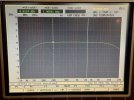
here is the frequency response 0db being 2.828v (1w into 8 ohms) down 4db at 20hz, but only a little over 1 at 40hz.
tempImagep3zdHt.jpg

I also ordered the smaller antek ms-10w70 opt's so I can try the 5k tap

edit: was missing grid leak resistor on small signal section input grid, the schematic showed a volume pot but I just went straight in. I added one but it did not change that distortion spike.
 
Last edited:
may just need to reference the heater to ground to get rid of that. I had weird stuff showing up at the output on my 6P3SE amp until I put a bypass cap from heater to ground. It was connected through a resistor divider to elevate it but it wanted that cap too. Also could be induced noise in the transformer core or something.

the grid leak resistors are critical-ish in the sense that too large can allow the tube to build up a positive charge and run away. Its more critical in fixed bias, often amps allow the resistor to be 3X or so in cathode bias what the value is for fixed bias. Outside of that its just an RC turnover thing. With no feedback the cap working into the resistor sets the low frequency response of the amp. I think its 1/2piRC or just use an online calculator. bigger resistor and/or bigger cap = lower frequency response. Up to the point that the transformer gives up at least.
 
I love my Fluke 407D, but man, ya gotta be careful and ensure the set-ups are well connected with well insulated wire. Oopsies are spectacular without programmable current limiting. Found that out the hard way..
 
Back
Top Bottom