
• The move to the new server is done. There are some software and database maintenance updates in process. This has us passing the hat around to help out. We appreciate any donations. Seriously, even a dollar helps. The payment page may be found here - https://www.audiokarma.org/support.html

Brilliant Friggin' Idea

djnagle

AK Subscriber
Subscriber
Or maybe not. So I was looking at my room last night and making plans about a real attempt at room treatment.

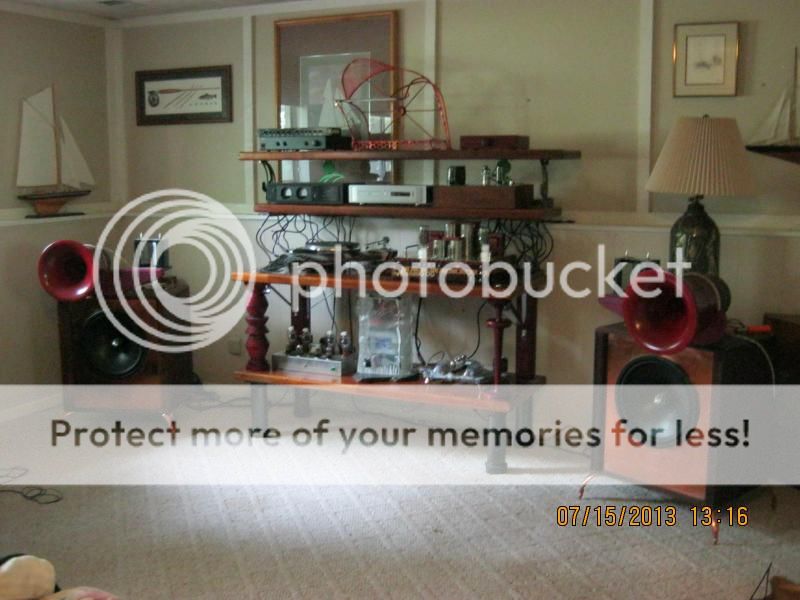
My room is 15'x16' the first picture is my system and the second picture is the back of the room opposite the system.


So, on the back wall from left to right, I have the stairs leading up to the kitchen so no reflection there. Then I have a sheet of acoustic foam on the door leading to the crawl space that is soaking up high reflections, then in the recess is the Ikea 5x5 bookshelf which has more albums now so is virtually a flat surface.

There is a 2' wide space between the wall and the bookshelf that will get a very large bass trap and a space on top of the bookshelf that will get the same size (5'x2'x18") bass trap.

But here is my brilliant idea....maybe. Unlike in the picture, now the top three sets of shelves on the bookshelf are full of albums. So I was thinking about cutting the below shape out of a 13" wide 2x4 and mounting it as a backstop on each shelf that holds albums. If calculated correctly, the albums would mirror the diffuser pattern and would turn the whole bookshelf into a diffuser.

This is just a conceptual drawing because I don't know the proper pattern for a diffuser as far as depth of each well, the order of each well, and the width of each well. For all of us that have that Ikea bookshelf, it could be an inexpensive diffuser.

So what do you think???

 
Register to hide this ad
Why not try staggering the depth of the albums a bit and see how this affects the sonic character. This way you could experiment until finding the optimum arrangement then make your cutout to approximate the changes?

Martin
 
I did try that last night Martin. Just my little bit of fooling around made the room sound bigger. BUT>>>> psychoacoustics says that because I made a change, my brain will perceive the results as positive. I figure I need to do this properly and really test it, but I don't know enough about diffuser to know if it is worth the effort.
 
I did try that last night Martin. Just my little bit of fooling around made the room sound bigger. BUT>>>> psychoacoustics says that because I made a change, my brain will perceive the results as positive. I figure I need to do this properly and really test it, but I don't know enough about diffuser to know if it is worth the effort.

By the way, love those speakers, bet the sound is VERY dynamic.

Martin
 
They do Martin. With all the off sets of the drivers (which I did so all the Voice Coils would line up) you would think the sound might not be very coherent, but the depth and width of the sound stage is amazing and the location of the instruments or vocals are pinpoint in the room. Also, the speakers just disappear. I got very luck.

I was just looking at an online calculator and it is over my head. I hope an expert chimes in.
 
Took me a minute, but yes the ironing board is sticking half way into the room from the laundry room☺
 
Last edited:
I'm no expert, Dennis, but I've done enough homework on diffusion (as well as built almost half dozen QRD well-type units and three stepped and modulated units) that if there's one thing that is for damn sure it's that a true diffuser...meaning able to uniformly and predictably redirect sonic content in both the time and spatial domains....has to be mathematically calculated and precisely built to within fractions of an inch to diffuse properly. Software like QRDude makes designing them pretty easy, but building them is a whole different animal. Well width, depth, number of wells and sequencing will dictate the spectral range the diffuser will operate in and the points at which true diffusion occurs. If the surface/device is not creating true diffusion based on mathematic modeling then it's just scattering. Scattering is a redirecting of sound energy but without uniformity in space and time....not as effective as diffusion but certainly better than a direct, early reflection. And also understand that true diffusion is generally ineffective within five or six feet of the device....so you need to be some distance away from it otherwise you won't hear its effect. The general rule is if the rear wall is around six feet or less from the listening position it should be treated with broadband absorption. I suggest you get a broadband absorber on the door to the crawlspace and build two stand mounted broadband absorbers to place behind you between the couch and the shelves. I guarantee you'll hear positive results from that....expectation bias be damned, it'll happen.

Look, I get that for most diffusion is kind of exotic and sexy and I'll quickly admit I'm a full blown freak over it. But one needs to understand it's not as easily implemented as absorption. Do it wrong, which is easy, and you may not hear any changes or, even worse, create some adverse sonic issues that didn't exist before. There are some clear rules and guidelines to follow so you can't just go throwing diffusion up where you think it will look good or is convenient. Staggering records or books or cds seems like a clever approach to getting some free diffusion, but unfortunately it's just not that easy.

- Michael
 
Not sure if this is in line with what you are trying to achieve but a thought to consider is putting some heavy cloth drapes accross the front of the Album case. It would reduce the reflections at least some. Could carry the treatment over onto the back wall with some more of the same or complimentry material as well. I know that you have the artists eye to make something like that both functional in terms of getting to your records and still make for a good looking room.

Just a sugestion that would not involve as much math and be easier to maintain I think.

Good Luck.

Shelly_D
 
Last edited:
If i were me, and I was doing it, which I'm not, so that's irrelevant. Whoever I was I would first experiment with easily put up and removable things. Be it Items to work as diffusers, or absorbers. The mathematical accuracy described by our friend from Arlington sounds like a nightmare to me. But if one could play around a bit you might not achieve theoretical sonic perfection on paper, but have a result your happy with.

I have spent many hours in my garage making " mock rooms" with sheets of plywood, drywall, and office dividers to see what affect it has on sound. Some things have a huge impact others not so much. I have used calculators to determine " optimum speaker / seating " only to find that if I move things slightly away from " optimum" it sounds better, to me at least.

Whatever happens good luck to you, have fun, and keep your stick on the ice.
 
Neat idea. If you get bored with the results or don't know how to proceed further with your trials, a really good reference book is "The Master Handbook of Acoustics" by F. Alton Everest.

I can't find my 3rd edition, so I looked it up on Amazon and it's going for $0.16 from used sellers.

It's not a fast read, and it's not terribly easy from what I remember. But it's certainly understandable.
 
Well there sure is a lot to think about. The more I dug into the QRD program that Michael mentioned, the more I realized that there are too many set parameters that won't work in my proposed situation.

I am going to try the scatter affect by making this out of a 2x6 then use it to push back my albums at an angle. I'll see if I can make that work. I want to avoid a hanging curtain or anything else that makes the room "seems" smaller.
 

Attachments

  • scatter.png
    scatter.png
    7.6 KB · Views: 22
If you're hell bent on getting some some sort of diffusion back there you might see if you can get the LeanFuser dimensions to work, Dennis. Width and depth dimensions are not fixed, but their ratio is. So as long as you keep the ratio between width and depth at the calculated constant you can possibly find numerical values that will fit in your cubby holes.

http://arqen.com/sound-diffusers/#blueprints

BUT....if your couch isn't six feet or more away from the "device" you may not hear the effects AND the diffuse sound field you create will be occurring ONLY over your left shoulder which I suspect could create a perception of spatial imbalance from the rear.

Remember...one of the first things one wants to try to achieve when addressing/correcting the acoustic response of the room is acoustic symmetry. So, with that, I'm not so sure you're barking up the right tree in terms of getting what you're after. You may make that area back there where the shelves are more diffuse, but you'll still be left with an acoustic profile across the rear of the room that is assymetrical. If the stairwell allows sonic content to disappear from the rear of the room and absorption on the door to the crawl space makes a region of spectral content disappear from the room you really need to have the area behind your left shoulder doing the same thing....and that would be accomplished with absorption.

So, the down and dirty of it is you either make the area behind you acoustically consistent or you simply trade one set of problems for new ones.

Sorry man....I doubt that's what you want to hear but, well, read my tag line.
 
Last edited:
If i were me, and I was doing it, which I'm not, so that's irrelevant. Whoever I was I would first experiment with easily put up and removable things. Be it Items to work as diffusers, or absorbers. The mathematical accuracy described by our friend from Arlington sounds like a nightmare to me. But if one could play around a bit you might not achieve theoretical sonic perfection on paper, but have a result your happy with.

I have spent many hours in my garage making " mock rooms" with sheets of plywood, drywall, and office dividers to see what affect it has on sound. Some things have a huge impact others not so much. I have used calculators to determine " optimum speaker / seating " only to find that if I move things slightly away from " optimum" it sounds better, to me at least.

Whatever happens good luck to you, have fun, and keep your stick on the ice.

This would be my take as well. If you want to build a dedicated listening room that is 'numbers perfect' - and solitary listening might be all it is really good for - you probably need to start from scratch with perfect dimensions and symmetry because 99.99% of the existing domestic spaces won't have that.

For most - and certainly in dj's case - room tuning is all about compromising to get the best from the space available and it really can come down to picking the compromises you (and your family) can live with while providing the flavor & balance you prefer. The 'numbers' are a fantastic tool but they are just that - a tool that can help you make the right compromises. I started with a room that was pretty close to the 'right' size and had decent symmetry but it is far from perfect and compromises had to be made and even after using the 'numbers' as much as I could, personal taste sometimes led me in other directions.

I'm all for using theory and science to go down the right path but trying things that leave your living space livable while seeing what you like and throwing things out that you don't, makes sense to me. If you want number perfect, better start with a new room in the back yard. :)
 
^^^

Which is what I really enjoy about the portable absorption panels....they can be easily moved out of the way when not in use and moved about the room to experiment with every available placement option. I've found them to be a very effective and useful tool in this regard. A pair just to "have around" will surely not go unused.

http://www.audiokarma.org/forums/showthread.php?t=572781

I realize I'm offering a suggestion that's a totally different course than you had intended, Dennis. I do so only because based on my experiences with this stuff (and circumstances similar to yours) I think it would be a more worthwhile investment of your time and resources. But like Bill and noise gate, I agree that experimenting with options that work for you and your space is a good course. I was under the impression (from some of your prior threads) this room is your listening space and not a multi-function family room, per se. Lord knows you have a good bit of time and money invested in those speakers and enough experience in the hobby to know how to make them sound extraordinary. When I see someone get to that level I'm of the opinion they owe it to themselves to the get the room as right as possible so they can hear exactly what the fruits of their labor and execution of years of acquired knowledge is capable of delivering. But I might take this stuff a bit too seriously. :scratch2:
 
Last edited:
We moved a couple years back and in that house I had a dedicated listening space....but in this house, it is a family room. Not perfect but a good room all the same. Nothing will be a perfect solution in this room, but this is a cheap experiment and Bill Collison who developed QRDude has worked out a shape that would work in each cubby hole. I'll start with that and see what happens.

I like the idea of portable absorber panels but I don't have space for them in this small room. However I do have sheets of absorber material that I can stick here and there to see what happens.

The one thing I know is that every pair of speakers I've ever owned, either stock or DIY, I put through an electronic xcrossover/eq just to them flat by measurement, then I would start tweaking them to my taste. All of them measured different after tweaking so I know now that there are no absolutes.

The thing I like about experimenting with room issues is that it is generally cheap and this experiment is no exception.
 
Back
Top Bottom