• Please note that Audiokarma will be offline briefly for updates early on Monday morning, September 28th.

C-2102 Power Supply board - Smoking resistor

JSMATT

Member
Having re-assembled the 2102, was setting bias for the two sections (equal. and Flat Amp)

Then, smoke began appearing at resistor R2 a 4.7Ohm .5W resistor on the Power Supply board (maybe 5 min or so in).

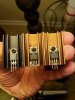
Almost all the Power Supply boards pieces were replaced with the exception of the transistors. This includes the three on the aluminum heat sinks (one SD357 and two SC1845s). So, all caps, resistors, and diodes. Sansui glue was a reason to take this path.

The original resistor was not fried prior to my receipt of the unit, but clearly something is now wrong. Now, it is becoming brown from overheating.

The three heat-sinked transistors have been reseated with fresh conductive paste.

R2 supports the middle sc1845 transistor.

Thoughts on likely problem sources for why it is overheating would be much appreciated.
 
Register to hide this ad
This includes the three on the aluminum heat sinks (one SD357 and two SC1845s).
This isn't correct, 2SC1845 are TO-92 case transistors which are not mounted on heatsinks, the schematic says 2SC3298 (NPN) & 2SA1306 or 2SA1111 (PNP), are the other two, please clarify what you have replaced them with.
So, all caps, resistors, and diodes. Sansui glue was a reason to take this path.
You say you have replaced 'all diodes' what have you replaced mD4 & mD5 with? - you know they are 'Current Regulator' diodes? check the orientation of mDZ1 and C6.
 
Last edited:
Avionic / Hyperion:

Thank you for taking the time to respond to my less than optimal post. I was in a bit of a 'freak-out' mode last evening. I do not like wasting the time of folks like you who take the time to reply, when some basic troubleshooting and a more full description of the situation are warranted.

My description last night was correct. Things didn't start to go south until I started dialing in the trimmers on the Flat Amp section.

So, with a fresher mind today, I pursued some troubleshooting first, before any further requests for info/assistance.

First I installed the Power Supply board, but did not make any connections with the Equalizer or Flat Amp sections of the main board. R2 stayed cool, no more than 80 F (IR therm.)

I then connected the Equalizer connections and checked R2. Still cool. Bias on this board still good to go.

So now I know something, likely, went wrong when I was ostensibly dialing in the 100 Ohm trimmers on the Flat Amp.

I decided to remove the two trimmers and read their respective resistance. Both were way out of whack, both dialed in to one extreme.

So, I adjusted them to a balanced point and, this time, connected the small connectors to the Flat Amp as well as well as the Equal. section.

Viola! All was good! Bias was easy to adjust, minimally, to near zero, each channel.

I thought I had installed the two trimmers balanced out of the gates - and maybe I did. But, a combination of a long day and whatever else was going on, for whatever reason, they ended up way jacked and that is the reason for the R2 overheating and smoking lightly.

I need to review the math of the schematic to understand why that was the case, but it seems to make sense at some level.

So, I have but one follow-up question. Is there value in replacing the R2 resistor? It seems I likely halved its MTBF with the crazy heat it experienced last night (195 F or thereabouts).

Hyperion to your point about the transistors, again, my mind was not firing on all cylinders apparently. The photo from 2 months ago show what they are, as you correctly noted. When mounted in their heat sinks, they are difficult to read, though that is not a great excuse. (I also did not change out the current limiting diodes.)

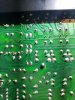
The other photo included goes to Avionic's point about a possible short. I checked both Power and main board. If you look at the middle of this main board, the underside of the Flat Amp I believe, you can see a little divot. I thought I had dropped a tool or something which cut the trace. I checked a similar unit (parts donor) and it had the exact same divot. So, clearly a factory mod. Strange, but I guess not too odd, from what I've read here.

So, note to self, install a new trimmer balanced. Confirm its orientation.
 

Attachments

  • 20220419_200037.jpg
    20220419_200037.jpg
    95.2 KB · Views: 12
  • 20220628_073549.jpg
    20220628_073549.jpg
    42.6 KB · Views: 13
Interesting.
If it was me I would still check again for capacitors in the power supply having installed them with correct polarity (would be the most common reason to have that resistor smoke, I know that because I had it happen myself). Second it would be smart to check the value of the resistor. And third check the output voltage of the powersupply unloaded and loaded.
Why?
Never heard of a dc-offset setting causing smoking resistors. In the first post you name them bias settings which would change the current,but Dc-offset?
Just to be sure before you close it up again.
 
Back
Top Bottom