• The move to the new server is done. There are some software and database maintenance updates in process. This has us passing the hat around to help out. We appreciate any donations. Seriously, even a dollar helps. The payment page may be found here - https://www.audiokarma.org/support.html

Can I safely use this switch for 2 amps into 1 set of speakers?

Yoss15

Active Member
Anyone know about these? It’s an old GC Electronics Controller II switch box. The bottom says Catalog number 30-8712. It has an A/B selector on the front and two inputs on the back.

I think it’s probably OK, but I mainly want to make sure it’s definitely safe for two separate (solid state, not tube) amps into one set of speakers. Also, how might a guy with limited diagnostic skills and a multimeter go about making sure it has break before make switches in it?IMG_1840.jpeg
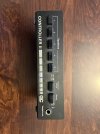
I was in the process of putting together a parts list to make an amp switch with a pair of dpdt toggle switches when I happened across this box at the thrift store for a mere $4.99. I did find an old GC Electronics catalog in the Internet Archive but it only shows a similar model with a single input.
 

Attachments

  • IMG_1841.jpeg
    IMG_1841.jpeg
    213.9 KB · Views: 41
  • IMG_1839.jpeg
    IMG_1839.jpeg
    242.8 KB · Views: 46
  • IMG_1838.jpeg
    IMG_1838.jpeg
    259.3 KB · Views: 43
Register to hide this ad
Yes, it does appear that that's how the Source switch is supposed to function.

To test break before make (and I'd be surprised if it wasn't):

Connect one MM lead to the Source A L + terminal and the other lead to Source B L +. Set the MM to continuity or Ohms. Flip the source switch between the A and B positions slowly, several times. If you get no indication on the meter during any of those flips, you're fine. If you really want to make sure, you can repeat for L-, R+ and R-. Might want to Deoxit all switches before testing, though.
Hey, I really appreciate your reply. So when I tested, I’m not seeing any signal getting through across either of the positive terminals. However, the R and L negatives give me a test tone regardless of the switch position.
 
In general, it's not a good idea at all. If your amplifiers are common ground, non BTL outputs, and the switches always break before make, it might work, but the switches themselves are line level designed and not rated for the currents loudspeakers would demand, particularly if switching while the amplifiers are on and passing signal.

It only takes a few mS of two amplifiers connected together playing a signal to potentially destroy one or both output stages in spectacular fashion.

The best way to do it is with relays and even then, you can have arc suppression issues at very high powers.
 
the switches themselves are line level designed and not rated for the currents loudspeakers would demand, particularly if switching while the amplifiers are on and passing signal.
What leads you to this conclusion?

Also, I fail to see the harm in the left ground of amp A being connected to the left ground of amp B, and so on. It's not like the left and right grounds are connected together.
 
What leads you to this conclusion?

Also, I fail to see the harm in the left ground of amp A being connected to the left ground of amp B, and so on. It's not like the left and right grounds are connected together.
Some amps are differential, and don't actually have a ground. Pair one of those with an amp with a grounded negative terminal, and you just dead shorted the diff amp to ground . . . . So, "It depends" . . .
 
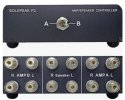
Check out the Solupeak P2. I just picked one up but haven't used it yet. According to reviews, the switch is break before make and the grounds are NOT tied together.

Rob
 
Of course, there is always the old standby of using two DPDT or one 4PDT switch, of the On-Off-On or On-On variety.

Double pole switches facilitate switching the ground too if that's a concern.
 
Some amps are differential, and don't actually have a ground. Pair one of those with an amp with a grounded negative terminal, and you just dead shorted the diff amp to ground . . . . So, "It depends" . . .
Is there a simple way to know or test whether I have differential amps?
 
Of course, there is always the old standby of using two DPDT or one 4PDT switch, of the On-Off-On or On-On variety.

Double pole switches facilitate switching the ground too if that's a concern.
I might end up doing that. That’s what I was headed toward before this switch fell into my lap.
 
I still think this would work for you. I was going to build a switch box till I found this.

IMG_0866.jpeg
 
Check out the Solupeak P2. I just picked one up but haven't used it yet. According to reviews, the switch is break before make and the grounds are NOT tied together.

Rob

Break before make is pretty much modus operandi for toggle switches. One would have to go well out of their way or be darn unlucky to run into a make before break toggle switch.

Far as grounds, if you have one of the switchers and a multimeter you could confirm common ground (or not) for the audience. Or, take the cover off and have a look see. Likely could tell just from that visual.
 
Also, I fail to see the harm in the left ground of amp A being connected to the left ground of amp B, and so on. It's not like the left and right grounds are connected together.

I've clearly explained why. In 2026, a huge number of class D and other amplifiers are differential outputs. Even a whole series of vintage Sansuis from the 1980s were differential. As is any BTL switched conventional amplifier.

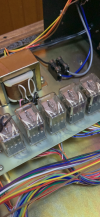
The switches in the box are clearly just slide contact DPDT, not the 4PDT needed for such connections.

These little boxes (I sold plenty of similar ones back in the day) had very low power ratings as they were usually built with switches not really suitable for anything more than 1A or so. We are talking a few watts max. I've got a high quality consumer switcher here, that will do two amplifiers and the main A-B amplifier switch is rated at 16A, with the individual speaker switches rated at 10A each. That has a continuous rating of just 100W switched.

My vintage Technics in-store comparator has ~10A 4 pole (switches the hots and the colds) relays for the five amplifier switches as Matsushita understood the potential for destruction of amplifiers, even though there weren't that many differential/BTL output stages on gear at the time.

IMG_6959.PNG

The Solupeak pictured above specifically state they use a 4PDT switch in their blurb.
 
Break before make is pretty much modus operandi for toggle switches. One would have to go well out of their way or be darn unlucky to run into a make before break toggle switch.

Far as grounds, if you have one of the switchers and a multimeter you could confirm common ground (or not) for the audience. Or, take the cover off and have a look see. Likely could tell just from that visual.
I do have one, and I just metered the grounds and they are not tied together.

Had to have one like this.

Rob
 
Is there a simple way to know or test whether I have differential amps?
Connect a meter, set to read ohms, to the negative speaker terminals. 0 ohms (a short) would not be. Even if you measure 1 ohm, due to meter or leads, it’s still not.

Rob
 
Anyone know about these? It’s an old GC Electronics Controller II switch box. The bottom says Catalog number 30-8712. It has an A/B selector on the front and two inputs on the back.

I think it’s probably OK, but I mainly want to make sure it’s definitely safe for two separate (solid state, not tube) amps into one set of speakers. Also, how might a guy with limited diagnostic skills and a multimeter go about making sure it has break before make switches in it?View attachment 3849016

I was in the process of putting together a parts list to make an amp switch with a pair of dpdt toggle switches when I happened across this box at the thrift store for a mere $4.99. I did find an old GC Electronics catalog in the Internet Archive but it only shows a similar model with a single input.
I would say, the answer to that is "no". Not that you cannot do that, but that it will not sound correctly. You are not bi-amping a set of speakers, dedicating a separate amp to say the tweeter or woofer... you could, however, if you cannot switch your amps into a mono-mode, run both channels into a single speaker. Not the best solution, which would be mono-blocs, but workable. The real issue with what you are describing is that different amps take a different amount of time to process data. While this is normally incredibly quick, you will probably experience a feedback, or echo affect. :idea:
 
Back
Top Bottom