• Please note that Audiokarma will be offline briefly for updates early on Monday morning, September 28th.

Can Sansui AU-707 drive KEF LS50 Meta?

mustsafmt

New Member
Sorry everyone if this is a dumb question. I am a newbie trying to get my first Turntable set up going. I have ordered an AU 707 which is a Japanese version of the AU 717. Along with them, I have acquired a set of KEF LS50 Meta which I plan to drive with the Sansui.

My question is, will the Sansui able to power the pair of LS50 Meta despite them having a) upto 100W requirement b) 3,5 Ohm lower end requirement while Sansui says it is only 8 ohms minimum.

Thank you all.
 
Register to hide this ad
I would think you will be ok providing your not cranking the hell out of tunes? The nice thing about that Sansui is if you find the amp is getting really hot and/or shutting down , you can add a different more capable amplifier into the mix and continue using the 717 as a preamp.
 
I would think you will be ok providing your not cranking the hell out of tunes? The nice thing about that Sansui is if you find the amp is getting really hot and/or shutting down , you can add a different more capable amplifier into the mix and continue using the 717 as a preamp.
Are there AMPs which have such a wide range of impedance. I am a bit upset as the Sansui did cost me quite a bit only to find out that the minimum it can provide is 8 ohms, while the speakers can take even a lower ohm with higher wattage (upto 100 vs 85 on the Sansui).

Am I safe for a bit while keeping the volume reasonable?
 
Are there AMPs which have such a wide range of impedance. I am a bit upset as the Sansui did cost me quite a bit only to find out that the minimum it can provide is 8 ohms, while the speakers can take even a lower ohm with higher wattage (upto 100 vs 85 on the Sansui).

Am I safe for a bit while keeping the volume reasonable?
Sansui 717 is rated at 4 Ohm, the 8 Ohm minimum is if you connect two pairs of speakers. Manual has copy/paste error (from some other model manual) somewhere stating 8 Ohm ohms min for one pair.
 
Sansui 717 is rated at 4 Ohm, the 8 Ohm minimum is if you connect two pairs of speakers. Manual has copy/paste error (from some other model manual) somewhere stating 8 Ohm ohms min for one pair.
Is this solid information? I have not been able to verify this whatsoever; not doubting your experience or skill in the topic ofc.

If this is indeed true, it would be a relief, or atleast give me ample time to save up for a better Amp and continue using 717 as a Pre-Amp as mentioned by Fuxtor
 
Is this solid information? I have not been able to verify this whatsoever; not doubting your experience or skill in the topic ofc.

If this is indeed true, it would be a relief, or atleast give me ample time to save up for a better Amp and continue using 717 as a Pre-Amp as mentioned by Fuxtor
It more depends on in what condition is the Sansui, refurbished or original (which might be trouble). In good condition (problem areas of close to 50 years old amp addressed) it is capable of driving 4 Ohm speakers. If the impedance is too low, or too loud, protection will kick in.
3.5 Ohm is not a problem, but 2 or 2.5 might be.
By the way, it has truly great phono stage (if working properly).
Also keep in mind that you will have to spend a lot of money to get a better sounding amp (if you like "wire with gain" accuracy it provides), more powerful is not a problem.
 
Last edited:
Yes it has A+B speaker options so 2 pairs of 8 Ohm speakers would be presenting a 4 Ohm load to the amplifier, it is quite happy driving 4 speakers like this. Your KEF's will be fine.

Do not try to use 2 pairs of 4 Ohm speakers this is where problems may occur.

40-100W for the KEF's meaning don't give them more than 100w your Sansui in good order may give a little over 100w regardless of the stated 85w in the specs. A 40w amplifier should also be able to run them. The sansui should have no problem with them.

I expect someone running these speakers on a 717 or 707 will comment, which I suspect is what you need to hear to put your fears to rest.
 
Yes it has A+B speaker options so 2 pairs of 8 Ohm speakers would be presenting a 4 Ohm load to the amplifier, it is quite happy driving 4 speakers like this. Your KEF's will be fine.

Do not try to use 2 pairs of 4 Ohm speakers this is where problems may occur.

40-100W for the KEF's meaning don't give them more than 100w your Sansui in good order may give a little over 100w regardless of the stated 85w in the specs. A 40w amplifier should also be able to run them. The sansui should have no problem with them.

I expect someone running these speakers on a 717 or 707 will comment, which I suspect is what you need to hear to put your fears to rest.
Thank you both CrSens, Alex22 and all others contributing!

The Sansui AU-707 has had maintenance done on it including the amp board recapping as per the description. It should arrive here in a month or so. I will be using a Step Down transformer with it. Also, I will not be running 2 pairs of KEF LS50 Metas, but just a pair. So a single pair should do fine as well right?
 
Thank you both CrSens, Alex22 and all others contributing!

The Sansui AU-707 has had maintenance done on it including the amp board recapping as per the description. It should arrive here in a month or so. I will be using a Step Down transformer with it. Also, I will not be running 2 pairs of KEF LS50 Metas, but just a pair. So a single pair should do fine as well right?
There are also maintenance issues on power amp boards, preamp and phono amp (12 fusible resistors that often go out of tolerance with time). If the drift up too much, amp functioning comes into question (uneven channels, or even no sound).
One pair is fine.
 
There are also maintenance issues on power amp boards, preamp and phono amp (12 fusible resistors that often go out of tolerance with time). If the drift up too much, amp functioning comes into question (uneven channels, or even no sound).
One pair is fine.
Here is what the ad mentions about the maintenance;

'In addition to basic maintenance, various capacitors and semi-fixed resistors on the power amplifier board that had deteriorated have been replaced with new ones. The capacitors we replaced this time are all high-quality audio grade capacitors, and the sound quality is a notch higher than the original sound quality. We measure each transistor one by one, clean the contacts, and replace any that show signs of deterioration. Replacement Transistors are basically of the same model number as the original, with consideration given to the original sound quality (alternative model numbers are used for model numbers that are difficult to obtain)

[Maintenance contents] ◆Cleaning the contacts of various rotary switches, lever switches, volume switches, etc. ◆Disassembling and cleaning the protect relay ◆Disassembling and cleaning the contacts of the rotary switch for the SP selector ◆Measurement and cleaning the contacts of small signal transistors in each part. ◆Power amplifier board...Measurement of final stage transistor, application of heat dissipation grease. Replace the semi-fixed resistor with a new one. Replace the capacitor with an audio grade high-quality capacitor (Nichicon FG) ◆Control circuit...electrolytic capacitor capacity has been checked ◆Equalizer circuit...electrolytic capacitor capacity has been checked ◆Re-soldering of solder floats and solder cracks on the board ◆Internal and rear surfaces including the board Cleaning of pin terminals ◆DC offset adjustment ◆Idling adjustment ◆Appearance restoration...cleaning and polishing of front and rear panels. Rust removal and repainting of bonnet'

 
Here is what the ad mentions about the maintenance;

'In addition to basic maintenance, various capacitors and semi-fixed resistors on the power amplifier board that had deteriorated have been replaced with new ones. The capacitors we replaced this time are all high-quality audio grade capacitors, and the sound quality is a notch higher than the original sound quality. We measure each transistor one by one, clean the contacts, and replace any that show signs of deterioration. Replacement Transistors are basically of the same model number as the original, with consideration given to the original sound quality (alternative model numbers are used for model numbers that are difficult to obtain)

[Maintenance contents] ◆Cleaning the contacts of various rotary switches, lever switches, volume switches, etc. ◆Disassembling and cleaning the protect relay ◆Disassembling and cleaning the contacts of the rotary switch for the SP selector ◆Measurement and cleaning the contacts of small signal transistors in each part. ◆Power amplifier board...Measurement of final stage transistor, application of heat dissipation grease. Replace the semi-fixed resistor with a new one. Replace the capacitor with an audio grade high-quality capacitor (Nichicon FG) ◆Control circuit...electrolytic capacitor capacity has been checked ◆Equalizer circuit...electrolytic capacitor capacity has been checked ◆Re-soldering of solder floats and solder cracks on the board ◆Internal and rear surfaces including the board Cleaning of pin terminals ◆DC offset adjustment ◆Idling adjustment ◆Appearance restoration...cleaning and polishing of front and rear panels. Rust removal and repainting of bonnet'
I guess you will find out.....they don't mention these resistors, but I doubt they will send you a not functioning amp, so most likely they are still in operating range. If the amp was in climate controlled environment all its life, they might be still usable (but potential failure point in the future). Sorry to point this out, but if you paid sizable amount of money for this service you should know. That is a pretty specific Sansui thing (although other vintage makers suffer for it too), maybe they simply did not know.
Edit: It seems they changed "semi-fixed" resistor on the power amp board (should be resistors, there are two on each), maybe they just have language issues in description.
 
Last edited:
235704a8-81a2-4631-b602-73f65d8bfb35.jpg

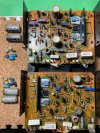
Are these the fusible resistors beside tha capacitor? If so, these also seem to have been replaced?

This is a picture from the ad in question. Yes I did pay a fortune (yikes)!
 
View attachment 3205799

Are these the fusible resistors beside tha capacitor? If so, these also seem to have been replaced?

This is a picture from the ad in question. Yes I did pay a fortune (yikes)!
Some ot the resistors are not original, but the fusible ones are. I have seen instances where fusibles did not drift up more than 15-20%, so maybe it will be ok. It's not hard to change them if need be.
 
I guess I will have to brace myself should they need any work. From what I can tell, they according to their inspection have classified it as in Excellent Condition/Proper Working Order with all apparent issues being rectified. I believe this would mean it was not overhauled as in doing preventative maintenance but rather repairs. Eitherway, I will set aside some green to get it repaired should problems arise. Would be happy to get some use out of them before then. Until them, I might educate myself more on what the internals are, how everything works and what in the is the Ohms Law!? Lol

Thank you everyone. Amazing guidance and help!
 
Not much to add from the experts but based on the specs, it will drive them as it should.
Maybe some bass will be missing compared to floorstanding speakers?
Please let us know your opinion when you get them, I would also like to upgrade my speakers to something new/current, now I have a pair of JBL L-96's and I love how they sound and the bass they have
 
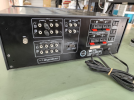
I got a new picture from the Proxy. On the back, it does clearly mention 4 Ohms to 16 Ohms. I compared it to the NA market AU 717, that does not mention this. Interesting.
 

Attachments

  • 1716511921639.png
    1716511921639.png
    759.1 KB · Views: 13
Back
Top Bottom