• The move to the new server is done. There are some software and database maintenance updates in process. This has us passing the hat around to help out. We appreciate any donations. Seriously, even a dollar helps. The payment page may be found here - https://www.audiokarma.org/support.html

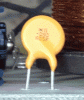
Can somebody help me identify the capacitance of these capacitors?

DangerBoy

Active Member
I'm trying to help a friend decide if he wants to try upgrading the capacitors in his speakers or just by a kit and make some new speakers.

The crossovers in his speakers have two electrolytic caps which I can identify. There are also two of what look to be orange drop caps which I can't identify.

One Cap says 475J© on the first line then 100VMPE so obviously 100V Metalized Polypropylene

The other cap says 335J©

I Googled a bunch to find out what capacitance they are but couldn't find anything. Does anybody know?
 
Register to hide this ad
Here are pictures of the crossover and orange drop type caps.

The two electrotytic are 6.8 uF and 22 uF.

I went on Mouser and I concur the 475J is a 4.7 uF and the 335J is a 3.3 uF.

If I wanted to try and get some better sound out of these speakers, should I just replace the electrolytic caps or should I replace all of them?

I'm not sure it's going to be worth it because the speakers aren't all that great to begin with but if we can do it for a low enough price it might be worth a try just to see what happens.

0
0
0
 
Being as sound is so damn subjective, in the end, you'll never know for sure if it was worth it until you actually do it and listen for yourself. I know that's not the definitive answer that everyone looks for, but if I claimed to have the definitive answer, I would rightfully be condemned as a poseur.
That being said, conventional wisdom says that woofers don't benefit from the advantages of poly-caps. I'll assume that the 22 uF cap is the one that parallels the woofer. The electrolytic version of that cap is 86 cents. If you replace the other three with Dayton poly-caps from Parts Express, the bill, including shipping, would come to $23.31. That's not to hard to swallow if you value the opportunity to acquire some first hand knowledge and swagger back in here like you know what you're talking about :)(that's one of the joys of AudioKarma).
I did some actual comparisons between poly-caps and electrolytics in the band-pass (midrange) leg of my ADS L-780/2 crossovers. There was a difference in sound, although my judging panel was torn between the two. The electolytics were a little more efficient and open, while the poly-caps were tighter and cleaner. I preferred the poly-caps, although the differences were not earth-shaking - if you're expecting miracles, you may be disappointed. If your electrolytic caps are 25+ years old, replacing them with ANYTHING new would be a bigger deal than the differences between polyethylene and electrolytic.
The photos in your post didn't seem to come through. What kind of speakers are they?

DangerCAPS.JPG
 
Here are pictures of the crossover and orange drop type caps.

The two electrotytic are 6.8 uF and 22 uF.

I went on Mouser and I concur the 475J is a 4.7 uF and the 335J is a 3.3 uF.

If I wanted to try and get some better sound out of these speakers, should I just replace the electrolytic caps or should I replace all of them?

I'm not sure it's going to be worth it because the speakers aren't all that great to begin with but if we can do it for a low enough price it might be worth a try just to see what happens.

0
0
0

When I recap crossovers, I always do one speaker first and then A/B them to compare the old and new caps. With guitar driven music, sometimes the difference is subtle, With horn driven jazz, in my experience, the difference is like there is a blanket over the old capped speaker, and it was removed from the recapped speaker. YMMV.
 
Back
Top Bottom