• The move to the new server is done. There are some software and database maintenance updates in process. This has us passing the hat around to help out. We appreciate any donations. Seriously, even a dollar helps. The payment page may be found here - https://www.audiokarma.org/support.html

Can someone help with this lightning hit Tandberg receiver

repair_guy

Active Member
Here is my Tandberg TR-2040 that had a lightning strike into the antenna terminals, happened back in the 1980's according to the person I bought it from. They had a whole long story on that. The lightning seems to have taken out the tuner, everything else still works. Is it possible to repair this fm front end tuner? This one seems to use a varactor to tune the stations, using a variable voltage. I have confirmed it is the tuner can by hooking my test fm front end from an old Sansui to the I.F. input and it works. The original tuner is getting the correct voltages and does barely anything.

I have tried to work on this tiny tuner can and I'm out of ideas. With the Sansui tuner patched in it sounds awesome, all the meters come to life, stereo light all works. If anyone has any information at all on where I could buy the tuner can I'd very much appreciate it.

Thank you,
Keith
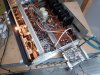
IMG_20190828_162415.jpg
Sansui test tuner appendage

IMG_20190828_162421.jpg
Pic of the ultra rare tuner can

IMG_20190828_162449.jpg
Works great with the other tuner
 
Register to hide this ad
It appears that the front end is pretty simplistic. If the transformers/coils are intact, I would suspect the MOSFET devices first, since they are far more sensitive to ESD than anything else in that circuit. The 3N204 might be a suitable replacement for the two N-channel FETs there.
 
It appears that the front end is pretty simplistic. If the transformers/coils are intact, I would suspect the MOSFET devices first, since they are far more sensitive to ESD than anything else in that circuit. The 3N204 might be a suitable replacement for the two N-channel FETs there.


That's exactly what I originally thought so I already replaced both mosfets, no improvement or change. I forgot to mention that before. I also checked all the varactors and transistors and they test fine. None of the transformers and coils are open. Maybe the lightning arced through the board somewhere and created a path to ground in the board itself?
 
Can you measure a change in C121 (tuning voltage) when the frequency control is adjusted? Do you know the acceptable voltage range for this input? Following the diagram, it looks like it might be as much as 0-24V.
 
Tuning voltage is changing with the dial position, looks to be right. It does actually tune, but the sensitivity is so low it can tune in maybe one station and that doesn't even get a rise out of the signal meter. It really acts as if the first stage isn't doing anything at all. Maybe I should build a RF probe to do some tracing. If I touch Q102 I get a little more signal, still very very low, Q101 has nothing going on at all. The voltages on the two are pretty close to what the schematic shows.
 
have you checked the AGC loop Q101 connected to the front end dual gate mosfet Q102 gate 2 ?

Keith
 
have you checked the AGC loop Q101 connected to the front end dual gate mosfet Q102 gate 2 ?

Keith

Yes I have, with the working test tuner the AGC from U201 is 0.5V on a station and about 0.05V to 0.01V off a station. I even fed a small voltage through a 10K resistor into the non-working tuner and it does nothing. The AGC stays at 0.01V with the original tuner. I have been working on this tuner on and off for weeks, and have a suspicion that it's a carbonized trace inside the board. Do you think that could happen with a lightning strike?
 
Interesting thread. I've never had to get that deep into the tuner on a 2000-series receiver myself... so I'm also curious as to the root cause.

The front end is certainly serviceable. And what may be more useful, it should be the same front end as the TR 2025 and possibly the next series TR 2030, 2045 which if true would open up options on finding a replacement. I may even have one, I definitely have several parts receivers from that series. Generally speaking, they're all the same, could even have the same front ends as the bigger models in the series - Tandberg provided their TOTL FM tuner solution across the whole line back then. I'd want to confirm that by checking assy #'s and the circuit diagrams though.

You probably would rather see it down the road with a new front end in it at this point (which if so I totally get, time is money) but it would be useful to know what failed at the component level.

I worked with another tech recently to track down an odd problem in a 3000-series tuner. I provided him with a spare tuning system board stack which allowed him to fairly quickly isolate the issue to a single IC, in a cost-effective period of time. He then fixed the original board via replacement IC and we can now use the spare board stack with socketed IC's as a test mule for those weird issues that come up sometimes. I'd guess that you'd be further ahead on this one if you were able to A/B it with a working unit sitting next to it, or just from being able to sub in the whole front end can from a working unit just so you can confirm everything downstream of that is ok. In my case having one or several of everything on hand makes that possible, harder to do when you only see one of these in a blue moon.

John
 
Interesting thread. I've never had to get that deep into the tuner on a 2000-series receiver myself... so I'm also curious as to the root cause.

The front end is certainly serviceable. And what may be more useful, it should be the same front end as the TR 2025 and possibly the next series TR 2030, 2045 which if true would open up options on finding a replacement. I may even have one, I definitely have several parts receivers from that series. Generally speaking, they're all the same, could even have the same front ends as the bigger models in the series - Tandberg provided their TOTL FM tuner solution across the whole line back then. I'd want to confirm that by checking assy #'s and the circuit diagrams though.

You probably would rather see it down the road with a new front end in it at this point (which if so I totally get, time is money) but it would be useful to know what failed at the component level.

I worked with another tech recently to track down an odd problem in a 3000-series tuner. I provided him with a spare tuning system board stack which allowed him to fairly quickly isolate the issue to a single IC, in a cost-effective period of time. He then fixed the original board via replacement IC and we can now use the spare board stack with socketed IC's as a test mule for those weird issues that come up sometimes. I'd guess that you'd be further ahead on this one if you were able to A/B it with a working unit sitting next to it, or just from being able to sub in the whole front end can from a working unit just so you can confirm everything downstream of that is ok. In my case having one or several of everything on hand makes that possible, harder to do when you only see one of these in a blue moon.

John


Thank you for the information, I very much appreciate it. I would be very interested in buying a new tuner can for this, mostly because I don't have much RF test equipment here and I've already spent months on and off working in this. I have confirmed everything downstream works fine, I used a test tuner from a Sansui and this might be the best sounding tuner I have ever heard, especially the MPX section. If I could source a new can for this I'd take apart the old one and test all the components, I just have to know what actually went bad. It could be a partially resistive capacitor or even the PCB itself. In a tuner just 100K or so in the wrong spot could totally stop it from working. I have worked on this too long and really would like it to perform well for FM DXing. I rarely give up on something but I just don't think this tuner is ever going to be right, I could get it to work eventually, but I doubt it would work well. I've pulled and tested about 25% of the tuner and I see some weird things, many of the resistors are not on tolerance, they are all carbon film and should not have drifted, but many are just out of the 5%, not enough to keep it from working but would certainly ruin the performance. I just want to get this working, this thing looks brand new and I'm itching to use it in my system.


Keith
 
Lightning strikes are extremely high energy. Caps could be bad. I would replace all of the semiconductors in the tuner, even if they seem to test good, they may not work at RF frequencies. You replaced both mosfets, what did you use and where did you get the replacements? Did you wear a wrist strap when you did it? Did you wrap a wire around the mosfet leads until it was in the board?
 
Back
Top Bottom