This is something that popped in my head... can you spray new speaker wires with d5 on the exposed copper to ward off future corrosion? Seems to make sense in terms of preventing versus correcting later on. I dont know if that would hurt sound or not. Same goes for RCA connectors, would that help again to ward off corrosion? Just a thought.


You are using an out of date browser. It may not display this or other websites correctly.
You should upgrade or use an alternative browser.
You should upgrade or use an alternative browser.
Can you spray new speaker wires with D5 to ward off corrosion? What about RCA connectors?
- Thread starter MOEB74
- Start date
Register to hide this ad

According to Caig, yes. DeoxIT D-Series page with shop - CAIG


I never had speaker wires corrode but that's cool
Im not sure Ive had visual green corrosion, but its something that crossed my mind. What if its there and we cant see it?I never had speaker wires corrode but that's cool

I have used Lear Chemical ACF-50 and Corrosion Block on electronic/electrical connections for marine and other vehicle applications for a couple of decades, very well reviewed and respected by military, marine, and aircraft maintenance companies for a long time. Available now on amazon I believe (although I haven’t bought any in a long time, each can seems to last forever).
 www.acf-50.eu
Otherwise, simple dielectric grease (pure silicone grease) seems to work very well to prevent corrosion also.
Time, along with dissimilar metals, humidity, and oxygen tend to otherwise slowly degrade connections even if it is not visually apparent.
History - ACF 50
History - ACF-50, Anti-Corrosion Formula, is a state of the art, anti-corrosion/lubricant compound, that has been specifically designed for the Aero Space Industry
Otherwise, simple dielectric grease (pure silicone grease) seems to work very well to prevent corrosion also.
Time, along with dissimilar metals, humidity, and oxygen tend to otherwise slowly degrade connections even if it is not visually apparent.

Doing what I can to seal the terminations before it intrudes the sheath with adhesive lined heat shrink, solder, epoxy, liquid tape, dielectric grease.
The actual contact surfaces for one of my systems is gold plated due to humidity. I clean those annually with swabs/pipe cleaners soaked in Deoxit gold. I've also used it on several items that are not gold. Seems to be gentle with all metals so far.
"improves conductivity and provides long-lasting protection on gold, base metals and other precious metal contacts and connections (gold, silver, rhodium, copper, bronze, nickel, etc.). It is the only product that actually penetrates plated surfaces, molecularly bonding to the base metals to seal and protect both surfaces.
Recommended for critical applications where only slight cleaning action is necessary. If the surface looks dirty/oxidized, preclean with DeoxIT D-Series contact cleaner. DeoxIT® Gold is designed to dissolve small amounts of oxidation."
The actual contact surfaces for one of my systems is gold plated due to humidity. I clean those annually with swabs/pipe cleaners soaked in Deoxit gold. I've also used it on several items that are not gold. Seems to be gentle with all metals so far.
"improves conductivity and provides long-lasting protection on gold, base metals and other precious metal contacts and connections (gold, silver, rhodium, copper, bronze, nickel, etc.). It is the only product that actually penetrates plated surfaces, molecularly bonding to the base metals to seal and protect both surfaces.
Recommended for critical applications where only slight cleaning action is necessary. If the surface looks dirty/oxidized, preclean with DeoxIT D-Series contact cleaner. DeoxIT® Gold is designed to dissolve small amounts of oxidation."
Thanks yeah so Caig finally got back to me and they said that the standard D5/D100 can be used for everything and each iteration only improves slightly based on what each niche version does. So all in all, if we have D5 or D100, that will work.Doing what I can to seal the terminations before it intrudes the sheath with adhesive lined heat shrink, solder, epoxy, liquid tape, dielectric grease.
The actual contact surfaces for one of my systems is gold plated due to humidity. I clean those annually with swabs/pipe cleaners soaked in Deoxit gold. I've also used it on several items that are not gold. Seems to be gentle with all metals so far.
"improves conductivity and provides long-lasting protection on gold, base metals and other precious metal contacts and connections (gold, silver, rhodium, copper, bronze, nickel, etc.). It is the only product that actually penetrates plated surfaces, molecularly bonding to the base metals to seal and protect both surfaces.
Recommended for critical applications where only slight cleaning action is necessary. If the surface looks dirty/oxidized, preclean with DeoxIT D-Series contact cleaner. DeoxIT® Gold is designed to dissolve small amounts of oxidation."

This is something that popped in my head... can you spray new speaker wires with d5 on the exposed copper to ward off future corrosion? Seems to make sense in terms of preventing versus correcting later on. I dont know if that would hurt sound or not. Same goes for RCA connectors, would that help again to ward off corrosion? Just a thought.
Use a nice OFC wire and you won’t have to worry about oxidation
I made some cables from canare 4s11g. Overkill I know but it wasn’t much more to get these versus regular cableUse a nice OFC wire and you won’t have to worry about oxidation
I made some cables from canare 4s11g. Overkill I know but it wasn’t much more to get these versus regular cable
Any pic?
 I build cables often
Yes, it works on new wires. But, will not reverse the oxidation in old wires.This is something that popped in my head... can you spray new speaker wires with d5 on the exposed copper to ward off future corrosion? Seems to make sense in terms of preventing versus correcting later on. I dont know if that would hurt sound or not. Same goes for RCA connectors, would that help again to ward off corrosion? Just a thought.
A lot depends on the quality of the copper alloy used in the wires. And the non-reactivity of the insulation. Some last much longer than others, Deoxit or no Deoxit.
I have some really old Belden wires that are still shiny. However, I have much newer generic stuff that is brittle and green — far down the wire — from each endpoint. Those have to be completely replaced.

Note: You cannot make a good solder joint on these "green" wires. So don't even try.


Thanks You for including a link to the product being discussed.According to Caig, yes. DeoxIT D-Series page with shop - CAIG
.

I see that Caig has indicated "yes", it can ward of future corrosion. However, having done this many times and from my experience, the answer is no.
However, my corrosion didn't occur after treating fresh speaker wire with D5/D100L to prevent it from ever happening in the first place. But rather, on silver plated cable connectors that were already heavily tarnished and oxidized to begin with, and on RCA cables where the connector plating metal had worn through -exposing the copper underneath which oxidized. After cleaning all of this with DeOxit and leaving a residual film of it behind, the oxidation returned.
DeOxit doesn't deoxidize just by having the material passively applied to the outer surface, but through the mechanical, cleaning action of rubbing it off (or working the controls back and forth) while using the product as the intermediary or cleaning agent.
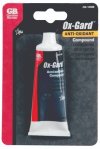
Because of this, I do not think it will prevent future corrosion. Everything that was oxidized to begin with and then cleaned/ treated with D5 (leaving behind a residual layer) has oxidized again, with time. One thing I've found for this that can be applied to an already clean/ non-oxidized surface to prevent oxidation is Ox-Gard. It is a conductive, protective paste that has tiny amounts of metal in it. I found that a light layer as opposed to a thick layer works just as well to prevent future oxidation. Keep in mind dielectric grease is non-conductive. Oxidation is like a cancer. Once it starts, it's very hard to eliminate completely and will try to come back, again and again. Also, the corrosion on one end (let's say RCA connector) can also spread its corrosion to the inside of the mating RCA jack -even if that mating jack was not corroded before. I didn't notice Ox-Gard had diminished sound quality after being applied, when compared to how it sounded before treatment when it was still corroded and coated with oxides which are less conductive and lead to a diminished sound.
If your fresh speaker wire doesn't oxidize with DeOxit on it, I'd wager it wouldn't have oxidized too badly without it.
However, my corrosion didn't occur after treating fresh speaker wire with D5/D100L to prevent it from ever happening in the first place. But rather, on silver plated cable connectors that were already heavily tarnished and oxidized to begin with, and on RCA cables where the connector plating metal had worn through -exposing the copper underneath which oxidized. After cleaning all of this with DeOxit and leaving a residual film of it behind, the oxidation returned.
DeOxit doesn't deoxidize just by having the material passively applied to the outer surface, but through the mechanical, cleaning action of rubbing it off (or working the controls back and forth) while using the product as the intermediary or cleaning agent.
Because of this, I do not think it will prevent future corrosion. Everything that was oxidized to begin with and then cleaned/ treated with D5 (leaving behind a residual layer) has oxidized again, with time. One thing I've found for this that can be applied to an already clean/ non-oxidized surface to prevent oxidation is Ox-Gard. It is a conductive, protective paste that has tiny amounts of metal in it. I found that a light layer as opposed to a thick layer works just as well to prevent future oxidation. Keep in mind dielectric grease is non-conductive. Oxidation is like a cancer. Once it starts, it's very hard to eliminate completely and will try to come back, again and again. Also, the corrosion on one end (let's say RCA connector) can also spread its corrosion to the inside of the mating RCA jack -even if that mating jack was not corroded before. I didn't notice Ox-Gard had diminished sound quality after being applied, when compared to how it sounded before treatment when it was still corroded and coated with oxides which are less conductive and lead to a diminished sound.
If your fresh speaker wire doesn't oxidize with DeOxit on it, I'd wager it wouldn't have oxidized too badly without it.
Last edited:
I feel the quality of the copper alloy and insulation is what matters in the long run.Because of this, I do not think it will prevent future corrosion. Everything that was oxidized to begin with and then cleaned/ treated with D5 (leaving behind a residual layer) has oxidized again, with time. One thing I've found for this that can be applied to an already clean/ non-oxidized surface to prevent oxidation is Ox-Gard. It is a conductive protective paste that has tiny amounts of metal in it. I found that a light layer as opposed to a thick layer works just as well to prevent future oxidation. Oxidation is like a cancer. Once it starts, it's very hard to eliminate completely and will try to come back, again and again. Also, the corrosion on one end (let's say RCA connector) can also spread its corrosion to the inside of the mating RCA jack -even if that mating jack was not corroded before. I didn't notice Ox-Gard had dimished sound quality after being applied, when compared to how it sounded before treatment when it was still corroded and coated with oxides which are less conductive.
I've even seen green rot in high-end speaker wires after just a few years. You really see this in aftermarket $$$ auto setups. Where the wires may be more exposed to the elements and temperature extremes.
Personally, I like Belden industrial- or mil-spec-grade wires. I still have rolls of the US-made stuff

Gold plated wire terminations & post. No corrosion ever.
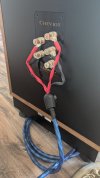

I use D100L instead of D5 now. It comes in a small bottle, no propellant. It doesn't have all the solvents in it like D5 but is more concentrated.
Last edited:
It's the wires that get the green oxidation, not the terminals.

I thought the original question was "Is it ok to treat new speaker wire"

Yes, it is. Not the terminals.I thought the original question was "Is it ok to treat new speaker wire"
Last edited: