• The move to the new server is done. There are some software and database maintenance updates in process. This has us passing the hat around to help out. We appreciate any donations. Seriously, even a dollar helps. The payment page may be found here - https://www.audiokarma.org/support.html

Cannot make any sense of this problem

pluske

AK Subscriber
Subscriber
Using a Luxman L-80V that was recently taken apart and refurbished - caps, transistors, the works. Was running beautifully for a while until I went away for two weeks so it sat without use.

When I came back upon powering on it produced a very loud and variable hiss that eventually died down. Now this happens every time I turn it on after not using it for more than a day.

Changing source or adjusting the volume does not affect it at all. Even though it dies down after a minute or two, there is usually a higher than normal level of hum until I play music for a bit, after that it seems normal. I am at a loss as to what could cause this.

Bonus question - after this happened the phono stage started making a little thumping noise at about 3-5 beats per second, like someone tapping a microphone. its only really audible at high volume or if theres nothing playing.

What the hell is happening to my stereo??
 
Register to hide this ad
First geus: Either a bad lownoise transistor, or a grounding issue. Probably in the pre-amp.

It's a nice open design, so for a quick check I would just pop it open. Turn it on, set it at moderate volume, using expandable speakers. Then whet the old finger a carefully tip the transistors from the preamp. Should one of them cause hum, or a tic or other sound over the speakers, then that is your suspect.

That is of course, if you want to dive in yourself.
 
In both channels, or just one? It could be a bad cap as well. But since caps were replaced along with some transistors, I would be carefully looking over the solder joints.
A poor connection like a ground on a cap, etc., can cause things like that. Once warmed up, a bad joint may flex just enough to make good contact again, or even go open.
Also, maybe reflow the solder joints an all the components that were replaced.
I've ran across cracked joints that were difficult to see without a magnifier.
But once the amp warmed up, it would loose contact.
I had one recently in one of my big tube mono blocks where most of the grounds are routed to one ground lug. Lots of wires soldered to one point. I had a power surge and heard a loud snap and saw a flash through a vent. I couldn't find anything wrong with it to cause the loud hum. Then, one of the times I powered it up I heard the snap and could tell where it came from. There was a big crack in that ground solder joint. I couldn't see it, but when I lifted a wire a gap opened up.
Reflowing the joint cured the noise problem.
 
forgot to ask: is the problem occurring on both channels (left and right) or just one?

I think it is only in the right channel but I need to test more carefully to be sure. The crazy thing is that using the balance knob does nothing, if I flip it all the way over to the left the right speaker still hisses (the stereo is close to the right speaker but far from the left so I KNOW its in the right channel and I am less sure about the left one).
 
Screen Shot 2022-11-02 at 6.41.33 PM.png
In both channels, or just one? It could be a bad cap as well. But since caps were replaced along with some transistors, I would be carefully looking over the solder joints.
A poor connection like a ground on a cap, etc., can cause things like that. Once warmed up, a bad joint may flex just enough to make good contact again, or even go open.
Also, maybe reflow the solder joints an all the components that were replaced.
I've ran across cracked joints that were difficult to see without a magnifier.
But once the amp warmed up, it would loose contact.
I had one recently in one of my big tube mono blocks where most of the grounds are routed to one ground lug. Lots of wires soldered to one point. I had a power surge and heard a loud snap and saw a flash through a vent. I couldn't find anything wrong with it to cause the loud hum. Then, one of the times I powered it up I heard the snap and could tell where it came from. There was a big crack in that ground solder joint. I couldn't see it, but when I lifted a wire a gap opened up.
Reflowing the joint cured the noise problem.

This makes sense... I have very little technical understanding of how an amp works but the fact that it is independent of source or volume modulation suggests that the problem is very close to the output. And the fact that it starts incredibly loud (I jumped the first time it happened the volume was at 9 oclock and the sound was as if it were at 2 oclock) and then grows quiet it seemed to me like a capacitor that was holding a charge and releasing it once the stereo is on. But truthfully I dont even know if the L-80V is capacitor coupled or what.

EDIT: ok so it is a direct coupled circuit design, and the service manual has information about time delay muting section. Since the noise happens right at power up, could this be the culprit?
 
Last edited:
Ow, that ain't good. The speaker relay should not be engaged right at the moment you switch it on. Normally, you would hear a small "click" from the relais after a second or two. There should be absolutely nothing coming out of the speakers untill that happens. You better get your precieus speakers unhooked of this one o_O.
 
I just checked when I got home. Definitely only right channel. There is a little delay after all, hopefully not the protection circuit.
 
Okay, so it takes a little while before the relay comes up, and before that there is no sound right?
-in that case the switch-in circuit is no longer suspect.

The noise comes from the righthand channel only. With additional noise when the phone-stage is switched in, correct?
-that leaves at least poor grounding, bad solder joints, and bad components in the race :rolleyes:.

Also since it's a direct coupled amp, poorly matching replacement transistors might be an issue. Where these matched at all?
 
I believe they were, all the work was done by TomB who is On Here and knows his business. Its going back to him this weekend, I wanted to ask in advance because its such a bizarre issue and he hadn't worked on Luxmans before.
 
Gonna try to revive this old thread. I had taken the amp in to @Tom B, it of course stopped having the problem once in his workhop but he found and fixed a bad solder joint and it came home working wonderfully. Its been about a year, the problem is back.

I push the power button and (after a brief delay) there is a very loud and variable static that comes out of one channel only. It is not affected at all by adjusting source, volume, balance, stereo/mono mode or any other setting. The only thing that stops it happening is if I turn off the speaker selector. After 10-30 seconds it dies down but leaves a very audible hiss that seems to suppress whatever music is meant to play on that channel. I can get music from there but at about 1/4 volume of the other channel, which plays cleanly. Any thoughts what this might be?
 
My initial start point would be the relay.

Does this occur only on one channel and on all inputs?
 
Yes. One channel only. Changing volume or source does not affect it. Super loud to begin then subsides, after that maintains a low hiss.
Maybe, try resoldering ALL the solder points.

Was this unit originally acting nice, before it was refurbished?
 
Maybe, try resoldering ALL the solder points.

Was this unit originally acting nice, before it was refurbished?
No, it had its issues. Mostly was functional but had trouble making contact in the input switch. Can’t speak to how it did otherwise because of that problem. After being recapped and all worked nicely until this showed up after I went away from a couple of weeks. It’s been getting worse too.
 
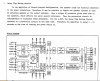
The challenge is to find which section of the amp is causing the problem. This noise should be measureable as AC or Dc on the output of the preamp section/input ot the power amp section (Marked as 1 on the circuit). Also have you tried to measure AC or DC on the right speaker output, noting the value (high) when the amp is turned on and consistent when it has stabilized?

Do you have a scope or any test gear?
 
Back
Top Bottom