• The move to the new server is done. There are some software and database maintenance updates in process. This has us passing the hat around to help out. We appreciate any donations. Seriously, even a dollar helps. The payment page may be found here - https://www.audiokarma.org/support.html

Capacitor ID

Lavane

Lunatic Member
These are in the crossovers of a pair of speakers I'm recapping. But I figured I would have a better chance getting them I'D'd here. They are big blue12uf film caps, but I don't know if they are a polypropylene, or Mylar cap. I'm thinking polypropylene. All the 12uf film caps I've seen in pictures of this crossover use these yellow Mylar caps that are known to drift over time. These are different. Does anyone recognize this brand and type?
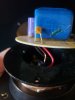
20201027_105400.jpg
 
Last edited:
Register to hide this ad
I bet those are Klipsch speaker crossovers?
Here are markings on Forte II crossovers and capacitors:

1.JPG 2.JPG 3.JPG
 
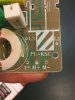
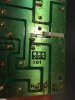
Interesting. These caps are acually in a pair of Polk Monitir 10's. Nice speakers, but Polk was known to use some pretty cheap caps. Most of the pictures I've seen have cheap drifty Mylar film caps. They may have very well used some surplus caps. Its kind of rare to see these blue film caps in these crossovers. Thanks for the post.
 
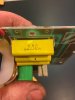
I'm guessing that yellow disk is a fuse or thermal breaker? Can't imagine ceramic cap in speaker crossover
 
I'm guessing that yellow disk is a fuse or thermal breaker? Can't imagine ceramic cap in speaker crossover
Poly switch for tweeter protection. Some versions of this speaker used fuses. The poly switch is being replaced with a .5 ohm resistor. From what I've read and tests done on these they drift up in resistance over time and supposedly, once they have tripped a few times, they trip earlier than before. As long as I don't run the amp or speaker into clipping the .5 ohm resistor is fine.
 
without a datasheet I don't know how you'd determine polypropylene vs mylar easily. I think they have different dissipation factors but I don't know how to measure that or what typical values would be to make a determination. @ConradH probably can tell you more.
 
There are a couple ways to tell the difference, but none are easy. If you have a good enough bridge to read dissipation factor for the Mylar (polyester), polypropylene will be near zero, 0.016 vs. 0.0002. Don't know if an esr meter can see the difference or not. If you set up a distortion test, Mylar will be worse. If you set up a DA (dielectric absorption) test, Mylar will be worse (I think). If you heat or cool the parts, Mylar will have a larger positive temperature coefficient and polypropylene will be negative and smaller. The problem is that Mylar is quite good so you need sensitive instruments. For a given voltage, polypropylene will generally be a big larger. General consensus is that Mylar sounds worse. I agree, but don't ask me to prove it. :naughty:
 
There are a couple ways to tell the difference, but none are easy. If you have a good enough bridge to read dissipation factor for the Mylar (polyester), polypropylene will be near zero, 0.016 vs. 0.0002. Don't know if an esr meter can see the difference or not. If you set up a distortion test, Mylar will be worse. If you set up a DA (dielectric absorption) test, Mylar will be worse (I think). If you heat or cool the parts, Mylar will have a larger positive temperature coefficient and polypropylene will be negative and smaller. The problem is that Mylar is quite good so you need sensitive instruments. For a given voltage, polypropylene will generally be a big larger. General consensus is that Mylar sounds worse. I agree, but don't ask me to prove it. :naughty:
Thanks. They test fine as far as the value. They are larger than the known yellow Mylar caps that were usually used. Thats what made me think they just may be polypropylene. I ordered all new caps so I might as well replace them to be sure.
 
Back
Top Bottom