Hi everyone,I'm a newbie to the forum so go easy on me,I have a question,I have a pair of Mordaunt Short Festival 2 speakers and want to recap them,can anyone tell me what I need to order ....the old caps are 10uf 50v. And 5uf 50v elcaps.... like capacitor types ..electrolytic film etc and what values i can safely use if i cant get the same values thats in the speakers,i hope im making sense.....


You are using an out of date browser. It may not display this or other websites correctly.
You should upgrade or use an alternative browser.
You should upgrade or use an alternative browser.
Capacitor replacements
- Thread starter kears
- Start date
Register to hide this ad


malden
Lunatic Member
the only thing that doesn't make sense to me is why you want to replace the capacitors?i hope im making sense.....

Blue Shadow
Waiting for Vintage Gear from this century
because he reads ak and it seems to be the thing to do.the only thing that doesn't make sense to me is why you want to replace the capacitors?
malden
Lunatic Member
yesThe old saying is...if it's not broke don't fix it....
maybe better, maybe worsei thought it would mean I would get a Better sound...
I've replaced capacitors in crossovers 50 years old and didn't hear any difference.after all the caps are 40 years old.
I think it's much more important to replace old capacitors in amplifiers than in speaker crossovers.
malden
Lunatic Member
@kears , on the other hand, if these are your speakers and crossovers, maybe it wouldn't be a bad idea to change the caps
more on "elcaps"
more on "elcaps"
Elcap vintage crossover caps
Just recapped my 40 years old Wharfedale Laser 80 speaker crossovers and was stunned with the before and after difference. I replaced original ELCAP capacitors with something called ALCAP from Falcon acoustic in UK, supposedly as close as possible to the originals. Now, since old ones drifted...
audiokarma.org
Recapping question - Does quality of caps matter to the sound, and what caps you use?
Hey AK, So I'm getting closer and closer to the recapping of my IMF TLS 80's. I've got some newbie questions about recapping, but I'll be less vague than what the thread states. First of all I do understand that different types of caps alter the sound, but I'm not sure why this is. For...
audiokarma.org
don't say that, i'm supposed to embark on a big cap job!yes
maybe better, maybe worse
I've replaced capacitors in crossovers 50 years old and didn't hear any difference.
I think it's much more important to replace old capacitors in amplifiers than in speaker crossovers.


knotscott
Super Member
I'd definitely change them. Caps from 40 years ago may have degraded, and probably weren't as good as what you can get now. Only you can decide whether or not it makes an audible difference.....every system and situation is different, but there's a good chance you will if the rest of the system is up to snuff.
While at it, I might even upgrade any sand cast resistors with non-inductive wire wounds if there are any and if they're accessible.
While at it, I might even upgrade any sand cast resistors with non-inductive wire wounds if there are any and if they're accessible.

Personally, I wouldn't get rid of "sand cast" resistors and swap them for wirewound resistors. There's a good chance that those "sand cast" resistors are wirewound anyway.While at it, I might even upgrade any sand cast resistors with non-inductive wire wounds if there are any and if they're accessible.
Vitrohm KH208-810B1R8 1r8 10% 5W Axial Power Wirewound Ceramic Resistor | Rapid Electronics
Vitrohm - KH208-810B1R8 - Vitrohm KH208-810B1R8 1r8 10% 5W Axial Power Wirewound Ceramic Resistor
 www.rapidonline.com
As for the capacitors, it would do no harm to replace them and it might give you peace of mind. For 5uF you could use polyester or polypropylene without them being too big or costing a fortune. For 50uF you might have to stick with electrolytic due to size/cost restrictions.

I think 4.7uf will be fine. You can always parallel a 0.22uf bypass cap to get closer to 5uf.Thanks everyone for your Help..im having difficult in getting the 5uf cap in my area will a 4.7uf be OK..
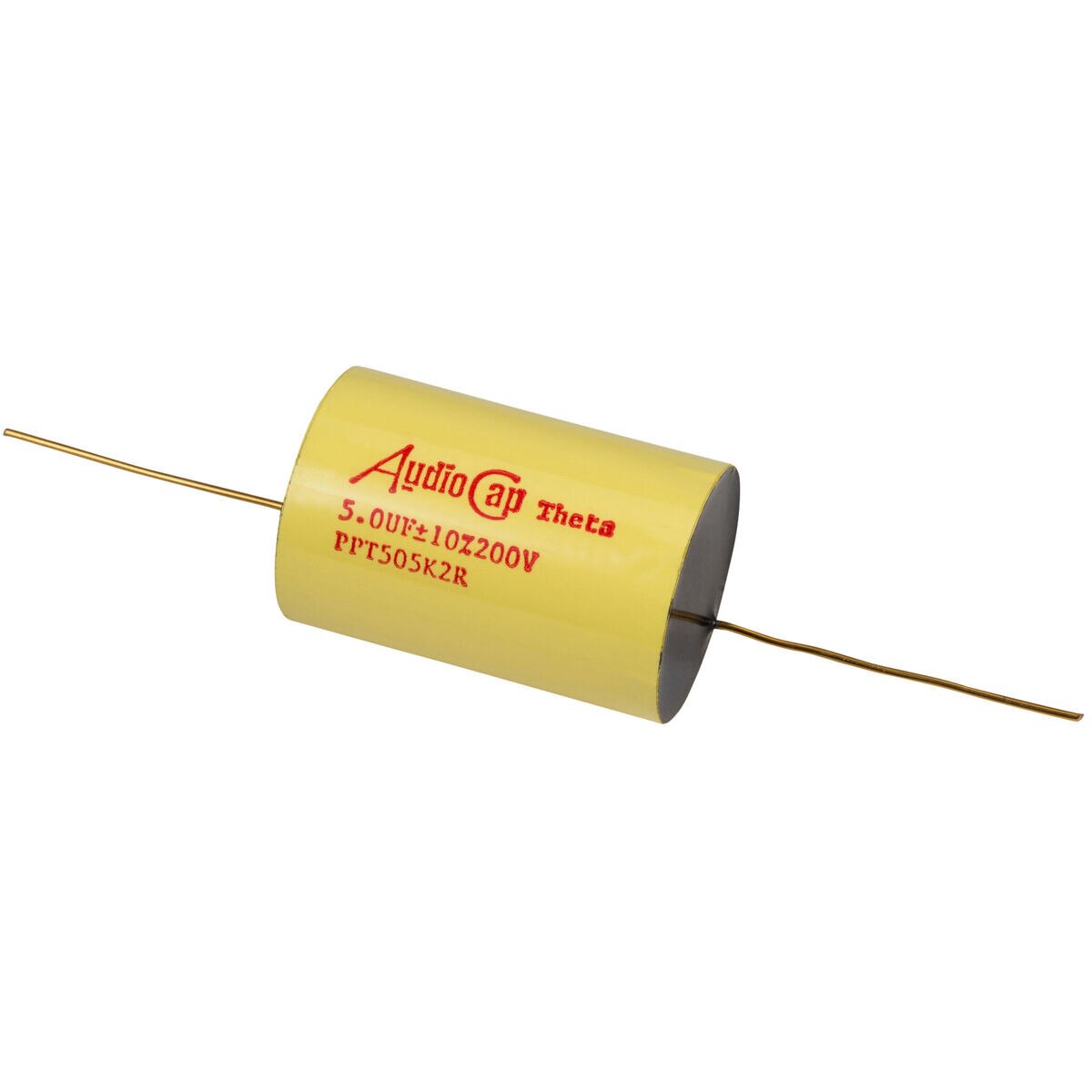
Parts Express has 5.0uf capacitors, they're not cheap.
Home
Audiocap PPT Theta 5.0uF 200V Film/Foil CapacitorThe PPT Theta AudioCap is an excellent film and foil capacitor for all audio circuits and power supplies. Theta capacitors are made with the finest polypropylene film and tin foil, and are considered by many to be the best audio capacitor in the...
www.parts-express.com
knotscott
Super Member
Personally, I wouldn't get rid of "sand cast" resistors and swap them for wirewound resistors. There's a good chance that those "sand cast" resistors are wirewound anyway.
It seems to me that an angry mob has formed on forums and they're out to get "sand cast resistors" without even knowing what they are.Vitrohm KH208-810B1R8 1r8 10% 5W Axial Power Wirewound Ceramic Resistor | Rapid Electronics
Vitrohm - KH208-810B1R8 - Vitrohm KH208-810B1R8 1r8 10% 5W Axial Power Wirewound Ceramic Resistor
As for the capacitors, it would do no harm to replace them and it might give you peace of mind. For 5uF you could use polyester or polypropylene without them being too big or costing a fortune. For 50uF you might have to stick with electrolytic due to size/cost restrictions.
"Non-Inductive" is a key element when upgrading resistors IMHO. That's something I could hear in the treble when I switched 30 years ago. No anger about it all...it's just better to eliminate another variable when possible. It's fairly cheap, and usually fairly easy.

Last edited:
Yes, I agree, a resistor with significant inductance wouldn't be a good idea. I'm not sure though how much inductance there would be from a resistor of a few ohms, as typical in a loudspeaker crossover."Non-Inductive" is a key element when upgrading resistors IMHO.

RVT1K
Super Member
Thank you all for your Help...If you see a Mushroom Cloud in the Direction of Ireland don't Panic its probably Me after changing the Caps...
Good luck, have fun and always remember that greatness has been achieved by those who dared to screw up!

Here are some measurements with a HP 4275A LCZ bridge. A 1 ohm, 5 watt; 10 ohm, 10 watt; 5ohm, 10 watt, 4.7 ohm 2 watt. Inductance is so small as to be negligible. The inductance of the wiring inside the speaker is probably on the same order. Measured at 10 KHz. Inductive reactance @ 10 KHz: .7 uH=.04 ohms; 1.2 uH=.07 ohms; 1.3 uH=.08 ohms; .3 uH=.02 ohms. The Q of these is so low as to be unmeasurable by the 4275A at 10 KHz, but at 1 MHz the Q of one I measured was 0.8.Yes, I agree, a resistor with significant inductance wouldn't be a good idea. I'm not sure though how much inductance there would be from a resistor of a few ohms, as typical in a loudspeaker crossover.
This is not a concern.


