• The move to the new server is done. There are some software and database maintenance updates in process. This has us passing the hat around to help out. We appreciate any donations. Seriously, even a dollar helps. The payment page may be found here - https://www.audiokarma.org/support.html

Cartridge ID help

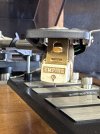
I recently purchased this Pioneer PL-71 and it came with this Empire cart. Can someone identify it, please? Don’t know the age of the cart or miles. Thanks for your helpIMG_0472.jpeg
 
Register to hide this ad
***Update***
The printing on the cart bottom is EMPIRE 4000 D/III. From my research, I believe this is for using a quadrophonic system. Is that accurate? Can this be used in a stereo system with good results? Thanks again!
 
That is the best Empire in its time. If the nail is still sharp, only known after evaluation by those that know how to look at them with a 200x microscope and proper illumination to see wear spots, it might be worth a couple hundred or more.

I bought one in 1974 to give you an idea of its age.
 
When you say “fundamental must haves”, I imagine you’re talking about a pre amp and such…right?
Those too, of course, but I was thinking of aligning the cartridge in the headshell, checking the cantilever for damage, making sure the cantilever is aimed straight ahead more or less, making sure the diamond is squeaky clean and pointing straight down-- you know, all the basic housekeeping things us phono-audiophiles fret endlessly about.
 
Last edited:
Worth checking the current stylus, which may be just fine. It may be worn, or the damper aged, but it also may be in fine fettle.
 
These checks are especially important for styli that come to us from the dangerous outside world. We of course welcome good closeup/macro photos showing the cantilever and black rubber suspension grommet. Mere visual inspection can tell what to expect.
 
Certainly worn styli should not be used, but my experience is that a fair number of cartridges have styli that are fine. My suspicion is that better cartridges are more likely to have unworn styli, since usually someone spending extra for a cartridge values it and is likely to replace styli when wear is probable (and toss the old stylus). Arguing against this suspicion is that a disappointing number of the lower end MCs I've found have been worn (though the econmics of MCs may be that the low end ones are bought by people who want to step up from MMs (on the belief that MCs are inherently better), but can't really afford the greater expense, and so the situation is like that of low end MMs, where cost encourages using a stylus longer than it should be used).
 
With that cartridge, I would go to considerable lengths to verify if the existing stylus is good. It's worth it.

Doug
 
None of the above. The geeky answer is that it's a variable-reluctance design, a subset of what we call "moving-iron", which in turn is a subset of what's generally put under the umbrella of MM or moving-magnet. The magnetic field moves against coils that don't.
 
Hello all! This may be a little off topic but still pertains to PL-71. I have the operating instructions and service manual to the PL-71 but these manuals do not show the tone arm mass value in them. I’m going down the rabbit hole of tonearm resonance and need that value. Maybe the owners manual has that information but can’t seem to find one online. Or, if anybody has that info, I would greatly appreciate it. Thanks!
 
By the looks of it, it is medium mass. Almost any cartridge will work in it, though probably best to not seek out super high compliance cartridges (they aren't made nowadays, so it may be easy to avoid temptation).
Rabbit hole is the right description for your conundrum. Arm mass/cartridge compliance matching is a very grey area since many unlikely matches are just fine, and some apparently good matches aren't pleasing. The numbers that are published for either factor aren't always correct and aren't always applied correctly, and compliance varies somewhat with age and with ambient temperature. And sometimes too low tracking force can be misdiagnosed as a matching issue, as in not riding warps well.

What matters is not the math, but whether the combo can track properly even on warped records, and whether it sounds good. If you can see oscillation/pumping on a flat record, it's a very bad pairing of high mass and high compliance. If it skips on slightly warped records (assuming your tracking force is realistically high), it's not a good pairing. If it tracks perfectly well but lacks bass, it may need more mass - try a weight plate between the cartridge and headshell.
This probably won't be a problem you face, but if it tracks poorly at a reasonable tracking force, it might be a low mass arm and a low compliance cartridge, but typically low compliance cartridges are either very old MMs (which can sound excellent in an appropriate arm, but you are unlikely to seek one out), or very expensive MCs, which, if you bought one, you'd only have done so intentionally, and would know that it needs a high mass arm.

I wouldn't fret about arm mass. If you want to obsess, would worry about alignment - recognize that it is almost certainly uses the Stevenson alignment, so don't try to use a Baerwald or Lofgren protractor. Pioneer was a big, very capable company, and they understood tonearm geometry perfectly well, so use the jig or alignment method they suggest. Use their suggestion for setting up the lateral weight. Use a tracking force at the higher end of the recommendations - bass might be better, and you will have less mistracking. You can start with the antiskating values they suggest, but antiskating is a crap shoot, changing with every change in groove modulation and so tinkering might be worthwhile, though set and forget is also an honorable solution to the issue.

 
Back
Top Bottom