• The move to the new server is done. There are some software and database maintenance updates in process. This has us passing the hat around to help out. We appreciate any donations. Seriously, even a dollar helps. The payment page may be found here - https://www.audiokarma.org/support.html

Cartridge Identification

huck1978

Active Member
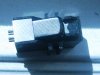
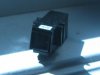
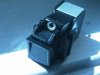
Just wondering if anyone can identify this cartridge. Pretty sure it'd best to just toss it and buy a new one, but I thought I'd take a shot to see if someone knows what it is. It was found on a Sears branded turntable model #28668.

The only identification on the cart are the letters GFH on the top.
 

Attachments

  • IMG_8334.jpg
    IMG_8334.jpg
    61.5 KB · Views: 84
  • IMG_8335.jpg
    IMG_8335.jpg
    44.6 KB · Views: 74
  • IMG_8336.jpg
    IMG_8336.jpg
    42.6 KB · Views: 42
  • IMG_8337.jpg
    IMG_8337.jpg
    58.8 KB · Views: 85
  • IMG_8338.jpg
    IMG_8338.jpg
    50.1 KB · Views: 68
  • IMG_8339.jpg
    IMG_8339.jpg
    52.9 KB · Views: 46
Register to hide this ad
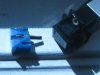
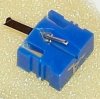
Haven't been able to find a photo of a stylus that's an exact match, though the Pfanstiehl-index 664 is close. Is that blue stylus an elliptical or a conical?

In any case, your options will be very limited. If it were me, I'd toss it in my Box-O-Cartridge Bodies and hope something will turn up. In the meantime, get something else.
 
Last edited:
Take a look online at photos of the 669-D7. Add the term STY100 (a Sharp model number) to bring a blue one up top.

All conicals. No luck finding ellipticals.

Hitachi, Sansui, Sharp and Mitsubishi all used the 669 stylus.
 
Wualta, I think you're bang on. I tried a Shure M44 stylus on it and the metal part is too wide. Your 669-D7 looks like the stylus that was on the cart.

I might give one a shot just to find out.
 
I bought a 669-d7 stylus and there is no sound when connected to the cartridge. It fits, but there is zero sound.

I put the old stylus in to make sure that the cartridge was still in working order and I got sound.

Doesn't make sense to me as they look nearly the same and the new stylus fits into the cartridge.
 
must be a technology difference, moving magnet vs moving iron. If the stylus is an MI type, it will do exactly nothing in an MM body. If you put an MM stylus in an MI body it should do something, but probably not much and it likely won't sound good.
 
Could be MI type cartridge as there is nothing to identify the cartridge by. I've also noticed that the silver piece that connects the stylus to the cartridge (not sure of its name) is also a bit shorter on the replacement. Perhaps this is the problem.
 
That'd be the cantilever. I can't believe that they would sell replacement styli with entirely differing underlying technologies, but I suppose you never know. Is the outer shell still blue on the new one?
 
Gadget's right. This has all the signs of a moving-magnet/moving-iron mismatch, which is puzzling.

You can check for the presence of a moving-iron magnet. It should be that circle that appears just in front of the diamond-shaped hole. It's best visible in your first and fourth photos. Get a small piece of iron or steel and see if that circle is a flush-mounted fairly strong magnet. In a moving-magnet design, there'd be no need for a magnet buried in the cartridge body like that.

If you can put up some hi-rez photos of the two styli you have, that might help too.
 
Last edited:
I hope this helps. I still think that the part metal part that connects the stylus to the cartridge is slightly different. (I'm also not so sure that this part is called the cantilever as I've always thought the cantilever is what the diamond sits upon).
 

Attachments

  • IMG_8392.jpg
    IMG_8392.jpg
    147.2 KB · Views: 25
Interesting! The 669-D7s are not all the same visually. Stylus color, especially in the aftermarket, is usually irrelevant. Possibly color makes a difference in this case. Take a look at this one from one of the known stylus vendors who also sells via online auction site. This is an aftermarket stylus by Astatic, which, in my limited experience, distributed styli that were very close to the originals. It would be interesting indeed to find that some 669-D7s are moving-magnet and others are moving-iron.
Sharp STY-100 MM stylus 669-D7 blue-.jpg
Don't forget to test for the magnet on your cartridge body.

The length of the brass-colored metal tube coming out the back (we usually call this the "shank", despite Shure's preferred nomenclature) of the stylus assembly probably doesn't make any difference, since the generating element has to be at or near the end of the cantilever, and that can only be so long.
.
 
Last edited:
I suspect we're dealing with a body that was designed for OEMing-- that is, it could be configured MI or MM depending on what the client wanted. That circle is exactly where a magnet face would be on certain Nagaoka and even ADC cartridges.

Check for a magnet in your blue stylus with a straight pin or an unbent staple. Hold the stylus so the brass tube points down and slide the pin up into it. If you feel a magnet tugging on the pin and the pin stays up in the tube when you let go, it's moving-magnet.

Choices at this point:

1 ) stop everything, cut your losses and move on, as originally counselled;

2 ) try the blue stylus ($9 shipped) which at least more closely resembles your original;

3 ) sit tight and hope we get a clue about the maker of that body. I've been roaming through old cartridge photos online without much success, although I've seen some that are close. I even own one, a Sony, that's close but not close enough.

 
Last edited:
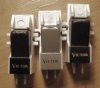
See if these JVC MD-1016 bodies look familiar. UPDATE: the MD-1011 and MD-1012 look promising too. Note the circles where in some versions there's a magnet set into the plastic.
JVC MD-1016.jpg

Also take a look at these Lenco cartridges, obviously made for Lenco by an OEM.

http://pedipsen.dk/LH/catalogue/top.jpg

These are all close, but not an exact match.

Last resort: if you have it, try looking by the Sears model number..
 
Last edited:
Thanks for your hard work. Based on your research, I would say that the cartridge I have best resembles the Victor on the right of the photo you posted.

Tried the pin trick and, based on your instructions, the stylus is an MM.
 
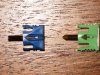
You have me thinking now. I checked out the Astatic distribution of this stylus via an auction site. The blue and the green shades, both made by Astatic, have me thinking that maybe the blue is MM and the green is MI. I guess there's one sure way to find out.
 
Finding out would certainly scratch an itch. Normally styli grouped together as belonging to one cartridge or to a line of related cartridges don't differ so much physically as the green and blue do, while also looking somewhat alike. Related, but. We're deep into OEM territory now and we'll have to puzzle our way out.

The kicker is that the JVC bodies above were the basis for one of their early CD-4 carts, and you can still get Shibata styli for them. That may or may not have anything to do with your cartridge (though I'm almost certain they were all made by the same manufacturer), but it's at least intriguing.

Well, let us know how it all turns out if you decide to "take one for the team". And I'll bet if you try the pin trick on the green stylus, you'll get nothing.
 
Success. The blue Astatic 669-D7 (listed as HI110-7d / DS-ST102 on the package) brought sound to the cartridge. Based on my experience with the two coloured styluses and the information provided here, I would suggest that the lime green stylus is for moving iron cartridges.

Thank you all for the help.
 
Back
Top Bottom