

You are using an out of date browser. It may not display this or other websites correctly.
You should upgrade or use an alternative browser.
You should upgrade or use an alternative browser.
Cassette tape resurgence ?

lorne
Sonic Lizard
AS TO A THREAD RIVIVAL
A general comment: one may get to a certain age (like me) and the efficacy of saving records is no longer an issue. How many times is a septuagenarian likely to play a record such that its worn out — unless you are using a chisel-like stylus at 4 grams or something.
There is a lot of argument to and fro about cassette tape. In my opinion, a lot of it is bogus because the proposition is fraught with so many variables. It just comse down to what pleases you.
* True: the quality of sound will not be as good as a good as a decent TT setup — a superior master source withstanding.
* True: the machines don't even come close to being somewhere equal. There is a vast difference between the mediocre and the best.
* True: back in the days, pre-recorded tape was considered inferior to what you could record yourself on good tape stock using good source transmission.
* True: three-head machines are the most desirable, but that being said, I once had a 2-head Nakamichi that was excellent.
* True: it is most desirable to have a machine that has the facility for dialing in the bias, especially considering the fact that today the user will be hunting around and acquiring different tape stock.
* True: anyone seized by the passion to get into tape best find a technician who can work on the machine. (Be prepared in some way to face problems finding spare parts.)
*True: the Nakamichi Dragon was the grail machine, and this was NOT because of some cultish fad. Other companies made some excellent machines ... Akai (sometimes rebadged as A&D) Sony .... and so on.
On a good machine using Type II tape with bias optimally set, some very enjoyable listening can be at hand. For capturing various sources over time, cassette is arguably more convenient than creating a disk. Also, commensurate with the same criteria, the results can thrash MP-3 which is ubiquitous these days.
My opinion: on decent tape I never use Dolby. It's a personal preference.
If everything comes together in some way — tape stock supply, the machine, maintenance issues blah blah, cassette recordings can be a very great pleasure. Each enthusiast should calculate just how much time, trouble and treasure it is going to take to enjoy the medium.

Bosphrous
Well-Known Member
Cassettes sound plenty good to me. I know that some people have better ears than others, particularly musicians say they can pick up on subtleties, but I don't hear anything preferable from C.D.'s. Actually, i prefer the analog sound of cassettes. It has something to do with homogenizing the sound. Digital sources just don't do that. There always seems like an un-natural separation between the instruments. I will admit that L.P's do sound better than cassettes, but again, it is because the medium seems to homogenize the sound better than any other. The main reason I use cassettes is because they are small and easy to handle. When I buy an occasional C.D., I record it onto cassette and then donate the disc to the public library.

Ken Creamore
New Member
Cassette is a very finicky format and it takes a lot to make it sound decent. Having said that, I own two Pioneer CT-F1250 that I record with all the time. I believe keeping your machines in top running condition plays a key roll in the the sound quality you get. I am fortunate that I know a good teck that services my decks once a year. I know most people would say that is over kill, but I take my car in for service more often then that. It cost next to nothing to have my decks serviced regularly as most times it is nothing more then a quick cleaning of pots ect. and a lube were needed. If you are comfortable working on electronics you could do this work yourself. Keeping the tape path clean is a must. Especially these days with the tape your playing being over 30+ years old. I clean both my cassettes and reel to reel deck religiously. Yes it takes a bit of time, but I enjoy fussing over my gear. To me it is half the fun of owning vintage gear. It maybe that I am a anal freak, but I get people telling me that they can not believe the sound they are hearing is coming from a cassette. Yes cassette is not for everyone. I get that CD is so much easier ... but were is the fun in that? Enjoy your gear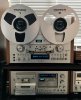 ...
...
Isaac C.
Cat Hoarder
@Ken Creamore yes maintenance is very crucial. My grandfather let his Pioneer CT F500 sit for a month or two without using it and it developed some major distortion and flutter. Fortunately after lubricating some of the moving components and cleaning the pinch roller, it is much better now. Cassette decks are really finicky if they are not used regularly.

BilboBaggins
Addicted Member
All electro-mechanical devices are like that. I used to dread thunderstorms because if the power went out in a data centre, I was going to be up all night working on dead devices. If they had enough time to cool down, then we saw a spurt in failures. That all ended when generators and UPSs were installed. It made a huge difference!
There do seem to be some brands that age better than others. I bet they never expected these would still be in use to the extent they are, at the time they were designed!
There do seem to be some brands that age better than others. I bet they never expected these would still be in use to the extent they are, at the time they were designed!

Reelist
Member
Best advice in Cassette Tape 2020 is to learn from your mistakes. If you really like the format, you'll bear the punishment.
The market is broken up into 2 segments right now-- Component & Tape. We are seeing a resurgence in tape, but there's only a sputter in the component segment of the market. The void is spurring activity in the second-hand deck market and in the repair sector. Good cassette decks are a thing of the past. Time will tell if that changes. The newest Mystik cassette player has potential but is starting to look like it will disappoint. But older decks are still out there and getting refurbished and resold. People are happy as long as they accept the gremlins inside antique components. Wow and flutter.... yeah, my 1980's ADS deck is a little slow on the take when it gets to the end of a tape when recording. So once and awhile, a recording will have a few seconds of warp. But I assure all of you that the fabric of time and space was not damaged by that warpy sound.The world kept going and everything was well.
I grew up on cassettes more than LPs, and always prefered tape over vinyl. I enjoy both. But I always liked compact cassettes. Nowadays, I Iisten to all formats flac-dac, r2r, vinyl, CD, SVHS... My favorite format is still compact cassette tape. I like the sound of it. It's more pleasant to my ears, less laborious than flac-Dac. In fact, I will go as far to admit here that I LOVE type-I tape, good old ferric oxide tape. The hiss only appears in-between songs, and it doesn't have any adverse affect on the quality of music (to my ears at least). And I happen to like that hiss in-between. Is there was a t-shirt that says "I like hiss", I'd probably wear it under a sweater. But I would still wear it.
And let's be reel here... Our favorite source format depends a lot on our pocket books. I don't have a $10k turntable, I have a $500 one. So my vinyl experience comes with its own issues, like the left channel wiring shorts out on occassion. I'd rather change a belt on a cassette deck than change the wires on my tonearm. That said, using a turntable also requires observational duty-- Almost like your on duty steering a navy ship.
Hands down, R2R and Flac-Dac has given me the best listening experience. But when it comes to daily commutes to musical therapy sessions, cassette decks gives me the hifi with less hassle and less work on the ears. Like using a motorcycle to weave through traffic. I can have a cassete tape play while I work and not have to do anything for at least 1.5 hours. It's easy. I actually dub CDs to compact cassettes and prefer to listen to the cassettes. I record everything with Dolby B or C, then use no filter during playback. I don't like filters during playback, and many think it's necessary. Doing it my way, the sound is wider range and barely has any hiss on Type-I. I always use type-I over type-II, and never use Metal. Metal tape is a special animal. I'll leave Metal tape for the studio mastering jobs. The slander of Type-I hiss is overhyped in my opinion. If you're listening to compact cassettes in 2020, how could you possibly be swayed by hiss? Isn't that the purpose of compact cassettes in 2020?
I can add a little unscientific market data-- I'm an active cassette tape reseller on ebay. Some of my customers feel the same way about type-I, they love it over type-II. You can get type-I for less than $2/tape. Type-II's and Metals are popular, but they sell at a premium and take longer to sell. They are most profitable. My heart breaks everytime I make a profit on type-II tape. A lot of these tapes go to Europe. I just sent Metals to Hong Kong. Compact tapes are very recyclable and the materials have stood the test of time. (I do not sell on this forum, so don't ask. Just want to add a marketeer's perspective.)
On a side note, I just spent a week buying-repairing my $100 LG TV with new LEDs. They all went out the day before the superbowl-- I kid you not! This push to get everyone into 4k is silly marketing... The human eye doesn't register anything over 2k. The 4k TV is all hype. If you haven't noticed it yet, 4k makes everything look like home video (looks like 4k-60fps). MeTV just rescanned all the old shows that were originally shot on 35mm film. They look horrible now in 4k. Yuck. I believe this romance with digital convenience and its expendability is losing its luster with consumers. Analog feeds the soul, digital just feeds the beast.

macman007
Mcintosh..Made In USA
There are multiple factors involved in cassette as it pertains to decent sounding medium, especially the media and the equipment, which some folks don't understand or want to learn. This is often true in the case of folks under 35, its not instant gratification. If you are a Gen X like me, you grew up with cassette, were along for the journey, from being dictation format to becoming more popular that CD and LP. CD didn't catch up until around '94-'95, when cassette began its swan dive. Vinyl was already down for the count by then as well.
Making your own recordings is a lost art for many. It's a skill set some never learned. Making a good mixtape is as much about the material, the original sources, tape type, tape brand, as the machine you use. Then you have the actual hands on skills required. Maintaining your cassette deck is very important. Using the correct media which the machine was calibrated to is very important for optimal results. A clean tape path, correct recording levels, bias levels, to, or to not use Dolby B,C,S HX Pro, or DBX, are among the important variables. You need to know your machine, be at ease with operating it and the equipment feeding the source to be recorded. Again, not something younger crowd is likely to embrace.
Yet another point to ponder is that there hasn't been a truly TOTL cassette deck designed, manufactured or marketed in close to 1/4 of a century. Nakamichi's Dragon was the IT deck if you really wanted to hear and record at the cutting edge of the medium. The 1000ZXL was another Nakamichi at that level, complex, to operate, both decks required periodic maintenance and repair to stay in top form.There are other decks out there that give cassette a run for the money, Akai made several direct drive models that used the same transport as some of the high end, but not TOTL Nakamichi's, Yamaha, Sony ES, Technics, Pioneer, Esoteric, TEAC, Tascam, all made decks that were at the top of the food chain. Double or Dubbing Decks featuring this level of performance capability are few and very far between. There were about a handful of them worth mentioning. The rest were completely forgettable. The same applies to most all modern abominations being sold currently using BOTL Chinese transports, junk heads, no Dolby B,C, S, DBX, or HX Pro capability to record, and play back.
For many people, finding blank new quality media was just as troublesome the last 2 decades. The big guns, Maxell, Thats, TDK, BASF all exited the market around the Millennium. This was as much about EPA pollution regulations as falling profit margins. Those of US who were smart enough, forward thinkers, to hoard a large quantity of quality blank tape, simply got lucky. Only recently has NAC, RTM, and ATR re-entered the cassette tape manufacturing arena. Before, it was all NOS tape, and NAC, along with a couple other duplication houses, were the only game on the planet. This was if you didn't want to buy cheap Saehen tape made in Taiwan or China,.. crap type I and II tape. Decent machines don't record well using that crap. Even the last made Maxell UD and Sony Normal position blank tape is rebadged crap tape, not real Maxel-Sony products from the days of old
Which brings us to machines. Nothing notable is being made today, same with open reel. Ballfinger makes a hand-made open reel machine, priced to where few can afford. We're talking a total 5-10 reel machines per year here.Revox talked about doing it but never got past the concept. This doesn't stop either format from being competent one which sounds spectacular when done right. BUT it keeps both from making a legitimate comeback, when there are no modern TOTL machines being built from new designs. So like open reel we play the NOS and restoration game, after paying a small fortune for a used TOTL machine. If you want to have the best, you have to pay the for the best. Then you need a trustworthy tech to make sure the deck is up to the task.
Those of us with that skill set are ahead of the curve. Still buying a Dragon or 1000ZXL worth restoring or repairing today will run you anywhere between 1,500$ and 10K$, depending on where you go and what you want. Currently, quality replacement heads are the major conundrum. Decks with high hours, even Naks Crystalloy and Akai's with GX heads wear out, and I don't know of any new replacements, There is lapping and NOS, aside from cannibalising other decks, which doesn't help to keep prices of better decks in check.
I've been on the hunt for a decent restorable Nakamichi RX-505, Dragon, or 1000ZXL for the better part of 5 years. Nothing I can afford or am willing to invest in has presented itself. My uncle Jim has a Dragon, low hours, Wily Herman serviced in the '90s, but won't come off of it, even though he doesn't use it. My current best decks include a AKAI GX-912 with direct drive I totally restored myself. Sony's also restored by me include 2 TC-K677ES, TC-K909ES, Teac V-5RX, and Yamaha KX1200U. I also have a Denon DR-F7 2 head, highly regarded, which is in the pipeline to be restored soon as I get some other stuff done. I restore open reels as well as other gear, so I have stuff here for others as well, but I'm slowing down taking in new stuff till all my stuff and the current crop of customer stuff is done and out. It gets to be too much some for one guy to do.
I'm happy to see the cassette comeback as it's being called. That said, its driving prices for high quality decks and decent media into the Stratosphere, not something I'm happy seeing. I never left vinyl, open reel or cassette, an embrace, CD music servers and HD streamers as well. I'm well rounded and not a format phobe. That said, I do recognise that owning a few units of each format representing the best hardware a format offers-offered (or best I can really afford) is better than having 30 lesser quality or junk units, in which 1/2 don't work.. of the rest, none were TOTL. Quality, not quantity trumps every time. I dumped all my lesser quality cheap 2 and 3 head cassette decks. Any older, or lesser quality/duplicate open reel decks and turntables are also being thinned as we speak. The proceeds are earmarked to pay for whatever gear I can afford what I really want. The stuff that will take me into my 70's 80's, 90's or death, if I can hear that long, which I hope to.
First round of culling gear paid for my VPI Prime Signature Rosewood, cartridge, dust cover and ADS drive unit, plus Phono Pre/Head Amp. I want to add a second Fatboy arm for another MC cart. Maybe if a dump a few of my better cassette decks and open reel unit, so I can afford a decent restorable Dragon or 1000ZXL. Only one way to find out. Don't forget media, whats the point in owning TOTL cassette or open reel decks and blank media if you don't own anything worth recording? Pre recorded tapes have been and will continue to be a crap shoot. Much of the Capitol and XDR tapes I've owned and encountered, are either sticky or suffer badly from dragging- squea, which is due to loss of lubrication. LOL is something that I don't think has been mentioned in any of this thread's posts. WEA and/or Digilog tapes are about the best quality and best sounding, IMO. Pretty much anything commercially recorded using HX PRO and Digital Bin masters ranks high. I believe I read somewhere Wilhelm where posted that WEA used the best kept machines and higher (BASF) quality tape overal in the duplication industry. Digital bins were a tremendous step forward in duplication automation, as well as consistently high quality. Before that, MFSL real time pre recorded tapes were about the best, and those were largely dependent on the quality of the MOFI audio remastering, which isn't always better than the original sources. Then there was the cost issue, MOFI cassettes were not cheap either way. The later Digilog tapes were about the best overall mass market pre recorded tapes available before the format finally died, IMHO. Dolby S took sound quality another step forward, though not a large number of Dolby S capable machines were built, comparatively speaking. Dolby S was pretty much the end stages of the cassette format. The peak of machines and blank tape quality, again IMHO was between 1989 and 1994, when cassette was at the top, above even CD sales. YMMV of course.
Last edited:
Taketheflame
Super Member
Reelist,
I love a good Type I tape. Cheap, plentiful, and the perfect tape type for adding some warmth and smoothness to recordings that lean a bit too bright for my liking. I don't mind the hiss on most rock/popular music, but for something softer/more dynamic, Dolby B is good enough for me.
On the state of the component market - there is definitely a lot more inflow and outflow of cassette decks happening at my local stereo shop due to increased demand. Prices seem to be starting to go up for desirable models, so who knows what that could mean going forward.
On that last paragraph, I agree the TV market to some extent. I'm less baffled at the push for 4K than I am about the hype for 8K (which would require an enormous screen to matter, if much). Yes those old TV shows look terrible on modern TVs, but to my knowledge, it's because they're broadcasting old SD/480P versions meant for smaller CRT screens than the modern stuff. If they went back and did 4K scans of the original 16 or 35mm prints, the old shows would look amazing.

I get very impressive results using either a Yamaha KX-800 or KX-1200 using the built in dbx2 facility. For those about to scream pumping, stop!!! There is NONE. I've recorded many genres of music and have not experienced it. With over 95 db SNR, its by far the best noise reduction system I have used without any HF loss.

MaxxVolume
Lunatic Member
I currently have two properly-functioning cassette decks, a Teac R-888X (upper-mid level single unit w/ adjustable bias and dbx), and a recently-restored Pioneer CT-F1250, which sounds quite incredible. I have auditioned these decks for guests who just stare in amazement, they find it hard to believe that the old "obsolete" cassette is capable of this quality of sound. I always find this both amusing and satisfying....
Taketheflame
Super Member
I've been thinking about hunting down/adding an external DBX unit to play around with at some point, since none of my decks have it (They're all Dolby B only decks!).I get very impressive results using either a Yamaha KX-800 or KX-1200 using the built in dbx2 facility. For those about to scream pumping, stop!!! There is NONE. I've recorded many genres of music and have not experienced it. With over 95 db SNR, its by far the best noise reduction system I have used without any HF loss.
I watched Techmoan's YT video about DBX-encoded records, and was pretty blown away at how silent they were...I'm guessing DBX on a Type II tape might be good enough to fool some people into thinking it's a CD they're hearing.
MaxxVolume
Lunatic Member
I've been thinking about hunting down/adding an external DBX unit to play around with at some point, since none of my decks have it (They're all Dolby B only decks!).
I watched Techmoan's YT video about DBX-encoded records, and was pretty blown away at how silent they were...I'm guessing DBX on a Type II tape might be good enough to fool some people into thinking it's a CD they're hearing.
I have a stand-alone dbx unit which I patch into the 1250 on occasion, the quality of the recording is very impressive, especially if copying a CD that tends to run a little hot or harsh on the top end. The cassette provides a nice gentle roll-off above 15K (which is not necessarily a bad thing), the result being that the cassette version is actually a bit nicer to listen to than the CD....I enjoy experimenting with this old gear, it`s fun and often productive !

This is one solution-with the usual caveat that any recordings when played back will require the DBX unit for decode. As I use tapes in my car from time to time, and send a mix tape to someone on occasion, I don't go this route, even though I have a DBX224.I've been thinking about hunting down/adding an external DBX unit to play around with at some point, since none of my decks have it (They're all Dolby B only decks!).
I am however, very impressed by recordings made with my Aiwa ADF810 deck, using HX Pro and Dolby B (the deck also has type C) With a type 2 tape, I get great results, and the tapes are playable on any deck. Type 1 tapes are nearly as good.
MaxxVolume
Lunatic Member
This is one solution-with the usual caveat that any recordings when played back will require the DBX unit for decode. As I use tapes in my car from time to time, and send a mix tape to someone on occasion, I don't go this route, even though I have a DBX224.
I am however, very impressed by recordings made with my Aiwa ADF810 deck, using HX Pro and Dolby B (the deck also has type C) With a type 2 tape, I get great results, and the tapes are playable on any deck. Type 1 tapes are nearly as good.
Yes, for sure....a dbx-encoded tape, if played back on a non-dbx deck, is not worth listening to, which is why I keep them for those "special-occasion, serious listening" sessions.
Taketheflame
Super Member
The caveat wouldn't really be an issue for me, as I'd only be playing tapes encoded with it at home (my car doesn't have a tape deck in it). I took a quick look and saw that the 224 units can be had for pretty affordable prices...I just might have to grab one in the not too distant future.This is one solution-with the usual caveat that any recordings when played back will require the DBX unit for decode. As I use tapes in my car from time to time, and send a mix tape to someone on occasion, I don't go this route, even though I have a DBX224.
I am however, very impressed by recordings made with my Aiwa ADF810 deck, using HX Pro and Dolby B (the deck also has type C) With a type 2 tape, I get great results, and the tapes are playable on any deck. Type 1 tapes are nearly as good.
Same here. My latest vehicle doesn't even come equipped with a CD player. Since all 3 of my decks have dbx, its a non issue for me.The caveat wouldn't really be an issue for me, as I'd only be playing tapes encoded with it at home (my car doesn't have a tape deck in it). I took a quick look and saw that the 224 units can be had for pretty affordable prices...I just might have to grab one in the not too distant future.

macman007
Mcintosh..Made In USA
My Jeep WJ has the CD cassette combo and Infinity gold system with the big amp. IIRC, Mitsubishi made the head units for Chrysler-Jeep, the have Metal capability and Dolby B, auto-reverse, and music search. I rebuilt the entire unit, new belts, rollers, caps, clean, lubrication and, set calibrated the speed, and adjusted the head for optimum response in both directions. I also tweaked the FM front end. For a stock player the sound is really good. Not as good as my Alpine pull-out from the mid 90's but up there with previous Kenwood cassette pull out I owned. Those Infinity Gold sound systems from around the Millenium sound really good, even the FM Stereo and CD quality is pleasantly surprising. No need to install and aftermarket system.
I have tried to digitize most of my important music from my old cassettes. I don't know how much longer my BIC T4 will keep going. My good stuff is on Metal tape at double speed.
For recording, I found the most convenient medium is MiniDisk. I cues up to bank space instantly and does not require a computer to record. Organization and storage of the physical medium does not require a computer.
For recording, I found the most convenient medium is MiniDisk. I cues up to bank space instantly and does not require a computer to record. Organization and storage of the physical medium does not require a computer.
Last edited:

benricci
Super Member
I really wish MiniDisc took off more here in the States. Dead-simple to use and looked super-futuristic. Sound quality was pretty darn good for recordable media, and got even better over time with the larger-capacity discs at the tail end of the product's lifecycle.I have tried to digitize most of my important music from my old cassettes. I don't know how much longer my BIC T4 will keep going. My good stuff is on Metal tape at double speed.
For recording, I found the most convenient medium is MiniDisk. I cues up to bank space instantly and does not require a computer to record. Organization and storage of the physical medium does not require a computer.