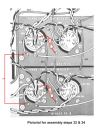
The pin out for the 6GH8, 7687, 6U8 tubes has a design weakness when used in a phase splitter circuit that can cause high frequency stability issues with some amplifiers originally designed for the 7199 or 6AN8 tube. The 6GH8, 7687, 6U8 tubes all feature the pentode grid (pin 2) right beside the output pin (pin 1) of the plate of the triode.
In almost all designs using the 7199 tube the input signal is amplified and inverted by the pentode and this signal is then applied to the triode's grid. The signal applied to the triode's grid is inverted onto the triode's plate. So now the pentodes input signal has been greatly amplified (often by 40DB or more) and inverted twice onto the triodes plate pin to be exactly in phase with the pentodes input grid pin. The design issue on 6GH8, 7687, 6U8 tubes is the input pin to the pentode grid (pin 2) is right beside the output pin (pin 1) of the plate of the triode. As the two pins are right beside each other in the tube and tube socket there is significant capacitive coupling between the two pins resulting in positive feedback.
The positive feedback effect of the capacitance between the two pins is greatly increased by the high gain in the pentode stage and by the fact many amplifiers designs leave the pentode input grid at high impedance from ground.
A spice simulation suggested that in some circuits as little as 0.06PF of stray capacitive coupling between the two pins results in as much as 30DB peaking of response at a few hundred KHZ. The true effect will of course be strongly determined by each individual unit being modified and is difficult to predict in advance.
Depending on many many amplifier design factors this high frequency positive feedback can be of little importance or in some amplifiers lead the amplifier into strong oscillation at some frequency well above the audio range. These stability issues can be hard to see unless the builder has a well equipped lab and often will result in a amplifier that sounds a bit "hard" or now lacks some "mid-range clarity" on complex music due the amplifier breaking into instability on some program material. Square wave testing "before" and "after" modification can be useful in checking for this issue.
I personally avoid 7199 or 6AN8 replacements where possible with a pinout that features the pentode grid and the triode plate being side by side pins.
In almost all designs using the 7199 tube the input signal is amplified and inverted by the pentode and this signal is then applied to the triode's grid. The signal applied to the triode's grid is inverted onto the triode's plate. So now the pentodes input signal has been greatly amplified (often by 40DB or more) and inverted twice onto the triodes plate pin to be exactly in phase with the pentodes input grid pin. The design issue on 6GH8, 7687, 6U8 tubes is the input pin to the pentode grid (pin 2) is right beside the output pin (pin 1) of the plate of the triode. As the two pins are right beside each other in the tube and tube socket there is significant capacitive coupling between the two pins resulting in positive feedback.
The positive feedback effect of the capacitance between the two pins is greatly increased by the high gain in the pentode stage and by the fact many amplifiers designs leave the pentode input grid at high impedance from ground.
A spice simulation suggested that in some circuits as little as 0.06PF of stray capacitive coupling between the two pins results in as much as 30DB peaking of response at a few hundred KHZ. The true effect will of course be strongly determined by each individual unit being modified and is difficult to predict in advance.
Depending on many many amplifier design factors this high frequency positive feedback can be of little importance or in some amplifiers lead the amplifier into strong oscillation at some frequency well above the audio range. These stability issues can be hard to see unless the builder has a well equipped lab and often will result in a amplifier that sounds a bit "hard" or now lacks some "mid-range clarity" on complex music due the amplifier breaking into instability on some program material. Square wave testing "before" and "after" modification can be useful in checking for this issue.
I personally avoid 7199 or 6AN8 replacements where possible with a pinout that features the pentode grid and the triode plate being side by side pins.