• The move to the new server is done. There are some software and database maintenance updates in process. This has us passing the hat around to help out. We appreciate any donations. Seriously, even a dollar helps. The payment page may be found here - https://www.audiokarma.org/support.html

Celestion Ditton 44 crossover capacitors

NickArchdale

New Member
Hi AK folk,

I'm restoring a pair of Celestion Ditton 44s and I have some questions:

- The Erie 2ufd 250VDC film caps are paralleled up to produce 4ufd and 6ufd values for the tweeter, the old ones were measuring double those values (out of circuit using my Peak ESR capacitor tester), is that usual as I thought this type of capacitor was very stable? I have ordered discrete Solen replacements as can see no point in the parallel approach, does that make sense?

- One crossover had an Erie 6ufd film cap in parallel with the 24ufd electrolytic C4 midrange the purpose of which is unclear and it is not shown on any schematic that I have found. I have ordered new 25ufd Alcap and plan to omit the film cap, will that be ok?

- The 72ufd film caps C1 & C2 woofer are measuring ok, phew, as very expensive to replace like-for-like but, if I had to, would Alcap electrolytics be ok?

I'm using Falcon Acoustics for the replacements: www.falconacoustics.co.uk

I have more to pairs to restore so any help would be great.

Many thanks, Nick
 

Attachments

Register to hide this ad
I got real lucky when replacing the 50uf electrolytic Cap'n in a pair of Ditton's with film caps. I found some on close out marked down to just under $5 each from a little over $50 each. They were really huge!.
 
The Erie 2ufd 250VDC film caps are paralleled up to produce 4ufd and 6ufd values for the tweeter, the old ones were measuring double those values (out of circuit using my Peak ESR capacitor tester), is that usual as I thought this type of capacitor was very stable?
In another recent thread, @ziggydave also describes the cap-clusters in his tweeter filters as measuring significantly higher than their ratings. Suggests this may be commonplace, though odd.

Beyond speculation, the definitive reason these are paralleled vs single values is probably lost to history.
One crossover had an Erie 6ufd film cap in parallel with the 24ufd electrolytic C4 midrange the purpose of which is unclear and it is not shown on any schematic that I have found. I have ordered new 25ufd Alcap and plan to omit the film cap, will that be ok?
A post at diyaudio shows a schematic for a 1972 model having the 24µF cap paralleled with 6µF. Apparently a variant that existed in some models. Are both of the speakers in your pair of the same vintage?
The 72ufd film caps C1 & C2 woofer are measuring ok, phew, as very expensive to replace like-for-like but, if I had to, would Alcap electrolytics be ok?
If your 72µF capacitors are 50V black ELCAPS with red ends, fairly certain they're not film caps. Nor do they generally seem to be held in high regard. Replacing them with new 50V Alcaps would essentially be like-for-like. The Alcaps even offer a 5% tolerance option for just three and six more (including Vat). The 2% option at twice that is perhaps overkill in this application.
 
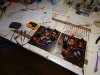
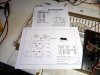
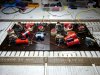
Thanks all, Falcon Acoustics recommend replacing the tweeter film cap clusters with single 5% caps, to ditch the 6uF film paralleled to the 24uF and replace the 72uFs as well (which are indeed black ELCAPS) so all on order. These crossovers are I think a pair but hard to tell. I bought them in driverless cabinets so they won't be driving what they used to anyway. Here's a photo of the state of play.

Ditton 44 crossover restoration.jpg
 
Last edited:
A post at diyaudio shows a schematic for a 1972 model having the 24µF cap paralleled with 6µF. Apparently a variant that existed in some models. Are both of the speakers in your pair of the same vintage?
.

Have had a closer look and they are not a pair but can't be far apart age wise, that explains the 6uF capacitor debacle. I bought them for £25 for parts but am now planning to build them up since I have ample drivers knocking about.
 
Have had a closer look and they are not a pair but can't be far apart age wise, that explains the 6uF capacitor debacle. I bought them for £25 for parts but am now planning to build them up since I have ample drivers knocking about.

Just out of curiosity, what are you going to replace the 24uF and the 6uF with?
 
Like for like with Alcap 100V DC electrolytics, 2x12uF for the 24uF as those no longer available. Nick

If the capacitors are parallel, you calculate the total capacitance by adding the caps together. So if you have a 24uF cap and a 6uF cap, you need to replace them with 30uF. This was why I asked. I did a 44 about 10 years ago, but have since lost my notes. Too many renovations! At that time, I spent about $100 to do the refresh.
 
The schematic shows a 24uF midrange series cap, and a 6uF shunt. That's part of the midrange bandpass circuit. Both are needed. Now, if the 2 speakers have mismatched crossovers, that's different. Either follow the schematic or the better sounding of the 2 speakers. Just make sure to match them up.
 
I didn't look at the schematic. Still haven't. Not since 10 years ago, when I drew one up for the 44s I had. I wish I knew what I had done with it! Probably got pitched.
 
Thanks all but it's not quite as simple as that. I bought these very beaten up and badly painted (!) cabinets without drivers, they were someone's unfinished project, because I needed some crossovers and, at £25, that was very good value. As I have recently stocked up on T1600 drivers, have some spare mids and have become adept at changing the diaphragms in HF2000 tweeters I thought instead that I'd build them up as I have a home for them in a painter's studio, hence recapping the crossovers.

However it appears that they are not a pair and there is no way of knowing when/why the 24uF electrolytic gets a 6uF film shunt, only one had such. Falcon Acoustics recommended going without so I have done so. I have kept the 6uF cap so I guess I could compare. Schematics exist with and without.

Further complicating this project is the fact that the cabinets have also been hacked back to accept a larger tweeter so I could instead fit the SEAS as I have a pair knocking about from before I found Nino Music in France. Not sure yet and, at 6 Ohms, these will require crossover tweaks and there's lots of consensus on that! ;-)

I'll report back....
 
The schematic shows a 24uF midrange series cap, and a 6uF shunt. That's part of the midrange bandpass circuit. Both are needed. Now, if the 2 speakers have mismatched crossovers, that's different. Either follow the schematic or the better sounding of the 2 speakers. Just make sure to match them up.

That depends which schematic you have! Whatever I do they will be matched, will recap as outlined here and use my ears to determine to add 6uF or not and also make a call on the tweeters....
 
Last edited:
That depends which schematic you have! Whatever I do they will be matched, will recap as outlined here and use my ears to determine 6uF mid shunt or not and also make a call on the tweeters....

I was referencing the schematic you posted. And in looking at the schematic, the 6uF shunt is necessary. I wouldn't arbitrarily remove it, unless I'm not fully understanding the big picture? :)
 
I was referencing the schematic you posted. And in looking at the schematic, the 6uF shunt is necessary. I wouldn't arbitrarily remove it, unless I'm not fully understanding the big picture? :)

That schematic doesn't show the 6uF in parallel with the 24uF @C4 - I'm not talking about the 6uF @C3. The paralleled mystery cap is elcap not film, my mistake. It's quite a big "tweak" that Celestion made to some of the Ditton 44s to add it - perhaps they had a batch of mis-wound drivers that needed matching? As I don't have a pair of crossovers nor the original drivers I'm at a loss here so will use my ears. I do have two other pairs in the workshop though so could look at those but will it tell me anything?
 
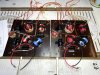
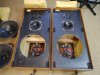
Recap complete with 24uF @C4 per the schematics (original Celestion and the 2010 reverse engineered one) but the plot thickens: I have looked at another pair of Ditton 44s from a similar era (black baffle, tagged crossover) and there are indeed parallel caps added across C4, photos herewith. Who, when and why were these added and why do they not appear on any schematic? What am I to do?

Ditton 44 crossover restoration 3.JPG Ditton 44 crossover restoration 2.JPG Ditton 44 crossover restoration comparison.JPG

These are definitely a pair so surprised that C4 done differently and yes, that inductor is cooked. The build quality of these crossovers sadly does not compare well with Japanese workmanship from the same era, it's as though they were made by someone with poor soldering skills with bits that were lying around :-(
 
I have removed the crossovers from the second pair to get a closer look at the C4 capacitor bundles and toasted inductor, photo attached showing 6uF paralleled across 24uF (or 2x12uF in one case). The 6uF capacitors appear to be field modifications added to the crossovers while in place, the purpose of which is a mystery but it's quite common.

Ditton 44 crossover restoration comparison 4.JPG

These are from 1974 and if the factory added them then why not use the same capacitor type as C3 and solder them to the lugs not the 24uF leads? This additional capacitance would presumably move the lower band pass frequency away from 500Hz, can someone point me to a calculation that would determine what the new frequency would be please with C4 30uF instead of 24uF? Thanks.
 
Last on this then as my recapped Ditton 44s are sounding great with all values per original schematic. Amusingly Falcon Acoustics, having insisted on selling me 5% tolerance caps, told me not to worry about 24uF vs 30uF as "it will make a small difference to the roll-off slope and you probably won't be able to hear the difference either way."

Hmmm :-)
 
Back
Top Bottom