Hello,
I’m starting this thread because I wanted to describe an interesting issue concerning transistors. These are my own experiences, and I thought they might be useful to someone. I mainly restore turntables, but from time to time I also repair or restore an amplifier, mostly for myself or for friends.
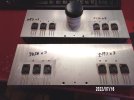
A few months ago, I was restoring an Onkyo M-508 power amplifier for a friend. One channel was faulty. I checked it and fairly quickly determined that the power transistors and driver transistors were damaged. The power transistors were 2SA1492 and 2SC3856.
I searched an online marketplace and found transistors with exactly the same markings. I bought them, installed them in the amplifier together with new driver transistors, and reassembled everything. When I switched it on, the amplifier blew up — there were sparks and smoke.
I was upset because I thought I had done something wrong. I bought another set of transistors, soldered everything in again, checked everything carefully, and powered it up. The same thing happened again. The amplifier blew up.
I bought another set of transistors. This time, for safety, I made a dim-bulb current limiter and connected it to the amplifier’s power cord. It turned out that the amplifier was again trying to draw a very large current.
I then decided to try powering up the amplifier without the power transistors, using only the driver stage. This time, everything worked correctly. I therefore decided to take the original power transistors from the working channel, install them in the faulty channel, and see how the amplifier behaved. After installing the original transistors, everything worked.
At that point, I was certain that the problem was caused by the power transistors I had purchased.
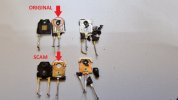
I asked some friends from a Polish electronics forum for their opinions. Together, we concluded that these were most likely yet another set of Chinese counterfeit transistors. I broke open the transistors to inspect the silicon dies inside. They looked like this:

The original transistors are shown at the top, while the ones I purchased are at the bottom. As you can see, the silicon dies in the original transistors are very large. These are very high-quality transistors. The ones at the bottom are counterfeit. Their silicon dies are extremely small. These are the silver squares in the middle of the transistors.
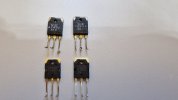
I then purchased transistors from several different shops — probably seven or eight pairs in total — and finally found some of very good quality, like the ones shown here:

After my first failures, I decided that before installing any transistors, I would have to break open one pair as a test to check whether they were Chinese counterfeits. Once I was satisfied with their quality, I installed the remaining pair and the amplifier worked correctly.
I then bought several more pairs from the same seller as spares.
After this incident, I decided that I would always do this in the future. Before installing power transistors, I will sacrifice one sample and break it open to check its quality.
From my experience, the main problem is not usually with small-signal or lower-power transistors, for example those in TO-92 or TO-220 packages. I have often bought such transistors even from eBay or AliExpress, and they did not cause any problems. The real problem seems to be large power transistors.
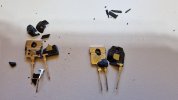
Together with friends from the Polish forum, we noticed that good-quality transistors differ from counterfeits in several ways. For example, the base of the center lead is wider in the original transistors. It is also wider in the good transistors that I eventually purchased, as shown in the photo:

However, personally, I do not want to rely only on details like this. I prefer to sacrifice one transistor and break it open to check the silicon die directly.
I am writing about this because people often want to replace perfectly good transistors with new ones during a restoration, just as they replace capacitors. I do not recommend doing this because I believe the original transistors are usually the best ones.
I replace transistors only when they are clearly shorted or are causing problems.
Of course, there are exceptions. For example, old small-signal transistors in the tone-control circuits of amplifiers such as the Sony TA-1120 or TA-2000 can become very noisy and produce crackling sounds as they age. In such cases, they need to be replaced. However, if the amplifier is working properly, I leave the original transistors alone.
I am curious about your experiences with this subject. Perhaps you have your own observations that would be worth sharing.
Przemyslaw
I’m starting this thread because I wanted to describe an interesting issue concerning transistors. These are my own experiences, and I thought they might be useful to someone. I mainly restore turntables, but from time to time I also repair or restore an amplifier, mostly for myself or for friends.
A few months ago, I was restoring an Onkyo M-508 power amplifier for a friend. One channel was faulty. I checked it and fairly quickly determined that the power transistors and driver transistors were damaged. The power transistors were 2SA1492 and 2SC3856.
I searched an online marketplace and found transistors with exactly the same markings. I bought them, installed them in the amplifier together with new driver transistors, and reassembled everything. When I switched it on, the amplifier blew up — there were sparks and smoke.
I was upset because I thought I had done something wrong. I bought another set of transistors, soldered everything in again, checked everything carefully, and powered it up. The same thing happened again. The amplifier blew up.
I bought another set of transistors. This time, for safety, I made a dim-bulb current limiter and connected it to the amplifier’s power cord. It turned out that the amplifier was again trying to draw a very large current.
I then decided to try powering up the amplifier without the power transistors, using only the driver stage. This time, everything worked correctly. I therefore decided to take the original power transistors from the working channel, install them in the faulty channel, and see how the amplifier behaved. After installing the original transistors, everything worked.
At that point, I was certain that the problem was caused by the power transistors I had purchased.
I asked some friends from a Polish electronics forum for their opinions. Together, we concluded that these were most likely yet another set of Chinese counterfeit transistors. I broke open the transistors to inspect the silicon dies inside. They looked like this:
The original transistors are shown at the top, while the ones I purchased are at the bottom. As you can see, the silicon dies in the original transistors are very large. These are very high-quality transistors. The ones at the bottom are counterfeit. Their silicon dies are extremely small. These are the silver squares in the middle of the transistors.
I then purchased transistors from several different shops — probably seven or eight pairs in total — and finally found some of very good quality, like the ones shown here:
After my first failures, I decided that before installing any transistors, I would have to break open one pair as a test to check whether they were Chinese counterfeits. Once I was satisfied with their quality, I installed the remaining pair and the amplifier worked correctly.
I then bought several more pairs from the same seller as spares.
After this incident, I decided that I would always do this in the future. Before installing power transistors, I will sacrifice one sample and break it open to check its quality.
From my experience, the main problem is not usually with small-signal or lower-power transistors, for example those in TO-92 or TO-220 packages. I have often bought such transistors even from eBay or AliExpress, and they did not cause any problems. The real problem seems to be large power transistors.
Together with friends from the Polish forum, we noticed that good-quality transistors differ from counterfeits in several ways. For example, the base of the center lead is wider in the original transistors. It is also wider in the good transistors that I eventually purchased, as shown in the photo:
However, personally, I do not want to rely only on details like this. I prefer to sacrifice one transistor and break it open to check the silicon die directly.
I am writing about this because people often want to replace perfectly good transistors with new ones during a restoration, just as they replace capacitors. I do not recommend doing this because I believe the original transistors are usually the best ones.
I replace transistors only when they are clearly shorted or are causing problems.
Of course, there are exceptions. For example, old small-signal transistors in the tone-control circuits of amplifiers such as the Sony TA-1120 or TA-2000 can become very noisy and produce crackling sounds as they age. In such cases, they need to be replaced. However, if the amplifier is working properly, I leave the original transistors alone.
I am curious about your experiences with this subject. Perhaps you have your own observations that would be worth sharing.
Przemyslaw