

You are using an out of date browser. It may not display this or other websites correctly.
You should upgrade or use an alternative browser.
You should upgrade or use an alternative browser.
Clipping Amps and Blowing Tweeters
- Thread starter House de Kris
- Start date
Well, clipping distortion is a direct effect of clipping. The greater the degree to which the signal is clipped, the greater the clipping distortion.
Very low level clipping of only the highest peaks will not have a drastic effect on sound quality, but as the amp moves further into clipping the effect on sound quality increases exponentially.
As for other types of amplifier distortion, such as harmonic, intermodulation, crossover, etc...I think of them as somewhat separate topics from clipping (although I would assume that clipping distortion can be categorized as a form of harmonic distortion).
Very low level clipping of only the highest peaks will not have a drastic effect on sound quality, but as the amp moves further into clipping the effect on sound quality increases exponentially.
As for other types of amplifier distortion, such as harmonic, intermodulation, crossover, etc...I think of them as somewhat separate topics from clipping (although I would assume that clipping distortion can be categorized as a form of harmonic distortion).

House de Kris
Loud-n-Deep
How does distortion play into all of this?
Very good question. The mechanism of clipping generates harmonics, thus harmonic distortion. It happens cyclically, thus is harmonically related. Just as the crossover distortion mechanism also generates harmonic distortion. This may be a good time to review what clipping means. It is when the signal runs out of wiggle room (I think it is technically called headroom) and can go no further. This typically happens when a device runs out of power supply, and can no longer increase in magnitude. It literally clips off the tops of waveforms at this power supply limitation.
Usually, it is observed on and oscilloscope as flat tops and bottoms on waves. When we can easily see it on a scope, this is often called hard clipping. But, even before the wave is visibly clipped as a fat line, the effects of power supply limitations start to impose their distortion. This lower amount of overdrive of the output section is where the more typical THD type of numbers are measured. If you've ever looked at a distortion vs. power chart of an amp, you'll often times see the distortion rise quickly at some point in the power increase. It is typically somewhere on this rise where manufactures decide what their claimed output power and distortion levels are. This is the onset of distortion and the limit of the power.
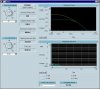
To this end, I've played around with my little program some more, and here is an example of extremely mild clipping. The behaviour is much more similar to everyday run-of-the-mill typical THD.
A few changes from before in the display. Since the program was working well enough, I upped the resolution. I also included the total harmonic power, and a THD measurement. I think this version only measured the first 10 harmonics, but it really doesn't change much by increasing the number of harmonics. Future versions measure the first 80 harmonics. Notice in the Spectrum display how it now looks like typical harmonic distortion display, and not some hugely distorted wave like the previous Spectrums. This very small amount of distortion (0.054%) has only 58uW of power contained in the first 10 harmonics. That's 58uW of distortion in the presence of about 200W of fundamental.
More to come...
Attachments

Very interesting topic. I think I actually kinda understand the concept. :scratch2:
PS Google blew my tweeters with spam they sent out from my smart refrigerator. This was right after the NSA stole my nervous system. Revenge I tell ya, revenge! :yes:
PS Google blew my tweeters with spam they sent out from my smart refrigerator. This was right after the NSA stole my nervous system. Revenge I tell ya, revenge! :yes:
One thing to keep in mind is that tweeters can handle far less power than woofers. So if the speaker is designed to handle 100 watts, the tweeters can only handle about 10 watts before blowing. Luckily the nature of music is such that most of the power is concentrated in the low frequencies anyway, and the woofer gets most of the energy, with the tweeters getting very little (normally) All thanks to the crossover.
So when the speaker is driven near the limits, the tweeter may already be near the maximum that it can take without smoking. Now add a couple extra watts due to clipping and good-bye tweeter. It doesn't take much extra high frequency power to do them in when they are already being pushed hard. It is not that clipping creates enough energy to destroy the tweeters alone, but that energy combined with what is already present can push the poor things past their limit.
Terry
So when the speaker is driven near the limits, the tweeter may already be near the maximum that it can take without smoking. Now add a couple extra watts due to clipping and good-bye tweeter. It doesn't take much extra high frequency power to do them in when they are already being pushed hard. It is not that clipping creates enough energy to destroy the tweeters alone, but that energy combined with what is already present can push the poor things past their limit.
Terry
House de Kris
Loud-n-Deep
TerryS's response is a good lead in to this next screenshot. In this version, I've added a tweeter crossover simulator to see exactly how much power gets to the tweeter. Sorry for my crude coding, but the crossover is a brickwall filter, meaning an infinite slope. So, results are similar to a third order, or higher, crossover on the tweeter.

Similar setup to a previous example in the first post, the desired swing is for up to 40V (200Wp), but the amp clips at 35V. This means there's about 1dB of overdrive (or, if we turned down the volume a little more than 1dB it wouldn't be clipping any more). The resulting THD would be about 5.4%. Since this is a 200Hz tone, it is pretty far away from the tweeter's crossover point of around 3kHz. In this example, the tweeter would receive about 1.66mW of power from the clipping behaviour.
So far, all of these clipping examples have been with symmetrical clipping thresholds on both the top and bottom of the waveforms. But, in my experience, few amps clip at EXACTLY the same voltage for the peaks and valleys. This is often due to slight differences in power supply voltage (center tap of power transformer not exactly in the center), or different VCEsat of the NPN and PNP sides of the output section. So, I made it so the Vcc and Vee supply can be set as tracking or independent supplies.

This is the previous picture, but with a clipping limit of +35V and -36V. Suddenly (as expected), lots of even harmonics show up. Overall total distortion goes down, but that should be expected since the swing is not 71V instead of 70V. Therefore, I would not be surprised a bit if a real world amp had measureable even-order harmonics included in its distortion pattern when clipping.
Similar setup to a previous example in the first post, the desired swing is for up to 40V (200Wp), but the amp clips at 35V. This means there's about 1dB of overdrive (or, if we turned down the volume a little more than 1dB it wouldn't be clipping any more). The resulting THD would be about 5.4%. Since this is a 200Hz tone, it is pretty far away from the tweeter's crossover point of around 3kHz. In this example, the tweeter would receive about 1.66mW of power from the clipping behaviour.
So far, all of these clipping examples have been with symmetrical clipping thresholds on both the top and bottom of the waveforms. But, in my experience, few amps clip at EXACTLY the same voltage for the peaks and valleys. This is often due to slight differences in power supply voltage (center tap of power transformer not exactly in the center), or different VCEsat of the NPN and PNP sides of the output section. So, I made it so the Vcc and Vee supply can be set as tracking or independent supplies.
This is the previous picture, but with a clipping limit of +35V and -36V. Suddenly (as expected), lots of even harmonics show up. Overall total distortion goes down, but that should be expected since the swing is not 71V instead of 70V. Therefore, I would not be surprised a bit if a real world amp had measureable even-order harmonics included in its distortion pattern when clipping.
Attachments


restorer-john
Addicted Member
Unfortunately all the focus here seems to be on the actual clipping and the spectral energy content of the harmonics and whether the sum of those harmonics can or can't blow a tweeter. Sadly, this completely misses the mark, as low powered amplifiers can and do blow expensive tweeters all the time (especially vintage amps) and it's got nothing to with the power in the harmonics or the peak to average ratio.
When the so-called myth (which it isn't) was in full swing in the industry, amplifiers were generally lower powered than they are now, trying desperately to have a wide power bandwidth for specmanship and trickling down feedforward and non NFB designs- all of which cause instability at overload conditions if not tamed properly.
Not only that, the tweeters of the day were often wound on paper formers and had little in terms of thermal interia (or heatsinking- ferrofluid, alu formers etc) to be able to withstand momentary bursts of HF OSCILLATION.
Yes, that's right, amplifiers would burst into feedforward or + feedback HF (ie inaudible) oscillation often at the point of clipping. It was this clipping driven, but HF oscillation that can and did destroy tweeters with reckless abandon.This was a well known issue with many brands and models of amplifiers, especially when driving reactive loads. It was of such concern that the overload characteristics of amplifiers were routinely tested as price or prestige wasn't an indicator of an amplifier that was stable at HF frequencies or at the onset of clipping.
It is easy to see the damage caused by a burst of HF oscillation in a failed tweeter. It is not the voice coil that is cooked, it is the lead in wire to the voicecoil, that tiny 1cm piece of voice coil wire that vaporises in an instant as it doesn't have the benefit of the thermal sinking of the coil to save it.
A tweeter with a cooked voice coil has been simply overdriven for a long period, be that from a low or high powered amplifier.
Amplifiers are much more stable than they used to be. Bandwidth limiting and effective control on oscillation and overload recovery are much better on higher powered and more expensive amps than it used to be on cheaper lower powered amps.
Tweeters are also alot tougher than they were, tighter tolerances in the gap, ferrofluid and metallic formers all help for long term high power (read: a few watts only), but rest assured, a low powered (especially our beloved vintage ones) amplifier going into momentary HF oscillation will still kill your tweeters.
When the so-called myth (which it isn't) was in full swing in the industry, amplifiers were generally lower powered than they are now, trying desperately to have a wide power bandwidth for specmanship and trickling down feedforward and non NFB designs- all of which cause instability at overload conditions if not tamed properly.
Not only that, the tweeters of the day were often wound on paper formers and had little in terms of thermal interia (or heatsinking- ferrofluid, alu formers etc) to be able to withstand momentary bursts of HF OSCILLATION.
Yes, that's right, amplifiers would burst into feedforward or + feedback HF (ie inaudible) oscillation often at the point of clipping. It was this clipping driven, but HF oscillation that can and did destroy tweeters with reckless abandon.This was a well known issue with many brands and models of amplifiers, especially when driving reactive loads. It was of such concern that the overload characteristics of amplifiers were routinely tested as price or prestige wasn't an indicator of an amplifier that was stable at HF frequencies or at the onset of clipping.
It is easy to see the damage caused by a burst of HF oscillation in a failed tweeter. It is not the voice coil that is cooked, it is the lead in wire to the voicecoil, that tiny 1cm piece of voice coil wire that vaporises in an instant as it doesn't have the benefit of the thermal sinking of the coil to save it.
A tweeter with a cooked voice coil has been simply overdriven for a long period, be that from a low or high powered amplifier.
Amplifiers are much more stable than they used to be. Bandwidth limiting and effective control on oscillation and overload recovery are much better on higher powered and more expensive amps than it used to be on cheaper lower powered amps.
Tweeters are also alot tougher than they were, tighter tolerances in the gap, ferrofluid and metallic formers all help for long term high power (read: a few watts only), but rest assured, a low powered (especially our beloved vintage ones) amplifier going into momentary HF oscillation will still kill your tweeters.
Last edited:
House de Kris
Loud-n-Deep
Unfortunately all the focus here seems to be on the actual clipping and the spectral energy content of the harmonics and whether the sum of those harmonics can or can't blow a tweeter. Sadly, this completely misses the mark, as low powered amplifiers can and do blow expensive tweeters all the time (especially vintage amps) and it's got nothing to with the power in the harmonics or the peak to average ratio.
I'm so sorry you're sad about it missing some mark. But, in actuallity, the intent and point of this thread is all about the energy found in a clipped signal. For decades, people have said this is what kills tweeters. The point of this experiement is to see just how much power a tweeter sees in a clipped amp situation.
This thread has absolutely nothing to do with can a low powered amp destroy a tweeter. The only tweeters I've every killed have been with my lowest powered amp. Again, that's besides the point.
I'm sure poorly designed amps can and do destroy tweeters due to oscillations. But, that is oscillations, and not clipping. This thread is about how much real world power there is in a clipped waveform situation. Nothing more. Please don't read into this what isn't there.
Otherwise, hell yeah, I agree with everything you've said. But, none of it is the point here.
Yes, that's right, amplifiers would burst into feedforward or + feedback HF (ie inaudible) oscillation often at the point of clipping.
Are you suggesting that clipping will (or can) induce oscillation...or just that oscillation may occur simultaneously with clipping (that is, simultaneously with the power supply at its full output)?
House de Kris
Loud-n-Deep
What if you raise the fundamental frequency higher so more of the low order harmonics end up in the tweeter, and push the clipping level up a bit (1 dB seems awfully low).
Terry
Can do. Will have to wait till tomorrow. We should be having bad weather then too, so I can stay indoors and play on the computer. With keeping this 1.1dB of overdrive, the total distortion power is about a half watt. So no matter what stimulous frequency we choose, it won't be much. That was going to be the next step, add user input for stimulous frequency. The next step after that is to use a sample of real music instead of a function generator, and see how much total tweeter energy increases with increased clipping. Should be more isteresting than test tones.
House de Kris
Loud-n-Deep
Is the magnitude spectrum plot scaled in dBV or dBW?
Terry
edit: Never mind, I see it is dBV....
Actually, it is in Volts. Note the log scaling.
Actually, it is in Volts. Note the log scaling.
20 log the voltage ratio then.
Terry

Cogito
Well-Known Member
Don't spend time trying to do any critical thinking or research...just have an opinion and stick to it! Much easier, and no brain pain.
Practical experience has it's merits too.
analoge4ever
Active Member
I would think that at least some manufactures have researched this and know exactly what is happening. Carver comes to mind, but there must be others.
However, in my admittedly limited experience I seem to be able to play the same speakers much louder with a high power amp, prior to damage, then with a low power amp. Additionally, my high power amp tends to damage woofers as opposed to the low power amp frying tweeters, but I think we mostly agree on the outcomes, it is the mechanism we question.
Personally, I do like reasonably loud music and I have damaged speakers, but these days I neither risk damaging equipment nor do I wish to suffer permanent hearing loss. I’ve settled on 150W RMS/channel as enough for most speakers, but YMMV. :sing:
However, in my admittedly limited experience I seem to be able to play the same speakers much louder with a high power amp, prior to damage, then with a low power amp. Additionally, my high power amp tends to damage woofers as opposed to the low power amp frying tweeters, but I think we mostly agree on the outcomes, it is the mechanism we question.
Personally, I do like reasonably loud music and I have damaged speakers, but these days I neither risk damaging equipment nor do I wish to suffer permanent hearing loss. I’ve settled on 150W RMS/channel as enough for most speakers, but YMMV. :sing:
restorer-john
Addicted Member
Yes KC Bluesman, clipping can induce many amplifiers into various from of oscillation, sometimes at much higher frequencies than anyone would expect. It is the overall recovery characteristics and the speed of that recovery that ultimately determines the destruction or lack thereof in tweeters, in that instance.Are you suggesting that clipping will (or can) induce oscillation...or just that oscillation may occur simultaneously with clipping (that is, simultaneously with the power supply at its full output)?
I have a very highly regarded power ampifier that has overload HF oscillation characteristics so bad, that it took out two tweeters in a single transient from a rimshot (on a grover washington CD) and caused me to spend six months corresponding with the Japanese designers in order to root out the reason. I still don't know and neither do they. I can see the momentary burst of oscillation (several mS), but I can't stop it. It only happens on particular transients and it is deadly to tweeters. It is yet another super high speed, DC-daylight, non-NFB design. It is too complicated for itself. It sits unused with it's big meters idle. I bought a few others exactly the same to compare, and yes, they all exhibit identical behaviour into various loads.
My point is this House de Kris, if the intention of your thread is going to challenge or investigate "the notion of low-power amps destroying speakers" (your quote), perhaps you should be considering what actually happens when a tweeter is blown by a low powered amplifier that has been forced into momentary or sustained clipping either by an overload or a transient, instead of focusing on analysing the spectral content of a digitally generated and artificially clipped waveform and coming to conclusions (or suggestions)- by extension, about how much 'power' is in the output of an actual clipped amplifier's waveform. Your investigation so far tells nothing about why an actual amplifier (which is what we are talking about) can blow a tweeter when it clips and more importantly what factors are at play when it does.
I applaud your software and effort, as usual thought provoking.
:thmbsp:
Yes KC Bluesman, clipping can induce many amplifiers into various from of oscillation
Interesting. I think of clipping as the situation in which an amplifier is incapable of correctly reproducing the amplitude of some portion of the signal because it is unable to produce adequate power to do so. I would be curious to understand how this specific event would cause an amp to oscillate.
But I think this would be taking this thread off-track, as the OP has made it quite clear that his focus is on clipping...or, more specifically, on the power produced by a clipping amp (as opposed to a non-clipping amp).
So, I'll end here and start a new thread on the topic of "can clipping cause oscillation...and if so, how likely is this phenomenon?'.
The main reason that amps oscillate after clipping is that clipping temporarily eliminates the feedback in the amp. Proper feedback of the output signal back to the input stage is essential in most amps to maintain stability (freedom from oscillation and ringing). But during the time the amplifier is in clipping, there can be no feedback. The only thing being fed back is a DC level that no longer is proportional to the input level. Luckily, while it is clipping, the output can't oscillate because it is sitting on the rail. But as it comes out of clipping, it must transistion from having no feedback to suddenly having feedback. It is difficult for the designer to get the amp to come back cleanly after a clip. Some will ring or oscillate for a short time as they come back out of clipping.
Terry
Terry
This gets complicateder and complicateder.