


Okke 70s
Super Member
Since I have them both here in good working order, why not make an elaborate comparison?
Akai AT-2600
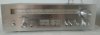
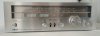
Akai AT-2650
Family tree
The AT-2600 was the top of the line Akai tuner, available from 1976 to 1979. Below it are the AT-2400 and AT-2200. The internals of these tuners are also found in the AA-00** series receivers of that time. The AT-2650 is the the top of the line model in the successieve series (1979). Below it are the AT-2450 and AT-2250. These tuners are build in to the AA-11** series receivers.
All of the above models and series where available in black and in silver face plate versions. Some models also came in an "L" version, accommodating radio reception in the LW bandwidth. Other option on some models where a channel pre-sets module, and a Dolby amp (only on receivers?)
Looks&feels
Both of these tuners are a joy, not least of all to look at! The 2600 has that iconic rounding around the tuning nob, giving it a kind of soft, slick-stylish look. The whole layout is very well balanced, although the tuning and signal meter look quite big compared to the tuning scale window. The scale is illuminated by three bulbs, stuck horizontally in to a piece of plexiglass, running over the scale. The meters have their own bulb, in a similar construction. The effect is a very smooth and well distributed soft light, that is just 'awesome' in the purest sense of the word.
The 2650 has a much larger scale window, and must have looked just so much more contemporary, back in '79. They seem to have taken some inspiration from that celebrated Pioneer-look there, but it is still very much an Akai. Note how the rounding along the tuning knob is still there, but in a kind of 'negative' form from the previous series. The meters are sunken into the frame now, leaving a more sophisticated impression. The scale is illuminated by only two bulbs, one in each corner. Yet somehow the light reflects all over the place and gets evenly distributed. Nice piece of engineering there!
Of course a good'old 70s tuner must feature a big, heavy, smooth running tuning wheel. And they both do! between the specimens I own, the 2650 runs a bit smoother, and roll's on longer after you let go of it. It also has these ribbons on the knob, that will give you more of an 'in control' feel then the smooth knob of the 2600. The later feels a bit more 'sticky' when turned, but that makes sense when you see the mechanics you're actually pulling with it. Another difference between the tuners is in the flip-switches. Those on the 2600 are clearly of a much higher quality. They "clunk" so satisfactory that you just got to stop yourself from doing it all the time.. Those from the 2650 are just okay. A bit odd looking on the silver-face version, but much better on the black one. One more difference that must be mentioned: the 2600 comes in a wood case, whereas the 2650 comes only with a metal hood (for as far as I know).
In all they are both stunningly looking, and inviting machines. Preference is a personal thing of course, but I got to say I like the looks&feels of the 2600 best.
Features
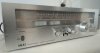
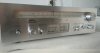
One might expect the newer model to have more bells and whistles, if only as a symbol of progress, but here it is the other way around. The extra features of the 2600 are a 'deviation' switch, an AFC indicator LED, and a fixed volume output, alongside the variable volume output. None of these would appear all that useful under normal circumstances, but nice to have right? I suppose the fixed output could be used to wire the tuner straight in to a recorder for instance. The deviation switch turns the signal strength meter in to a kind of 'output level' indicator. The AFC LED, well that's mostly decorative I guess.
A truly useful feature, found on most Akai tuners and receivers of this era, is the adjustable muter. Why didn't all brands put those in? It's great! Both tuners also offer some help to get ride of the hiss and such. The 2600 features a high blend filter. Mixing the high frequencies of both channels and reduce some of it, in order to drown out that distortion caused by poor stereo reception. The 2650 features 'noise reduction'. I'm not quite sure, but it looks like a more sophisticated version of the same thing. The effect of it is similar, but the loss in sound quality that the high blend filter causes, is also smaler with the noise reduction from the 2650. Then of course both models have a signal strength and tuning meter, AM, FM, FM-mono selector, output volume control, and the unavoidable "ON" switch.
Inside the machine
AT-2600 AT-2600 (detail) AT-2650
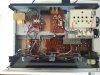
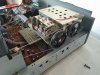

One difference that stands out is in the front end. At the 2600 they actually bothered to make completely separate carrousels for AM and FM. A 3-gang for AM and a 5-gang for FM. The 2650 also offers a 5-gang FM (from what I can tell) but in the same carousel as AM and with less adjustment options.
Performance
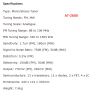

Let me just start out by saying both tuners perform great! In the above spec, taken from hifiengine, the 2600 shows a higher distortion in FM. Probably to do with the lesser quality electronic components. I remember after replacing components the tuner sounded noticeably clearer, louder and more detailed. So comparison is a bit uneven here, as the 2650 only got new elco's in the power supply, spark killers, bulbs and potmeter+switch treatment. Both selectivity and sensitivity are higher spec'ed for the 2600. I suppose that is the virtue of the more elaborate front end.
Well, I have been doing a lot of listening to both. Headphones on, skipping around the stations listening to pop (vocals), electronic music and of course a lot to that illusive classical music station. After a bit more ""fle-du-liep!" and "POM-POM-POM!" then I usually keep up with, I feel I'm ready to report now.
Reception on the 2650 is really impressive. T-wire indoor antenna or just a wire; the signal meter slams out nearly all the way at over ten stations. Locks in, doesn't drift and meters don't move. It's also very well adjustable. Even with excellent reception however, there is a pinchy bit more noise in the silences from the 2650 then from it's predecessor. not so much hiss, but more irregular noise. Perhaps the limits of it's selectivity? But you need to catch an absolute silence and crank the volume to actually notice. The 2600 does about equal at reception. The signal meter slams out les, but reception is still good on stations with the signal meter hanging halfway. This one doesn't drift either, at all. The signal meter is a bit more prone to wobble around with the music volume, but not much. There is hardly any hiss in the silences, and absolutely no other noise at all. On less well received stations the 2600 is more sensitieve to stereo-decoding errors. The high blend function resolves that quite effectively, but at the cost of some of the "space" and liveliness in the sound. Maybe alignment could still improve that.
As for the sound: they both put up an enormous stage! As it is here, the 2600 sounds a bit more dynamic and detailed. Must be the replacement components. It's most noticeable when listening to classical music. On electronics music the 2650 appears to actually sound smoother. Either way both of them sound pretty good to me!
 that has turned out a long story...
