• Please note that Audiokarma will be offline briefly for updates early on Monday morning, September 28th.

Computer cooling fan for tubes... got one, but...

It has a noise rating of 16 dBA at 54CFM, so it is about as quiet as it gets. Hence the name "Silent Wheel"
Thanks Richard. I shopped for my fan at a well stocked store that is exclusively for computer building. There was a large rack of fans from different makers and another for filters and another for ... anything connected with fans. But I never saw one rated this quiet! I'll be looking out for this.

It comes to mind that the electrical and motor components are not the only parts that must be engineered for quiet running. The pitch, curve and scoop of the blade would have to be carefully engineered in order to reduce the sonics of forced air — and could this be in the same realm as the science of designing turbine blades for aircraft jet turbines? I daresay yes, and this application may be finally benefiting from a trickle-down of of the technology that has revolutionised jet turbines.
 
Does anyone here have any experience using multiple fans wired in series? This may sound crazy at first, but the reality is that you can add more fans to in effect slow/quiet things down, while maintaining good cfm air exchange, works well in my pro sound racks and the reduced air velocity keeps the dust collection down.

i agree with others on this thread that the use of fans in close proximity of tubes is a noise related no no. In RF applications where large output tubes are forced air cooled, the fan/blower is located some distance from the output tube/s and the air is effectively ducted where it's needed.
 
There is also that age old question-Do you blow into the enclosure or out of the enclosure? Forced induction or induced induction? Does blowing air onto one side of the glass tube cause a temperature differential that creates undue stress on the envelope?
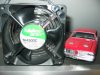
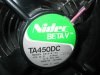
Great thread!! One thig I love about audio nuts(including myself) is the fact that they can inject the greatest complexity into the simplest of projects. Check out this finger chopper in the pics - blades designed by NASA!! :lmao:
 

Attachments

  • IMG_9016.JPG
    IMG_9016.JPG
    110 KB · Views: 11
  • IMG_9017.JPG
    IMG_9017.JPG
    98.3 KB · Views: 6
  • IMG_9019.JPG
    IMG_9019.JPG
    97.5 KB · Views: 13
Lorne,
The Thermaltake "silent wheel" is $13.00 at TigerDirect.com and here is the Item #: T925-2184. This is a large fan and it turns slow, so it moves a large volume of air without the noise. I hope there will be more attention paid to quiet air flow.

Bowtie427ss,
I have hooked 120 VAC fans in series, but they won't always share equally. The air flow is greatly reduced, and some fans won't even start on 60 V. (or will just slow down and stop after a while)


Rickon66,
I think either blowing into or pulling air out of a hot spot needs carefull design to reduce and equalize hotspots. I like the tube amp design that pressurizes the underside of the chassis and has several holes drilled around the largest tubes. Each tube gets several streams of cool air.

Richard C.
 
Thanks Richard. I've made a note.

In regards to my experience with SS gear — where I am living is very humid in the summer and my SS amp boxes cook. One of them is a big Pioneer that drives the family AV/TV system for hours of a tropical type day. I've looked for the easiest and most expediant (lazy) solution and have come to the idea that if I aimed the air stream primarily on the transformers, it would sufficiently relieve the rest of the circuit of thermal stress. This might be an answer to the differential problem in tube envelopes or hot spots.

An under-chassis, pressurized air distribution system that Richard has suggested seems like an excellent solution. If anyone knows of an example that we can visit on the net, I for one am interested.
 
Back
Top Bottom