

You are using an out of date browser. It may not display this or other websites correctly.
You should upgrade or use an alternative browser.
You should upgrade or use an alternative browser.
Constant Directivity Cornerhorns
- Thread starter Wayne Parham
- Start date


I'd think the little full range driver would be a waste of effort if you were going to employee a 2" compression driver on something like one of your horns.
It is. My thought was to make a larger version with a 8" or 10" woofer(s) for the midbass, then cross to my horns up top.

Wayne Parham
Active Member
I've run a lot of variants over the years, and some with direct radiating mids, much like a full range speaker. My thinking was that corner placement would confine the pattern even though the sound source was acoustically distant from the walls at the upper end of the mid/full driver passband. This is true, of course, but it is also true that adding a midrange horn that sets directivity at the upper end side-steps the problem because it keeps the beamwidth within the wall angle. At low frequencies (from Schroeder up), the pattern is set by the room corner wall angle and at higher frequencies, by the mid/high horn/waveguides.
Constant directivity also requires proper sound source placement and crossover phase. It's not just a matter of the directivities of each individual source, but also of their interaction. Summing between sources in the crossover region sets the position of the vertical nulls. That's why you can't use a Klipschorn bass bin, because its path length prevents constructive summing through the crossover region. Constant directivity requires the forward lobe to be clean, i.e. properly phased for constructive summing.
Constant directivity also requires proper sound source placement and crossover phase. It's not just a matter of the directivities of each individual source, but also of their interaction. Summing between sources in the crossover region sets the position of the vertical nulls. That's why you can't use a Klipschorn bass bin, because its path length prevents constructive summing through the crossover region. Constant directivity requires the forward lobe to be clean, i.e. properly phased for constructive summing.

skywave-rider
Slumming in Akihabara
Wayne, this is a bit OT, but I am thinking of using your mid horn for a 3 way with direct radiator LF, because perfect corners are not available for the location. Any conceptual problems with that apart from the need to modify the crossover? Unfortunately I am away from my cone area vs directivity chart.

Spectrum77
Super Member
Anecdotal evidence only- used 4 Pi bass cab (2226H) with 7 Pi mid horn and HF. No discernible abnormalities, sounded great....thinking of using your mid horn for a 3 way with direct radiator LF...
Below are 7 Pi, finished 12 months ago. Still in nasty MDF- can't bear to have them out of service.

skywave-rider
Slumming in Akihabara
Awesome!
I see you are awake same time as I am...currently in Tokyo.
Back to NY Thurs.
How did you mount the HF horn?
I see you are awake same time as I am...currently in Tokyo.
Back to NY Thurs.
How did you mount the HF horn?
Spectrum77
Super Member
Tokyo- on business?Awesome!
I see you are awake same time as I am...currently in Tokyo.
Back to NY Thurs.
How did you mount the HF horn?
HF just in a simple MDF box. Crossovers also in separate boxes.
In comparison to the midhorn, the LF enclosure was a piece of piss. Made both in a day. The difference with the rear-firing woofer VS forward was not so great- though it seemed that bass was smoother, tighter and mids improved.
If you're considering building these, don't hesitate. PM for a link to detailed build description(s) of these speakers.

Russellc
Addicted Member
Wayne, this is a bit OT, but I am thinking of using your mid horn for a 3 way with direct radiator LF, because perfect corners are not available for the location. Any conceptual problems with that apart from the need to modify the crossover? Unfortunately I am away from my cone area vs directivity chart.
This is exactly what I've wanted to do for some time. I can recall a few doing it with 4 Pi, about the same as E'wave...
Russellc
Russellc
Addicted Member
Anecdotal evidence only- used 4 Pi bass cab (2226H) with 7 Pi mid horn and HF. No discernible abnormalities, sounded great.
Below are 7 Pi, finished 12 months ago. Still in nasty MDF- can't bear to have them out of service.
What waveguides are those on top?
Russellc

How about...
...modding EV Aristocrats for this prupose?
I also have a set of those that could be hot rodded....:scratch2:
...modding EV Aristocrats for this prupose?
I also have a set of those that could be hot rodded....:scratch2:
Wayne Parham
Active Member
Acoustic Scale
You can use the midhorns for other applications besides a constant directivity cornerhorn, yes. Some have done that, putting a midhorn on top of four π's, for example. It's a good midhorn, and could be used in a variety of applications.
But I always try to remind people that the horn was really designed for use in a constant directivity cornerhorn. That's where the magic is. While it can be placed on top of a direct radiating midwoofer, crossed-over to a waveguide/horn tweeter, I probably wouldn't do that, myself. If I don't have the right corners, I'll stick with a DI-matched two-way. Here's why:
It's all a matter of acoustic scale.
At low frequencies, the woofer is within 1/4λ of the walls and there is no self-interference from reflections. There are room modes, standing waves between opposite walls, but that's below the Schroeder frequency, under 150Hz or so. From this point up to where the woofer is 1/4λ away from the walls, the corner forms a giant waveguide. That's also why you turn the woofer around, snug it back into the corner. It needs to be close enough to the walls to be within 1/4λ through its range.
At high frequencies, the horn/waveguide sets the pattern. If you use a horn with constant 90˚ horizontal beamwidth, then the high frequency pattern matches the low frequency pattern. You can obtain directivity that is truly constant through the whole audio band, from the Schroeder frequency up. With multisubs smoothing the modal range, you can actually achieve uniformity throuout the room through the entire audio band. It's really awesome.
Think of the midhorn as an interface, between the low frequencies where the woofer is closer than 1/4λ and the high frequencies where the tweeter takes over. The midhorn is designed to be used in the 200Hz and 2kHz decade but its real strength is that it prevents self-interference from occuring. It's just large enough to set the pattern from about 500Hz up if it were used in freespace, but tucked back into the corner, it keeps control all the way down. The mouth is closer than 1/4λ at the low end, and so there is no self-interference. And above that, the midhorn profile sets the pattern, providing a constant 90˚ beamwidth to match that of the tweeter.
You can use the midhorns for other applications besides a constant directivity cornerhorn, yes. Some have done that, putting a midhorn on top of four π's, for example. It's a good midhorn, and could be used in a variety of applications.
But I always try to remind people that the horn was really designed for use in a constant directivity cornerhorn. That's where the magic is. While it can be placed on top of a direct radiating midwoofer, crossed-over to a waveguide/horn tweeter, I probably wouldn't do that, myself. If I don't have the right corners, I'll stick with a DI-matched two-way. Here's why:
It's all a matter of acoustic scale.
At low frequencies, the woofer is within 1/4λ of the walls and there is no self-interference from reflections. There are room modes, standing waves between opposite walls, but that's below the Schroeder frequency, under 150Hz or so. From this point up to where the woofer is 1/4λ away from the walls, the corner forms a giant waveguide. That's also why you turn the woofer around, snug it back into the corner. It needs to be close enough to the walls to be within 1/4λ through its range.
At high frequencies, the horn/waveguide sets the pattern. If you use a horn with constant 90˚ horizontal beamwidth, then the high frequency pattern matches the low frequency pattern. You can obtain directivity that is truly constant through the whole audio band, from the Schroeder frequency up. With multisubs smoothing the modal range, you can actually achieve uniformity throuout the room through the entire audio band. It's really awesome.
Think of the midhorn as an interface, between the low frequencies where the woofer is closer than 1/4λ and the high frequencies where the tweeter takes over. The midhorn is designed to be used in the 200Hz and 2kHz decade but its real strength is that it prevents self-interference from occuring. It's just large enough to set the pattern from about 500Hz up if it were used in freespace, but tucked back into the corner, it keeps control all the way down. The mouth is closer than 1/4λ at the low end, and so there is no self-interference. And above that, the midhorn profile sets the pattern, providing a constant 90˚ beamwidth to match that of the tweeter.

doucanoe
Registered Audio Abuser
Hey Wayne,
Like I was saying earlier, I have the "corners" but my room is less than ideal (11'-6" front wall x 11'-0") or there abouts.. It opens to the living area with a 8'-0" pass thru on a side wall.
If I decide to proceed with a 7pi system, would there be any way to reasonably change (shorten up) the dims (height) of the LF horn section to allow for a closer listening position?
I'd like to go ahead with this but am concerned about overall height of a 7Pi, also, how well this would even work in here obviously.
Thanks, RC
Like I was saying earlier, I have the "corners" but my room is less than ideal (11'-6" front wall x 11'-0") or there abouts.. It opens to the living area with a 8'-0" pass thru on a side wall.
If I decide to proceed with a 7pi system, would there be any way to reasonably change (shorten up) the dims (height) of the LF horn section to allow for a closer listening position?
I'd like to go ahead with this but am concerned about overall height of a 7Pi, also, how well this would even work in here obviously.
Thanks, RC
Wayne Parham
Active Member
You know how it is with mods. When you deviate, unintended consequences can come up. The cabinet dimensions and placement of the woofer and port set the internal standing waves and how they line up inside. So you can have the Helmholtz frequency right, but get a peak in response from pipe modes. You can also change the shape of the forward lobe, and where the vertical nulls fall. Those are the kinds of things to watch for when making modifications to a known loudspeaker design of this type.
That said, of course, you can do a lot with this basic configuration. The computer modeling tools that are available make it possible to do a lot of "what-if" scenarios, and to get a pretty good design on the table before ever even cutting wood. Then build it and make measurements of a physical model to verify.
That said, of course, you can do a lot with this basic configuration. The computer modeling tools that are available make it possible to do a lot of "what-if" scenarios, and to get a pretty good design on the table before ever even cutting wood. Then build it and make measurements of a physical model to verify.
Spectrum77
Super Member
G'day Russell,What waveguides are those on top?
Russellc
That's Eminence H290 from Parts Depress.
http://www.parts-express.com/pe/showdetl.cfm?Partnumber=290-554
BTW, Wayne has flat packs available for the midhorn. Wood (sic) make construction a breeze.
doucanoe
Registered Audio Abuser
You know how it is with mods. When you deviate, unintended consequences can come up. The cabinet dimensions and placement of the woofer and port set the internal standing waves and how they line up inside. So you can have the Helmholtz frequency right, but get a peak in response from pipe modes. You can also change the shape of the forward lobe, and where the vertical nulls fall. Those are the kinds of things to watch for when making modifications to a known loudspeaker design of this type.
That said, of course, you can do a lot with this basic configuration. The computer modeling tools that are available make it possible to do a lot of "what-if" scenarios, and to get a pretty good design on the table before ever even cutting wood. Then build it and make measurements of a physical model to verify.
Your are correct there for sure. I think I may have figured out a way to get around it. Not to change or deviate, but accommodate.
RC
Wayne Parham
Active Member
One thing about cornerhorns, they really tuck away. You can put a whole lot of speaker in the corner without seeming like it takes over your room.
Russellc
Addicted Member
G'day Russell,
That's Eminence H290 from Parts Depress.
http://www.parts-express.com/pe/showdetl.cfm?Partnumber=290-554
BTW, Wayne has flat packs available for the midhorn. Wood (sic) make construction a breeze.
I have a pair of those! In the pick it looked somewhat taller than the H290. Thanks for the response.
Russellc
Wayne Parham
Active Member
As an aside, the Parts Express website lists the H290 as a "BiRadial" horn. It is not. BiRadial is a JBL trademark. Probably just splitting hairs, but I thought it was worth mentioning.
Wayne Parham
Active Member
On one of these threads (can't seem to find it now), you guys were talking about looking for waveguides suitable for replacement of discontinued models.
Just a thought - Have you ever considered making them yourselves? Something like this:
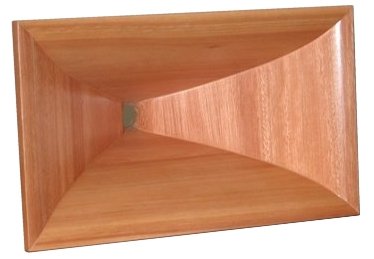
I realize it's out of reach of the average DIYer because it requires CNC. But the flare profile is pretty simple, and you could probably arrange a group deal with a shop somewhere. Might even be someone here that has a CNC and would be willing to make them for you.
My waveguide is basically straight sided, with caternary to match the 8° compression driver exit to the 90° (horizontal) flare profile. The last inch is radiused (ala tractrix) to remove a sharp mouth edge. The top and bottom walls are essentially the same, but the 8° entrance angle is only (caternary) radiused to 50° in the vertical. It is also radiused at the mouth in the vertical, in my opinion, more important since this is the shorter section.
Anyway, you can see the basic profiles are kind of simple. It's mostly a matter of CNC setup and assembly. The hardest problem we faced, actually, is having a mechanism to hold the parts while the CNC machine cuts them - something rigid enough to prevent movement during cutting but easy to remove accurately and consistently after the cutting operations are done. It is almost like a riser for a mold, something you cut off afterward and throw away.
Just a thought - Have you ever considered making them yourselves? Something like this:
I realize it's out of reach of the average DIYer because it requires CNC. But the flare profile is pretty simple, and you could probably arrange a group deal with a shop somewhere. Might even be someone here that has a CNC and would be willing to make them for you.
My waveguide is basically straight sided, with caternary to match the 8° compression driver exit to the 90° (horizontal) flare profile. The last inch is radiused (ala tractrix) to remove a sharp mouth edge. The top and bottom walls are essentially the same, but the 8° entrance angle is only (caternary) radiused to 50° in the vertical. It is also radiused at the mouth in the vertical, in my opinion, more important since this is the shorter section.
Anyway, you can see the basic profiles are kind of simple. It's mostly a matter of CNC setup and assembly. The hardest problem we faced, actually, is having a mechanism to hold the parts while the CNC machine cuts them - something rigid enough to prevent movement during cutting but easy to remove accurately and consistently after the cutting operations are done. It is almost like a riser for a mold, something you cut off afterward and throw away.