• The move to the new server is done. There are some software and database maintenance updates in process. This has us passing the hat around to help out. We appreciate any donations. Seriously, even a dollar helps. The payment page may be found here - https://www.audiokarma.org/support.html

Converting Hammond Amp to Guitar Amp.

Codojimbodie

New Member
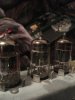
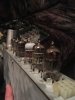
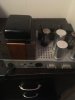
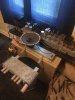
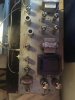
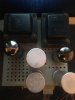
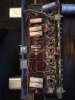
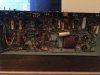
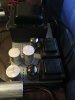
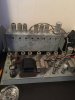
I recently have acquired a H-AO-70-1F as well as the H-AO-71-1 power supply along with the H-AO-72-0 reverb amp/reverberation unit. I have never messed around with tubes or much electrical components before this but am an avid guitar player and have become intrigued as to how I can turn this into a good guitar amp! Any tips or pointers would be greatly appreciated! Thanks
 

Attachments

  • A3B8EB47-EF2C-4E73-B769-BA83D800DE37.jpeg
    A3B8EB47-EF2C-4E73-B769-BA83D800DE37.jpeg
    82.4 KB · Views: 42
  • 15C9D509-88BE-48A7-A1E3-7B5F8820644F.jpeg
    15C9D509-88BE-48A7-A1E3-7B5F8820644F.jpeg
    74.9 KB · Views: 33
  • 7ADB6286-B831-408E-A3C9-C553178F439E.jpeg
    7ADB6286-B831-408E-A3C9-C553178F439E.jpeg
    75.7 KB · Views: 34
  • image.jpg
    image.jpg
    55.9 KB · Views: 33
Register to hide this ad
Hi, in my opinion, that's not really a good candidate for a guitar amp. What you have is a multi channel amplifier. Looks like it uses four 6BQ5 tubes in which two are being used in push push pull for one speaker and the other two are also being used in push pull for another speaker. These two channels could have the same specs and could possibly be used as a hi fi stereo amplifier with a bass channel.

It also looks like the other channel (possibly the bass channel) is being driven by two 7591 tubes in push pull.

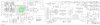
You would need a schematic and a proper understanding of the circuit to convert this to a guitar amplifier. Certain gain stages would be needed plus you would need to swap out the output transformer(s) to get your guitar sound. Maybe not but then again, I am not a guitar player.
 
Need the schematics, but I generally agree its not really great as a direct conversion. Parts source for a completely different build could work though. I'd probably make it a single-chassis rig too just for convenience. It won't need nearly so many parts to be a single channel instrument amp.

If this has a pair of matching 6bq5 transformers, turning that part into a stereo amp would leave you with the 7591 (?) channel, and that might work out nicely as a guitar amp.
 
B97325F6-3ED1-4F60-B1AF-4B1F782854B4.jpeg B97325F6-3ED1-4F60-B1AF-4B1F782854B4.jpeg B97325F6-3ED1-4F60-B1AF-4B1F782854B4.jpeg This has been definitely taking up most of my brain power and energy lol. My hopes is to use what I can out of everything and make a nice single channel guitar tube amp and then see about creating a high gain pre amp pedal possibly?
 

Attachments

  • image.jpg
    image.jpg
    111.7 KB · Views: 18
  • image.jpg
    image.jpg
    92.1 KB · Views: 16
  • image.jpg
    image.jpg
    68 KB · Views: 15
I've taken a number of tube pa-type amps and converted them to guitar amps. Usually I leave the output stage more or less the same but rework/revise the gain stages and tone stack. I've mostly used plans for the preamp and tone stack stuff from ax84(dot)com. I think an archive of that exists but the current action is on a new site/forum.
 
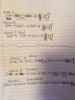
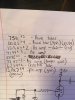
So I have been studying different configurations I could use and I have written down what I think I am gonna convert the 3 channels to. The tube configuration on top is the amps original and my new proposed configuration is on bottom. I’m still unsure and curious as to how and put the reverb driver and unit into the mix and what to do for the power supply. Is there a way I can not have to use the giant separate transformer and GZ34/5AR4 rectifier tubes? Thanks!
 

Attachments

  • 0EBA39DA-61AD-427F-A468-F8347831D0DF.jpeg
    0EBA39DA-61AD-427F-A468-F8347831D0DF.jpeg
    98.9 KB · Views: 21
  • 1A103269-DE7B-407C-ABA6-D23070710FEE.jpeg
    1A103269-DE7B-407C-ABA6-D23070710FEE.jpeg
    96.2 KB · Views: 19
  • B7658CF5-235D-43C9-872C-495F310D946C.jpeg
    B7658CF5-235D-43C9-872C-495F310D946C.jpeg
    132.8 KB · Views: 18
  • 6A0674D2-DA9B-4D41-9844-64E1A9B30CF5.jpeg
    6A0674D2-DA9B-4D41-9844-64E1A9B30CF5.jpeg
    114.1 KB · Views: 18
  • F6453739-3D09-43C6-98F1-D1281EBB9720.jpeg
    F6453739-3D09-43C6-98F1-D1281EBB9720.jpeg
    87.9 KB · Views: 19
That's more than 3 channels, that is three separate amplifiers sharing one power supply. Besides the need for three separate speakers to use the amps, it is much more than you need for a first tube amp project. I have been where you are now and I would have learned a lot more easily if I had started with a one channel, single power tube amp. Like a Champ or Princeton circuit (or the P1 at AX84.com, as whoaryu99 mentioned). . Once you get the building blocks in an amp like that, you will be in a better position to decide what you might want next with the Hammond. And...... they can sound terrific.

Most of the marketing for guitar amps is around features, variety, more is better, etc. As a builder that translates into more troubleshooting, more potholes to step in, and generally more potential for frustration. I realized I would rather have one great sounding tone that a whole lot of okay tones, and this can be done very satisfactorily with a simple amp.

My 3c worth :)
 
Last edited:
I've taken a number of tube pa-type amps and converted them to guitar amps. Usually I leave the output stage more or less the same but rework/revise the gain stages and tone stack. I've mostly used plans for the preamp and tone stack stuff from ax84(dot)com. I think an archive of that exists but the current action is on a new site/forum.

I just restore these amps to more-or-less stock. And use pedals to get the final tone(s) you are after. The irons in these vintage amps are worth their weight in gold.
 
Conversion of Hammond amps for guitar is well documented on the net. The stuff the OP has is not what is typically used and is way more complex than is needed. There's enough in there to make several other simple amps. The iron and tubes are worth more than any resulting guitar amp would be.

By the time you get a guitar amp out of it there's going to be a pile of parts and a largely empty chassis that's too big and awkward for practical use as a guitar amp. The OP could likely deal that gear and end up with a much better candidate for the project while making enough profit to fund the guitar amp build. My 2 cents.
 
Back
Top Bottom