• The move to the new server is done. There are some software and database maintenance updates in process. This has us passing the hat around to help out. We appreciate any donations. Seriously, even a dollar helps. The payment page may be found here - https://www.audiokarma.org/support.html

Cornscala Style D Upgrades? Sound Quality Improvements, Finishes?

intelonetwo

New Member
Hello, I have a pair of Cornscala Style D 2-way speakers from Bob Crites. (I would like to squeeze some more sound quality out of them if possible. I am NOT unhappy with the sound quality I am getting from the speakers, but I would like to hear what others have done to get the last bit of sound quality out of their Cornscala D's?

Also, as mine are unfinished, I would like to see some differences you have used (I've search the web and seen other finishes but I thought I'd start a fresh tread for recent finish work.)

Here is a quick run down of my system. Auralic Aries Mini --> Alamarro A318B --> Cornscala D's.
 
Last edited by a moderator:
Register to hide this ad
installing good brace work into a cabinet and interconnecting all the braces with strapping will yield an much more rigid enclosure. you have not provided any background nor discussed what it is that fails to impress you? You have an 18 watt per channel SET and I would expect these speakers to do much better with more power than that remember these are not Cornwall loudspeakers which would do reasonably well with 18 watts per channel. The drives and horn are all top quality I would leave those alone and look to perhaps playing with capacitors and inductors but that is not for most folks and it can get very expensive.
 
installing good brace work into a cabinet and interconnecting all the braces with strapping will yield an much more rigid enclosure. you have not provided any background nor discussed what it is that fails to impress you? You have an 18 watt per channel SET and I would expect these speakers to do much better with more power than that remember these are not Cornwall loudspeakers which would do reasonably well with 18 watts per channel. The drives and horn are all top quality I would leave those alone and look to perhaps playing with capacitors and inductors but that is not for most folks and it can get very expensive.
Moray,
Thanks for the reply. Sorry for the confusion. I reread my post and realized I left out the word NOT. I've made the correction.

I meant to say I am NOT unhappy with the sound quality. I'm just looking for tweaks to make them sound even better than they already do,
 
well the brace work is always a good investment especially in such large cabinets. Experiment with some more powerful amplifiers and see what you think. I would say a very solid 50 -100 watts per channel. I use dynamat and F-11 Acoustical felt to damp inside my drivers. You could look into that but I find most folks don't feel comfortable going there. As I said before caps do make a difference but that is a very expensive and time consuming game. if necessary raise your speakers so the centre of your horn is at your seated ear level. good luck. moray james.
 
SET amps are not the best choice for controlling woofers. The low damping factor and high harmonic distortion show up easily on great speakers. So I would either bi amp and choose a great SS amp with a very high damping factor for the woofer. Or replace the amp all together. You will have to use an Electronic crossover if you bi amp. . The next thing I might try is a tweeter, but if you enjoy a smooth laid back high end above 7,000 hz I would leave well enough alone. Changing room location of the speakers and listening position can totally change the balance of the system. So experiment.
 
there is a simple dirt cheap tweak that you can experiment with if you like. The single biggest problem that horns have (all of them) are reflections especially those from the mouth back into the throat. You can take a ping pong ball and tape a length of thread to it so you can position and hang it in the horn. You want o get the ball as close into the throat as you can to block reflections. Don't worry about blocking the throat so long as you have some gap the waves simply slide around the ball. It is easy to tell when you have it right vs when you are too close to the throat. The closer you can position to the throat the more reflections you will catch and bounce back out. What you will hear is smoother response, more extended response (better and more extended high end response) which results in much improved stage and image qualities. When you find the right position you can make the balls black with a marker or some spray paint and hard mount then any way you like (tooth picks and glue). I think that you will be quite surprised with how well this works. This is an idea that I came up with years ago and it had worked in every horn that I have tried it in.
 
there is a simple dirt cheap tweak that you can experiment with if you like. The single biggest problem that horns have (all of them) are reflections especially those from the mouth back into the throat. You can take a ping pong ball and tape a length of thread to it so you can position and hang it in the horn. You want o get the ball as close into the throat as you can to block reflections. Don't worry about blocking the throat so long as you have some gap the waves simply slide around the ball. It is easy to tell when you have it right vs when you are too close to the throat. The closer you can position to the throat the more reflections you will catch and bounce back out. What you will hear is smoother response, more extended response (better and more extended high end response) which results in much improved stage and image qualities. When you find the right position you can make the balls black with a marker or some spray paint and hard mount then any way you like (tooth picks and glue). I think that you will be quite surprised with how well this works. This is an idea that I came up with years ago and it had worked in every horn that I have tried it in.

I was going to try this once but, didn't have a basketball handy... :D :eek: :D
 
Hey Coytee: the speed bumps on the sides of your K402 (toward the mouth) are there to catch reflections in the same way and bounce them out away from the throat. You use a two inch exit driver so you don't need a very big reflector. I know that this idea seems counter intuitive but when you get the ball in the right place the improvement in smoothness and clarity is amazing. You can then expect much improved stage and image and lower overall distortion less smear would be a good description of the effect. Regards moray james.
 
Do you mean the 'mumps'?

If so, the K402 doesn't have the mumps, only the new 510.

If not, then I'm yet again displaying my ignorance... o_O
 
Do you mean the 'mumps'?

If so, the K402 doesn't have the mumps, only the new 510.

If not, then I'm yet again displaying my ignorance... o_O
no not mumps though you could install some diy mumps with Plasticine. The is a subtle broad speed bump vertical on the side walls (not sure if the top and bottom wall have then they probably do it s frequency issue so distance out from the throat determines where and it will reflect but when the wall angle is different the position or curvature will differ to compensate. They are essentially just curved reflectors and you dont need much of a curve o shift the bounce. Many of the newer horns by Klipsch incorporate them. Take a close look.
 
Have to try the ping pong ball. If I read this correctly it's on the outside, behind the grill's?
 
The is a subtle broad speed bump vertical on the side walls (not sure if the top and bottom wall have then they probably do it s frequency issue so distance out from the throat determines where and it will reflect but when the wall angle is different the position or curvature will differ to compensate. They are essentially just curved reflectors and you dont need much of a curve o shift the bounce. Many of the newer horns by Klipsch incorporate them. Take a close look.

Gotcha.

To me, a speed bump isn't as subtle as a dead bug on the road.... I know of the transition point you refer to, just never looked at it as a speed bump since it's so subtle.

If memory serves me (and I very well could be wrong....but I THINK it's the K402 he was talking about...)

Roy told of a story once where they sent the data out to build a new prototype horn. The people that manufacture them looked at the data, noticed a 'bump' in the curve....and 'fixed' it.

Roy got his prototype back and they were pretty tickled with themselves for having caught his 'mistake' and fixing it for him.

I guess their smile got turned upside down to a frown when they had to make another one and this time, WITH the bump that he clarified to them, was not a mistake.

oops!!
 
Have to try the ping pong ball. If I read this correctly it's on the outside, behind the grill's?

inside of the horn. there are two types of ping pong balls a non official size and the official size, the non official is a little bit smaller than the official I use a non official sized ball in my K79 tweeters I just wrap a narrow piece of electrical tape around it so it will friction fit snugly into the horn walls and I place a small piece of F-11 acoustical felt on the back side (3/8" dia 1/8" thick) of the ball facing the throat. I also use some 25 ppi open cell foam between the start of the throat and the ball. I use the slightly larger official ball in the K700/701 and other Klipsch home horns (klf20 Forte ll and cf3). I use the 25 ppi open cell foam in the throats of all my horns and also in my Karlson K-Tubes. I use the 25 ppi open cell foam in the throats off all my horns and also in my Karlson K-Tubes as well. Hope this helps.
 
Last edited:
Thanks moray. I was way off base. Could have sworn I heard improvements. I'll have to sit and ponder your explaination for a while and try and get this figured out.

Good for laugh
 
Thanks moray. I was way off base. Could have sworn I heard improvements. I'll have to sit and ponder your explaination for a while and try and get this figured out.

Good for laugh
actually if you follow the same idea only larger you can clean up a lot of cross cone cancellations and additive wave fronts and clean up the upper end response as the woofer hands over to the mid horn so don't laugh too hard.
 
Hello, I have a pair of Cornscala Style D 2-way speakers from Bob Crites. (I would like to squeeze some more sound quality out of them if possible. I am NOT unhappy with the sound quality I am getting from the speakers, but I would like to hear what others have done to get the last bit of sound quality out of their Cornscala D's?

Also, as mine are unfinished, I would like to see some differences you have used (I've search the web and seen other finishes but I thought I'd start a fresh tread for recent finish work.)

Here is a quick run down of my system. Auralic Aries Mini --> Alamarro A318B --> Cornscala D's.

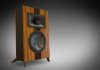
How about the visuals of the all new klipsch Fifteens? That would look nice on a Crites Cornscala "D".
 

Attachments

  • Klipsch The-Fifteens.jpg
    Klipsch The-Fifteens.jpg
    37.4 KB · Views: 96
If you read my thread a few threads below on my RF-25's you can follow through with some of the things I've done, they will help. I would HIGHLY recommend putting Dynamat or MOJO mat on the back sides of the horns, that was a huge improvement. As for your amp, I use SET amps and would have a very hard time moving away from that technology. Your speakers are very efficient, around 100db I would guess so amps shouldn't be a big deal. Experiment with wire first. the CAT5 braids I made were a big improvement over the monster cable I had before. The Plitron OPTs on my amps also provide very tight base control but are expensive. I've looked at building Cornscallas as well. These days those big woofers aren't really the ticket. The physics of something that large and keeping it in control will never be as good as a smaller cone with neodymium magnets and good crossovers. My trip out to the Denver Audio show last fall listening to many many different amp and speaker combinations proved to me that 8" is about all you would ever want for good tight bass. BTW most of those guys weren't using subs either. That thunder in the bass comes from quality components not size.
 
Back
Top Bottom