
• The move to the new server is done. There are some software and database maintenance updates in process. This has us passing the hat around to help out. We appreciate any donations. Seriously, even a dollar helps. The payment page may be found here - https://www.audiokarma.org/support.html

Crossover 101: Advice Needed for Luddite with Aspirations

As much as I hate to do this, I have a newbie question that I'm gonna guess will garner a plethora of condescending replies.. So be it.. I'm tired of not knowing how to do this..

I'm one of those audiophiles who simply doesn't understand how to adjust a crossover.. I pretty much know what they do and how they do it, but even after reading numerous explanations here at AudioKarma and other places, I'm still don't know where to physically start. I'm one of those people who needs things 'splained to me like I'm a chimp on 'ludes.... but once I eventually understand... It'll stick with me forever... It's just that initial "aha!" moment that I need. Let me lay out the exact scenario...

I just bought a used pair of speakers and I'm about to hook them up to my vintage amp and use two subs. ... Pretty sure the model and brands are irrelevant.. If they are... let me know.

The plan is simple and I've done it many times..... I will run my left speaker wire from my amp to the back of my left subwoofer... Then run another speaker wire from my sub to one of the new speakers... Simple easy..

However.. I do NOT know how to set the Low Pass Crossover on the sub. As you can see in the pic, the knob goes from 80 to 160hz. The frequency range of the speakers is 30Hz-20kHz..

So, using those numbers, is there an initial setting I should make on that filter? and why?.. Just need a simple answer and explanation using simple words.
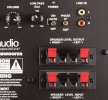
 

Attachments

  • polk-audio-PSW10-back-side-features.jpg
    polk-audio-PSW10-back-side-features.jpg
    149.2 KB · Views: 20
Register to hide this ad
I*d start the sub crossover around 50HZ and go from there. Unless you have an spl meter, it's pretty much adjust by ear. The tendency is to adjust for too much bass. Just be judicious and not overdue it.
 
The practice of starting with the lowest crossover point, and slowly moving upward to see if there's improvement, is usually valid. As is starting with low output level, and only increasing output, until the sub "blends" with the main speakers- the idea is to make it where you don't "notice" that the subwoofer is on (it doesn't draw attention to itself), but you DO notice when you turn it off (the low bass "disappears" markedly).

Starting with the lowest frequency, then adjusting the output level upward until you start to "notice" it, then trying reversing the phase switch (if the bass increases, leave the phase switch reversed and re-adjust the level again, if it decreases, then go back to the first phase setting), then trying increasing the frequency slightly, usually works fine.

Regards,
Gordon.
 
Now, i'm no engineer. Heck, i'm not even a good reader.

But, i'm pretty sure the OP said the following: "As you can see in the pic, the knob goes from 80 to 160hz."

So, could you please indulge my curiosity and explain how he's going to set the sub crossover @ 50hz? ;)
I misread the OP. Do you suppose being drawn and quartered would be suitable punishment?
 
Subtlety is your friend here. A well set-up sub should not be noticed until it is. If that makes sense. It really is for filling in the very bottom but it is easy to get carried away.

I agree with al the instructions in post #4 so I won't repeat it all.
 
Do you run it in a home theater set-up? The THX standard is 80 Hz.

Do you run it from a dedicated subwoofer output from your preamp/integrated/receiver? If so, that will also have a setting and you will be setting a setting on a setting so may not end up with the setting that you think you are setting.
 
Your subwoofer may have a high pass crossover when you use the speaker level inputs (like you plan on doing). Just something to consider.

I found best results using a frequency sweep on youtube and a db meter. Get it close and tune to taste.
 
Do you run it in a home theater set-up? The THX standard is 80 Hz.

Do you run it from a dedicated subwoofer output from your preamp/integrated/receiver? If so, that will also have a setting and you will be setting a setting on a setting so may not end up with the setting that you think you are setting.
No... No home theatre set up... I listen to TV or movies with headphones due to my hearing problems 100% of the time....
and my amp is vintage 70s... no ports for subs.. Back then subs were an anomaly... Today I run my subs directly from the speaker ports..
 
Your subwoofer may have a high pass crossover when you use the speaker level inputs (like you plan on doing). Just something to consider.

I found best results using a frequency sweep on youtube and a db meter. Get it close and tune to taste.
That's actually good advice. I didn't even know that was a "thang."... No access to Youtube where my system is set up today, but we're moving to a new house within the next few weeks or so and I'll have a dedicated sound room with TV so I can try the YouTube test.. Thanks for the suggestion...:rockon:
 
The practice of starting with the lowest crossover point, and slowly moving upward to see if there's improvement, is usually valid. As is starting with low output level, and only increasing output, until the sub "blends" with the main speakers- the idea is to make it where you don't "notice" that the subwoofer is on (it doesn't draw attention to itself), but you DO notice when you turn it off (the low bass "disappears" markedly).

Starting with the lowest frequency, then adjusting the output level upward until you start to "notice" it, then trying reversing the phase switch (if the bass increases, leave the phase switch reversed and re-adjust the level again, if it decreases, then go back to the first phase setting), then trying increasing the frequency slightly, usually works fine.

Regards,
Gordon.
That's the advice I was looking for and I just tried this earlier. Thank you.. However, I've discovered another problem now and I'll have to do some more research.. Earlier, I set it up for absolutely stunning base on one of my favorite recordings, but when I later changed the CD to a Stevie Ray V for some Texas blues, ... I had waaaay too much base.. Differences in recording engineers, studios, production, or all of the above.. Looks like I'm either gonna have to A. buy a sub with controls on the top or facing for easy access and adjust accordingly... or B. buy a sub with a remote (and I don't even know if anyone makes one of those)...or C. buy speakers that don't need a sub... More reasons to spend more $...
 
That's the advice I was looking for and I just tried this earlier. Thank you.. However, I've discovered another problem now and I'll have to do some more research.. Earlier, I set it up for absolutely stunning base on one of my favorite recordings, but when I later changed the CD to a Stevie Ray V for some Texas blues, ... I had waaaay too much base.. Differences in recording engineers, studios, production, or all of the above.. Looks like I'm either gonna have to A. buy a sub with controls on the top or facing for easy access and adjust accordingly... or B. buy a sub with a remote (and I don't even know if anyone makes one of those)...or C. buy speakers that don't need a sub... More reasons to spend more $...

It sounds like you may have a problem like I did when I moved into the new place.

There were certain songs that would "boom", some bass parts would just dominate. But only certain songs.

The issue is most likely the room and the way your sub is interacting with it. The first thing to try is moving the sub to another part of the room if possible. Move it away from a corner or wall if it is near either one and see if there is an improvement. You may wind up having to make a compromise.

I took a more complicated route since there was very little I could move around. I bought a DSP. I used the free REW software and a UMIK-1 to look at the room response. There was a very large hump in the bass and a large dip next to it. I used the equalizer function built in to the DSP to help correct the issue and eliminate the "boom".

Large hump next to a dip, is frequently a room standing-wave or other type of room resonant mode. As the sound goes in and out of phase with itself near the standing wave resonant frequency, there's a large variation in cancellation. Kind of like a one-hump version of a comb filter.

Those kind of things are where you want to start breaking out bass traps and/or multiple subwoofers, to kill or compensate for standing waves. Using subwoofers as "active room compensation" to "break up" room modes, is a very clever thing I've learned to do, in the last 10 years or so. If one subwoofer, placed most optimally, can't ameliorate all the room anomalies- a second subwoofer, set to "counter" the problems of the first, by being located in a different part of the room, and therefore activating different room modes, can go a long way toward making bass much more "even" throughout the room.

Regards,
Gordon.
 
It sounds like you may have a problem like I did when I moved into the new place.

There were certain songs that would "boom", some bass parts would just dominate. But only certain songs.

The issue is most likely the room and the way your sub is interacting with it. The first thing to try is moving the sub to another part of the room if possible. Move it away from a corner or wall if it is near either one and see if there is an improvement. You may wind up having to make a compromise.

I took a more complicated route since there was very little I could move around. I bought a DSP. I used the free REW software and a UMIK-1 to look at the room response. There was a very large hump in the bass and a large dip next to it. I used the equalizer function built in to the DSP to help correct the issue and eliminate the "boom".
Good advice.. and I do think this is my problem... I've got my system set up in the absolute worst listening environment possible (my work shop in my basement) and no room to move anything... BOTH subs are in corners with concrete all around them.. About to move into new home with a dedicated sound room. I'll wait until I'm all set up there before putting more thought into this... Once there, I'll also take your advice and evaluate the room sonics to lesson the uncertainties and optimize what I have.. Again.. Thanks..
 
About to move into new home with a dedicated sound room.

Three words..envy, Envy, ENVY!!!

That is very cool. I would have loved to have been able to add a dedicated listening space when we had our house built.

Good luck getting your new space dialed in.
 
Three words..envy, Envy, ENVY!!!

That is very cool. I would have loved to have been able to add a dedicated listening space when we had our house built.

Good luck getting your new space dialed in.
I just turned 70.... looking at the math and the bleak reality of my family history.. (no male going back 200 years has lived past 63) ... my time on this planet may be limited and this has always been on my bucket list... It's kind of a "now or never" scenario.. Very excited about it...
 
I just turned 70.... looking at the math and the bleak reality of my family history.. (no male going back 200 years has lived past 63) ... my time on this planet may be limited and this has always been on my bucket list... It's kind of a "now or never" scenario.. Very excited about it...

One of those sayings that seems to be getting more relevant each day, to me, is: "Better now, than never."

People sometimes get irritated with me, as I will frequently think of something that needs to be done, and want to do it RIGHT NOW. If I don't, I may forget about it, other things may come up to prevent doing it, or the opportunity to capitalize on the benefits of doing it, may pass...

Regards,
Gordon.
 
Back
Top Bottom