• The move to the new server is done. There are some software and database maintenance updates in process. This has us passing the hat around to help out. We appreciate any donations. Seriously, even a dollar helps. The payment page may be found here - https://www.audiokarma.org/support.html

Crossover Caps price comparison (Parts Express)

toxcrusadr

Omelette au Fromage
Subscriber
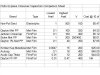
I was preparing to order a bunch of caps to redo the crossovers in some Advents as well as the heavily populated capacitor department of my AR-9's. I like PE's selection and prices, but the various types, available capacitance ranges, prices etc. of the 13 types offered has always confused me to no end. I put together an Excel table which will not upload to AK so I'll insert it below hoping it looks readable.

Aside: the AR-9's in particular, have in their upper crossovers alone, 2 uf, 30 uf and 3 x 40 uf caps. When you have to put these together by combining 10s and 15s to get the right values, costs can add up fast. It's said the cheap nonpolar electrolytics sound 'grainy' in the mids and highs, so I'm looking at what I can do with other types affordably.

The table lists each type, the voltage rating, lowest and highest values available, and the cost for a 10 uf cap for comparison purposes. Interestingly, 3 clear price ranges resulted: the electrolytics, for pennies, the mid range for around $5, and the fancy ones for $25 to $45 a pop.

Question for the ages: Why doesn't someone make high quality crossover caps in 50 or 100 v ratings to cut costs, rather than making them only 250 and 400v? I know you need those for tube circuits but good grief.

Parts Express Crossover Capacitors Comparison Sheet

Brand Type Low Avail Hi Avail V Cost @ 10 uf

Non-Pol Elect NP Elect 1 500 100 $0.47

Dayton Met PP Met Film 0.1 100 250 $4.33
Jantzen CrossCap Film/Foil 0.1 100 400 $5.12
Solen Met PP Met Film 1 200 250/400 $6.01
Dayton 1% Met PP Met Film 0.1 40 250 $7.65

Kimber Kap Mtlzd Met Film 0.0047 15 200 $25.00
Auricap Met Film 0.1 18 400 $40.00
Audio Cap Theta Film/Foil 0.01 12 200 $44.00

Dayton FF PP Film/Foil 0.01 0.47 400 NA

[Well, it doesn't look like a table here, if someone can tell me how to upload an excel file or Word table let me know).
 
Register to hide this ad
Not sure I have the capability to do that. I can print screen, and paste it into a Word document, but then it's a Word document. I don't have the Acrobat software to make a PDF. It's that "make that a picture" part...
 
I used Dayton 1% polypropylenes, with a Dayton Film & Foil bypassing it. I didn't mind that, and new binding posts in Epicure 100Ws that I got for free, or that I owned from new. The two pairs, that I purchased used, I had used the regular Dayton polypro's, and no bypass cap. I won't make that mistake again. $5 per speaker extra was worth it, to me.

You have much nicer speakers to start with, so I would treat myself to the better, more closely matched 1% caps, and the F&F bypass caps.
 
Aha!

Imported into a Powerpoint slide and exported the slide as a jpg.

:tresbon:

I swear I've seen someone upload a .xls file here...
 

Attachments

  • Parts Expr Cap Table.jpg
    Parts Expr Cap Table.jpg
    85.4 KB · Views: 86
What value did you use for a bypass? I've read about that here but never tried it. 0.1 or 0.01 uf, something like that?
 
I recently bought some new caps for my RTR 100E's. Based upon advice I've read from EchoWars (as well as others), I went with the standard Daytons. I think with the number of caps I was ordering, it would have pushed my $40 order a little higher in price than I wanted to spend if I went with the 1%.
 
Actually with the AR9's, I'm now thinking of only doing only the tweeter and mid circuits. Most people leave the huge coke cans in the woofer circuit alone, and maybe I'll skip the mid bass circuit right now, which would save buying 30 and 80 uf caps. I'd only need 4, 6, 6, 24 and 40. Still a bale of caps but looking more manageable.

I blew a tweeter, is how all this started.
 
Imported into a Powerpoint slide and exported the slide as a jpg.

:tresbon:

I swear I've seen someone upload a .xls file here...

In Excel, I used Save As, then selected Save As Type = Web Page (htm, html). Or, you can just do a Save As Web Page, since Office 2003, I think.

Unfortunately, AK doesn't let you Attach that as a file type, so I had to load it on my own web server and then refer to it. If you figure out a way other than creating a pdf, a lot of us here would like to know about it.
 
I've used the Jantzen Cross caps and the Dayton polys in my crossovers and would recommend them as a good value.
 
Funny you bring this up, I'm getting ready, as soon as I find the time, to re-cap my AR-9s. I went with the Jantzen Crosscaps for all three upper range drivers. It turned out to be slightly less expensive than the Dayton 1%. I'm using .01uF AudioCap Thetas for bypassing. I already have the parts, I just need get to work. The big caps for the lowpass are computer grade, I'll test them with my trusty Cap Wizard and leave them alone if they are still good.
 
I just placed an order with Erse for caps to redo the tweeter circuit in my ADS. The prices were reasonable for their top grade metalized polypro caps. Has anybody tried these? Are they any good.
 
So toxcrusader, you've shown 200 and 400V caps in the $5-$6 range in your table and some at the same voltage rating at $40.
Your table shows there is no correlation between voltage and $.
It's all about marketing high end caps to justify the high prices.

What you need to do is some experiments with 1 or 2 low vs high value caps to prove to yourself whether the high price is justified.

The net is awash in discussions about this very subject. What matters most should be what you feel is the best value for your $.

Many posters here seem to favor the Daytons for their value vs cost.
This is not a plug for Daytons, just an observation.
 
Well put spkrdtr. Although, in the middle range where things are $5 apiece or so, voltage rating actually could make a difference in cost, esp. for the larger caps - *of the same brand and model*, if they actually tried it. I agree it probably wouldn't as much up on the top shelf.
 
I may be wrong on this, but the voltage above what was OEM is almost a moot point as the tweeters should never see anything that high. I don't think spending money on a cap who's only added virtue is a higher voltage rating will pay the sonic dividends you may expect.
If stock is 25V, there's no need (or payoff) in using 400V
 
.
If stock is 25V, there's no need (or payoff) in using 400V

The payoff, or advantage here is replacing NPE with polypropylene, most polypros come in 200 and 400v ratings. Or, at least the Daytons, Solens, Jantzens and whatnot.
 
I was preparing to order a bunch of caps to redo the crossovers in some Advents as well as the heavily populated capacitor department of my AR-9's. I like PE's selection and prices, but the various types, available capacitance ranges, prices etc. of the 13 types offered has always confused me to no end. I put together an Excel table which will not upload to AK so I'll insert it below hoping it looks readable.

Aside: the AR-9's in particular, have in their upper crossovers alone, 2 uf, 30 uf and 3 x 40 uf caps. When you have to put these together by combining 10s and 15s to get the right values, costs can add up fast. It's said the cheap nonpolar electrolytics sound 'grainy' in the mids and highs, so I'm looking at what I can do with other types affordably.

The table lists each type, the voltage rating, lowest and highest values available, and the cost for a 10 uf cap for comparison purposes. Interestingly, 3 clear price ranges resulted: the electrolytics, for pennies, the mid range for around $5, and the fancy ones for $25 to $45 a pop.

Question for the ages: Why doesn't someone make high quality crossover caps in 50 or 100 v ratings to cut costs, rather than making them only 250 and 400v? I know you need those for tube circuits but good grief.

Parts Express Crossover Capacitors Comparison Sheet

Brand Type Low Avail Hi Avail V Cost @ 10 uf

Non-Pol Elect NP Elect 1 500 100 $0.47

Dayton Met PP Met Film 0.1 100 250 $4.33
Jantzen CrossCap Film/Foil 0.1 100 400 $5.12
Solen Met PP Met Film 1 200 250/400 $6.01
Dayton 1% Met PP Met Film 0.1 40 250 $7.65

Kimber Kap Mtlzd Met Film 0.0047 15 200 $25.00
Auricap Met Film 0.1 18 400 $40.00
Audio Cap Theta Film/Foil 0.01 12 200 $44.00

Dayton FF PP Film/Foil 0.01 0.47 400 NA

[Well, it doesn't look like a table here, if someone can tell me how to upload an excel file or Word table let me know).

Your right about the AR9 there sure is a pile of caps in there. Here's what I did.
I emailed Jim McShane and asked his opinion as 1)I know he is a big fan of these speakers. 2) his uncle was involved in the design 3) uses a Citation II to drive them as I plan to do. 4) the R&D is done already. Since he is a dealer he was able to assemble and match each circuit.
Give Jim a shout, I'm sure you will find his price competitive and give yourself less of a headache.
Your not going to be able to get away from the non-polar caps as the circuit requires them. The Bennic 2000mf is about all there is available in an NPE in that size to get you to 2400mf. Jensen makes an NPE to replace the 470mf but it is pricey. There was much discussion on the Classic Speaker Pages, AR forum earlier this year, check it out. You really do want to replace the big cap for the woofer, many say they still test good but have noted improvement when replaced. Also there is no advantage in going to a cap rated to a higher voltage.


http://pages.prodigy.net/jimmcshane/

http://www.classicspeakerpages.net/
 
If you hate idea using non-polar electrolytitc caps, try metal film caps like Panasonic or Wima. For example, 68uf 100v Wima costs rougly 4 USD. So far I have seen no scientific proof that boutique insanely priced parts would have any sonic advantages.
 
There is a rough correlation between voltage rating and size of the capacitor.
Just research the size of a Dayton 6.8 uF 200V cap and compare it with a Mundorf 6.8 uF Silver-oil 1200 V cap.

I have a silly theory that larger size means more surface area of the wound films perform better - synonymous to speaker wire size advantages.
 
Back
Top Bottom