I restore a lot of these decks, but I focus on the CT-F9xx series mostly. However, I do work on the CT-F1250 from time to time, and I've retained one of them for my audio stack. Normally, for any restoration on these decks, I start with the mechanism whose belts, tires, some springs, pinch rollers, and switches are tired and need attention. Once I've tuned-up the mechanism, I hit the electronics occasionally recapping entire boards or only certain areas giving trouble. It's important to note that I have pulled electrolytic capacitors, during a recapping exercise, only to find many are in better spec than the "audio quality" caps I buy from Mouser. Pioneer built these decks for the long haul; and after 40 years for many of the electrolytic caps to measure dead-on is a testament to their quality.
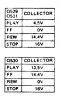
So, I use my CT-F1250 almost every day. And yesterday, it mysteriously stopped fast-forwarding the tape. Rewind worked fine. Take-up worked fine in play mode, which told me the mechanism wasn't having trouble. Putting it on my bench, I found the rewind/take-up motor was working (which runs at two speeds, depending on input voltage, and when voltage polarization is reversed it rewinds). In rewind, the motor was supplied with ~14.4 VDC; however, nothing for fast forward.
Clearly, this was an issue with the control board.
The take-up motor has two wires: blue and red. When in rewind mode, blue to ground measures ~14VDC. When in fast forward mode, red to ground should measure ~14VDC.
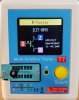
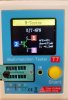
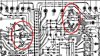
Reviewing the schematic, there are two companion transistors, Q531 and Q530 for rewind and fast forward respectively. The collector on Q530 should measure ~14.4VDC. It didn't, so that was the problem (so I thought). It's a 2SA934. I have some stock on those, but the pulled 2SA934 tested fine on my M-Tester. But the replacement didn't fix the problem.
So, I traced further up the board to find another two companion transistors, Q529 and Q526. Both are 2SC2060. Uncertain I had found the issue, I simply swapped them. Now, rewind didn't work, but fast forward did. There's the problem.
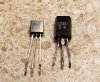
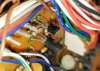
Now, while I have a lot of NOS transistors, I don't have everything. I cross-referenced the 2SC2060 and found I had a dirt-cheap S8050. Pinouts were different for base and collector (so I had to carefully cross them over w/o touching).
I'll include some pictures of the work and transistors.
I hope this helps folks keeping these beautiful creatures alive, kicking, and playing (and recording) our favorite mix tapes!