I had some similar issues - trouble is there is no one size fits all solution....
Let me explain - your problem is caused by vibrations being transmitted from floor/wall to the stand/furniture on which your turntable sits.
There are basically two methods of removing the vibrations:
1) Damping - the vibration is "received" but you absorb it by converting it to heat/friction
2) isolation - find a way for the TT to reject the vibration
in reality most solutions are a combination of the two.
Isolation is usually achieved through some form of "springs" - Sorbothane, various other elastomers, MagLev, or actual springs - they all behave as a spring.
Springs tend transmit/pass through frequencies below their resonance, and to a varying degree absorb frequencies above their resonance...
So if you want to isolate you need to know the frequencies you are trying to isolate from, and the resonant frequency of your "sprung system".
The softer the springs, the lower the resonant frequency for the same mass....
Raising the mass will also lower the resonant frequency (up until the point it totally squashes the spring, after which it no longer isolates at all! - it no longer acts as a spring)
Typically footfall, door slams and such tend to be in the 2Hz to 3Hz range roughly.
An easy way to measure the problem, is to (gently) lower the needle onto the plinth or a stationary record (turn off the motor, assuming you table allows you to do this without muting the arm/cartridge!) - or lower it gently onto the TT plinth.
Then do the door slamming/stomping whatever it is that you are trying to isolate from - and record it . (no fancy stuff needed for the recording, a laptop line/mic input is fine, and take the output from your phono stage)
Then analyse it with a bit of FFT software so you get a spectrum of the recorded track - this will show you what frequency the problems are at.
The same method can then be used to test different "shock absorbers"/springs until you find the combination that works best.
My optimum solution was as follows (took a couple of weekends of working through various permutations and combinations !)
At the base - a 60cm x 60cm 36kg concrete paver sitting on 5 sorbothane pucks (I chose the sorbothan pucks so that the total mass on top of them would be towards the top end of their weight allowance - ie: get the resonant F as low as possible!) - Sorbothane also acts as a damper - so some of the energy is also absorbed and transmuted to heat.
Then the rack sits on the pave
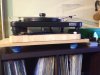
Then the TT platform sits on 4 MagLev feet, then the TT itself is on 5 isolating rubber feet, and the TT plinth has been filled with 3.5kg of plasticine (both adding mass to lower the res. F, and acting as a damper for frequencies between 300Hz and 3kHz)
hope this helps
bye for now
David