• The move to the new server is done. There are some software and database maintenance updates in process. This has us passing the hat around to help out. We appreciate any donations. Seriously, even a dollar helps. The payment page may be found here - https://www.audiokarma.org/support.html

DAC Newbie. Help!

rromeo

Active Member
Well not exactly a newbie but pretty clueless. I have been using a HRT Streamer II for a few years usb out of laptop and external hd flac files.

I was kind of ok with it. Generally listened to Vinyl if I wanted better sound. Then I was at a friends house and he had a PS Audio Direct Stream Player and my world has turned upside down. I was totally impressed with the sound of Digital for the first time.

So PS Audio Dac etc is a little pricey but I am considering it. It has also led me to consider some other things. I would love any advice. Firstly I am looking for that 3D sound that I heard w/the PS Audio. Secondly I dont have any CDs and dont plan on getting any. I have about 4000 albums in flac format with a number of the being 24/192. Thirdly I would kind of like to move away from being pc based. Lastly I would love a remote.

About my system. Currently running two systems and switching them using a Schitt Sys backwards.
System 1- Fisher X100C tube integrated or Simple 45 Tube amp w/ Aikido pre going to Altec 604-8G speakers.
System 2- Conrad Johnson Sonographe SA-400 w/Aikido pre going to Magnepan MMGi.

Dollar amount willing to spend including and most likely on the used market. $1500 but would love to do for less, still want that 3D analog type sound etc.

TIA.
 
Register to hide this ad
In that price range my choice would be the Schiit Gungnir MB (Gumby) $1249 plus shipping. 15 day trial/return policy - so no risk, and you will be amazed at how smooth, detailed and 3D sounding that DAC is.
 
Would it be possible for you to borrow your friends DAC so you could hear it in your system/house? My point is, the DAC may not be what the big difference is.

On the other hand.... :)
 
I agree ... take a look at the Schiit line. They really pack in some nice features for a great price on their products.

One of the differences in sound quality I've noted in DACs is the chipset manufacturer. I've listened to AKM, TI, Burr Brown, ESS and a few others. I prefer the ESS based chipsets and if you can get your hands on a few DACs to demo in your system I'd recommend doing that. By the way, Schiit uses AKM chipsets.

You'll still need some form of storage for your digital files to feed them to the DAC. Going USB out of some form of storage a media player or small music server, then on to the DAC; is the cleanest, best data transfer method you can use. There may be combination components available that act as a server/HD and have a DAC in them. I haven't used one so I can't recommend anything specific there. My setup uses a NAS which houses the files and is connected to my music server via CAT V ethernet cable (a small Win10 based PC) which has JRiver loaded on it. From the server I use an USB connection to the DAC. The DAC sends it's output via balanced XLR cables to the pre-amp.

Another thing to note regarding the quality of your playback is the source file. There are upconverted 24/192 FLAC out there that started with a 16/44.1 master file. Normally upconverting adds nothing to the quality of the file. Native formats of 24/192 or 24/96 do sound better to me vs. a file that has been upconverted to those values.

Good luck!
 
Would it be possible for you to borrow your friends DAC so you could hear it in your system/house? My point is, the DAC may not be what the big difference is.

On the other hand.... :)
I wish I could. He has a very nice system that cost a bit more than mine. Still he remarked how much he was impressed with the PS Audio Direct Stream and its ability to make digital files sound so Analog etc.
 
Dac alone can not make system sound better.

digital stream transportation is also important.

I have specially build PC with PPA V4 USB CARD OCXO, that have Linear a-class power supply.
That alone is big improvement to any DAC.
Also cables (USB, AES/EBU, LAN) can change sound dramatically.
Then system configuration, software also have effect on sound (I use Fidelizer pro and Roon)
 
Dac alone can not make system sound better.

digital stream transportation is also important.

I have specially build PC with PPA V4 USB CARD OCXO, that have Linear a-class power supply.
That alone is big improvement to any DAC.
Also cables (USB, AES/EBU, LAN) can change sound dramatically.
Then system configuration, software also have effect on sound (I use Fidelizer pro and Roon)

I dont understand hardly any of this. I am willing to build a dedicated PC music server. It would take some help/advice from others. How much would it cost do what you did?
 
You need to have good digital audio signal for dac do his job properly.

It all starts with server where you music is located, it must be on Local network, streaming services like Tidal is not there jet but still is sound better than Mp3 or Sotify
Then you need main PC who will play music. This is most important part.
My recommendation for music player PC (i5, fast good quality ram 4-8GB) There is many options here also many fan-less options - I believe you need to do some research.
PC addons:
audiophile optimizer (optimized OS)
fidelizer (OS optimization software) there is free version to try ( I use Pro version)
Music player - foobar2000, JPlay, Album Player, HQ Player, Roon (my favorite is Roon) ( ASIO or WASAPI mode is a must)
PPA CARD OCXO + linear power supply (USB interface) sotm is also option
Also I suggest read what bios optimizations You can do
Then you will need proper usb cable from PC to Dac most simple solution is make it yourself. USB solder connectors are available. Wire you can try what is available - some are better than others. Make it short as possible.

only then DAC come in...
 
In properly made setups USB cable can make huge difference. USB signal is no digital it is analog, so as with any analog signal - cable (material, construction, length) will have effect on it.
 
USB 2.0 compliant is technical specification of cable and what minimal requirements it must have. it is all good. But you can always do better than specification.
There is no such thing as: w/o degradation, there will be always some effect from cable.
 
I'd like to know when the audio signal on a USB port became analog.

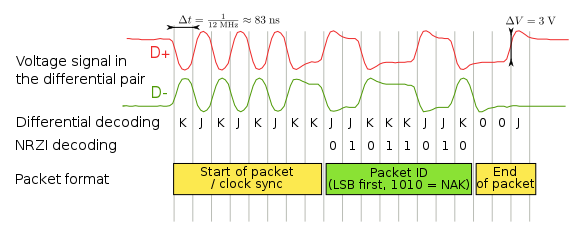
So you think 0 roll in cable and 1 jump. it is all analog voltage change.
and it looks something like this:
581px-USB_signal_example.svg.png
 
I have a Nokia 2520 tablet sitting around. Could I use that? It has 2 usb ports for external hd and usb dac. I could possibly clear it of all programs etc and dedicate it to this task.
 
So you think 0 roll in cable and 1 jump. it is all analog voltage change.
and it looks something like this:
581px-USB_signal_example.svg.png
Despite the rounding of the square wave edges, that's what's known as a digital signal. Analog signals look very different. Every digital signal ever created uses an analog voltage change.

If this isn't so, why would you need a DAC to convert a USB signal to analog. They are "DIGITAL TO ANALOG CONVERTERS".
 
Last edited:
I have a Nokia 2520 tablet sitting around. Could I use that? It has 2 usb ports for external hd and usb dac. I could possibly clear it of all programs etc and dedicate it to this task.

Mobile devices are known for not allowing bit-perfect playback by default. For example, my Android phone would resample everything up to 192kHz if the DAC allows it, or 48kHz on DACs that only go to 96kHz. Not ideal. Windows Mobile supports native audio APIs such as Wasapi but you need to research if there are medial player apps that can use it in order to bypass the OS audio stack/mixer and avoid its associated resampling.
 
Like botrytis I am using an old Core Duo machine too. It uses Ubuntu for its operating system and runs Logitech Media Server (free). It connects via ethernet to a wireless router. The music is stored on two 1TB USB HHDs. One is for backup.

As for the player I suggest the Raspberry Pi ($50 with a case) running squeezelite (free) or just use PiCoreplayer OS (free) for the
RPI. If you only need one player then combining the server and player can be done with Daphile (which is LMS & squeezelite) which can be done with an old mini computer, laptop or a Raspberry Pi.

Right now the players I am using are an old netbook (Atom CPU), a Chromecast Audio ($35 but no gapless playback) and a Pogoplug V4 (hacked to run Arch Linux and squeezelite).
 
Not disagreeing in principle but asynchronous transfers should take care of these issues.
Regardless, that doesn't make any signal on a USB port anything other than a digital signal. Synchronous or asynchronous is completely irrelevant. Being synchronous or not is a function of how the clock signals are implemented.
 
Back
Top Bottom