• The move to the new server is done. There are some software and database maintenance updates in process. This has us passing the hat around to help out. We appreciate any donations. Seriously, even a dollar helps. The payment page may be found here - https://www.audiokarma.org/support.html

Dahlquist DQ-10 bigdome midrange - Crossover problem?

AudioCarMan

Member
I purchased a pair of Dahlquist DQ-10 that were supposed to work perfectly, but didn't. By the time I found out I had driven 3 hours to get them (6 hours total).

Woofers dry rotten and some of the drivers weren't working at all.
I replaced the foams using Rick Cobb's kit, checked all of the drivers using a battery and they all produced sound!
I bypassed the tweeter fuses (BUSS AGC 8/10, 250 Volts on one speaker and BUSS AGC 3/4, 250 Volts on the other one) and the small dome tweeters worked, so I replaced the fuses.
There is only one driver that is not producing any sound, the bigdome midrange, on one of the speakers.

This bigdome midrange works fine when tested directly with speaker wire, but not when it is connected to the speaker.

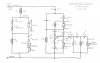
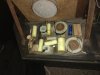
What can I do? Any suggestions? I have attached a picture of the crossover.

Another question: I replaced the tweeter fuses with BUSS AGC 3A, 250 Volts. Does this look good? These days Regnar/Dahlquist seem to recommend AGC .75 fuses instead of .80.

Big thanks to Blue Shadow and baco99 for their advice and patience.
 

Attachments
  • IMG_20191207_192507 - Copy.jpg
    IMG_20191207_192507 - Copy.jpg
    58.5 KB · Views: 62
Last edited:
Register to hide this ad
Those 3 amp fuses for the tweeter need to come out right now. That is not tweeter protection. If you have the old fuses 8/10 and 3/4, test them with the meter and if good use those and hunt down some 8/10 or .75A fuses.

The crossover is posted in numerous places on the web, maybe even some threads here. Look at that diagram and see if you can follow the signal from the input to the midrange and check each component with the meter including the midrange. Maybe you can't check the cap without a cap testing meter but you might find where the signal stops for some reason. Only a couple of screws and the crossover will come up off the speaker so you can get to the back of it as there are some jumpers there.
 
Thank you for your answer. I will remove them right now. I have checked the old fuses with the multimeter and they are blown.

I am attaching the diagram. I don't need to desolder the different components on the crossover to check each of them, right? I need to have the Ohm option in the multimeter, correct?

I have never before read a diagram, so we will see how it goes...

EDIT 1: I have unscrewed the crossover but there are wires connected to the L-Pad and drivers that prevent me from getting to the back of the crossover.

Thank you!
 

Attachments

  • post-101048-1087924836.jpg
    post-101048-1087924836.jpg
    51.4 KB · Views: 39
Last edited:
It will fold up maybe just enough but you might not need to do that.

You can use a smaller fuse or if you don't play loud maybe a 1a until you get the right fuses.

Yes ohm from input along the road that goes to the midrange. What ohms is the midrange.
 
I think that the mistery has been resolved. The 4 Ohm bigdome midrange is blown. I disoldered and swap the midrange and connected another tweeter instead and it produced sound, which means that the crossover is feeding the midrange fine. Now, I soldered the midrange again and checked it with the multimeter and it seemed to be working too, but as soon as I disconnected the midrange from the speaker and checked it alone with the multimeter, multimeter gave me zero. The midrange alone doesn't produce any sound. I think that the time I checked it with the battery and heard a click, it was coming from another driver.

When I connected the midrange to the speaker and connect a quiet mini amp I have to the midrange alone, the midrange didn't produce any sound, but the smallcone midbass did instead!

This means I need to buy a replacement or a used one. I have checked prices and the bigdome midrange seems to be quite expensive...
 
Not looking at the midrange, maybe it can be opened to investigate. Yes, there isn't much on the DQ-10 that is cheap. May find one on the bay. Search for possible repair. You'll find something.
 
Last edited:
Yes, there is a person on the bay that sells one for $85 ($100 with shipping).

I will open it and see what I can find... Thanks for the advice!
 
Last edited:
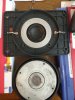
I have opened the midrange. Just for future reference, this is how the big dome midrange looks inside. I checked the metal connectors with the multimeter and no luck... It is very clean inside, so I don't know what's wrong, maybe the finnicky wire that crosses the midrange is the problem.
 

Attachments

  • IMG_20191207_235049 - Copy.jpg
    IMG_20191207_235049 - Copy.jpg
    56.3 KB · Views: 118
Last edited:
check the wiring from the connections to the voice coil to see if there is a break. Sometimes these break outside of the coil and can be repair by unwrapping one coil and reconnecting it. verify that the connection at the connector is good.

I don't know if there are anymore diaphragms available for such and old driver. Might call some of the speaker repair places and see if they repair it for less than the bay. But bottom line, there is a solution to a dead midrange dome in a DQ-10.
 
I have reopened the midrange again and left it like I showed in the pictures attached to my previous message. Do I need to take the midrange apart further or get close to the voice coil to check the connections? It seems that this is the most I can take it apart. I don't know if there is something in the midrange I should pull out.

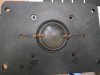
I have inspected checked the connections to the dome from outside and they seem fine (from outside). There is a plastic protector wrapping the wires to the soft midrange dome. Do you suggest I do something with these wires? How can I do that? I have attached another picture.

As you said, it might be more affordable to take the midrange to a speaker repair place so an expert can try to fix it, or maybe contacting Regnar/Dahlquist, as they offer midrange dome rebuild services too, but this will probably be more expensive than taking it to a repair place.

Also, do you know why Regnar is selling 0.75 replacement fuses for the 0.80 fuse? I just called them and left them a voice message. I will share what they say. I guess the Amps are similar enough. It has been easy to find 0.75s, but not that easy to find 0.80 in local harware stores.

Thank you very much for your help. Hopefully somebody in the future will find this thread useful --or at least have a laugh at my lack of knowledge...
 

Attachments

  • IMG_20191208_110740 - Copy.jpg
    IMG_20191208_110740 - Copy.jpg
    66.3 KB · Views: 64
Last edited:
Maybe because they don't get fuses from one of the big supply houses Digikey/Mouser that have the 0.80 but charge a good bit for it and prefer to make more money with the 750mA fuse. Or maybe since these guys are the continuation of Dahlquist they know something about the tweeter and its desire to have a slightly lower amp fuse.

using a sharp needle you can pierce the tinsel that loop of wire on the front of the dome or find where it goes into the dome on the underside and find the solder connection of the tinsel to the voice coil. Check that you have continuity from the speaker solder connection from the crossover to this solder connection on both sides. Then check the continuity between the two voice coil solder connections. VC dead find a replacement or a service center. Find a loose wire at the vc-tinsel connection, resolder it.
 
I talked with Joe, who repairs Dahlquist DQ-10 for Regnar/Dahlquist, he was extremely friendly and helpful. He told me that the reason why they don't provide the .80 fuse is that the company BUSSMAN discontinued making the .80 a long time ago, and they use the .75 as replacement, which gives "a hair more protection" than the .80. He said I might find .80 fuses online but they are rather old, so it is better to use the .75.

We commented on the plastic cone super tweeters and, as Blue Shadow mentioned on a different thread, the supertweeters are very noticeable when isolated, but when they are connected to the rest of the system they just give small little brushes of sound, Joe said they are padded donw and very very low volume, and that this is normal. This was engineered this way on purpose. On a side note, I wish I had known this before, I think I have tinnitus on my left ear from this Sunday when I was trying to test whether the super tweeters were working at all or not again and again. I am not joking...

He said the speaker's handle capability in terms of power is 200 watts RMS. 150 up to 200 watts per channel is what they recommend, especially for medium size to large rooms, of course it also depends on the music taste.

By the way, he said they are now jam packed busy at Dahlquist, which is good. Hopefully, they will be in business for years.

He seems to love his job and the DQ-10s. He said sometimes people don't use the right receiver and is like having a Ferrari and being cheap with the gasoline. "Just because it's old it doesn't mean it is not fantastic". He said that the dq-10 "it is a piece of history" and that you have to spend a lot of money to get anything better. Joe is so passionate about his job!

I contacted all of the local repair shops and none fix neither midranges nor tweeters. The most they do is replacing components. In case anybody is interested in fixing the midrange, I found several relevant threads in Audiokarma. This one and this other one. I still need to find a liquid to remove or soften the cover of the wire in the tinsel that is attached to the dome, to check if there is a sort. I have read Strypeze works.
 
Last edited:
Using a receiver is like powering that Ferrari with carbonated horse piss.

He said the speaker's handle capability in terms of power is 200 watts RMS. 150 up to 200 watts per channel is what they recommend, especially for medium size to large rooms, of course it also depends on the music taste

You solid state only guys might need that much power and I use that much sand power but my DQ-10s sound so much better with 50 watts of Luxman tube power. They are great amps and bring out the best of the Dahlquist.

Even local high end stero shop has sales guys that think the DQ-10 is still a very competitive speaker.

Mouser has a few different 0.8A fuses. Regnar is just taking the easy way out.

Why strip the tinsel? Don't need to.
 
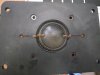
This is finals week, so I have been pretty busy lately. Sorry for not keeping you guys updated. I have good updates for you. I followed Blue Shadows's advice last week (who made me believe I could fix the midrange myself) and tried to fix it. And I fixed it!!!! I have attached pictures in case anyone finds them useful in the future.

I am totally amateur to this, so it took me an hour more or less. I cut part of the tinsel wire, installed a new one (using very thin speaker wire) and soldered it, I checked the resistance and everything looked good! I have taken a few pictures so you can tell me what you think.

The midrange works well now, but I can still hear some subtle distortion or vibration in this midrange sometimes when the it reaches certain notes. I don't know if this might be fixed by improving the soldering I made or by adding ferrofluid to the midrange or what. Any advice?

I have read multiple posts about the plastic protector/coat for the tinsel wire. Is there an agreement on what to use to cover the tinsel and protect it? Liquid electrical tape? Is that what Dahlquist used originally?

Do you think the soldering work looks good or should I adjust it more?

Thank you for the advice!

By the way, I actually fixed it a few hours after I had ordered an original replacement. It is fine, though. It has been totally worth it being able to fix it by myself.
 

Attachments

  • IMG_20191208_110740 - Copy.jpg
    IMG_20191208_110740 - Copy.jpg
    66.3 KB · Views: 62
  • IMG_20191211_194927 - Copy.jpg
    IMG_20191211_194927 - Copy.jpg
    65.3 KB · Views: 63
  • IMG_20191211_194957 - Copy.jpg
    IMG_20191211_194957 - Copy.jpg
    96.4 KB · Views: 63
Last edited:
I have posted a video so you can hopefully hear what I am talking about. The sound from the midrange I "fixed" sounds like it comes from inside a can, or kind of distorted or resonating.

Any advice would be welcome.

 
Last edited:
This is finals week, so I have been pretty busy lately. Sorry for not keeping you guys updated. I have good updates for you. I followed Blue Shadows's advice last week (who made me believe I could fix the midrange myself) and tried to fix it. And I fixed it!!!! I have attached pictures in case anyone finds them useful in the future.

I am totally amateur to this, so it took me an hour more or less. I cut part of the tinsel wire, installed a new one (using very thin speaker wire) and soldered it, I checked the resistance and everything looked good! I have taken a few pictures so you can tell me what you think.

The midrange works well now, but I can still hear some subtle distortion or vibration in this midrange sometimes when the it reaches certain notes. I don't know if this might be fixed by improving the soldering I made or by adding ferrofluid to the midrange or what. Any advice?

I have read multiple posts about the plastic protector/coat for the tinsel wire. Is there an agreement on what to use to cover the tinsel and protect it? Liquid electrical tape? Is that what Dahlquist used originally?

Do you think the soldering work looks good or should I adjust it more?

Thank you for the advice!

By the way, I actually fixed it a few hours after I had ordered an original replacement. It is fine, though. It has been totally worth it being able to fix it by myself.
The Dahlquist mid domes are the Peerless 4 ohm version of the Peerless 8 ohm mid domes used on the Infinity Quantum series.
The breaks are quite common and quite fixable, congrats on your patience.
I wouldn't cover any new lead wire just in case another repair ever becomes necessary.
If the repair was made on the inside of the dome just make sure the uncoated speaker wire you used is not shorting against any metal(a piece of electrical tape can buffer).
A vibration may indicate the voice coil needs adjusting or the soldered wire is a bit loose and vibrating.
 
The force exerted by the new wire might possibly be causing the voice coil to be positioned a bit out of place causing a distortion at certain notes and what was mentioned above.

Glad you have another skill in your tool belt.
 
Last edited:
Thank you for your kind words, Blue Shadow and tubed. I did learn a lot from this repair.

Quick update: I contacted a person on the Bay that fixes midrange domes. He was very kind and told me a trick to fix this issue I had with distortion:

upload_2019-12-27_10-30-27.jpeg


Yes, spreading/rubbing a little bit of vaseline on the voice coil helps preventing distortion. Now the midrange dome sounds way better.

On this other thread I have explained the process more in detail, with videos. Hopefully it will be useful to anyone that faces the same problem.

Thank you guys for your help and orientation.
 
Last edited:
Back
Top Bottom