• The move to the new server is done. There are some software and database maintenance updates in process. This has us passing the hat around to help out. We appreciate any donations. Seriously, even a dollar helps. The payment page may be found here - https://www.audiokarma.org/support.html

Dating AR2ax's Speakers

bdp35

New Member
I just picked up a pair of very nice vintage AR2ax's, which I will be restoring for personal use. :banana: They are the earlier versions with the cloth surrounds, which believe dates them before 1969. They are serial numbers AX 11856 and AX 11866. My question is, how do I find out when they were actually manufactured? :scratch2: Also, without cutting into the wax coated crossover capacitor box, is there a way to know what type of caps it has by knowing when the speakers were made?
 
Register to hide this ad
I just picked up a pair of very nice vintage AR2ax's, which I will be restoring for personal use. :banana: They are the earlier versions with the cloth surrounds, which believe dates them before 1969. They are serial numbers AX 11856 and AX 11866. My question is, how do I find out when they were actually manufactured? :scratch2: Also, without cutting into the wax coated crossover capacitor box, is there a way to know what type of caps it has by knowing when the speakers were made?

Dates are often stamped on the AR drivers. That is as close as you will get to the actual date of manufacture.

The wax coated boxes are the capacitors. They are electrolytic capacitors, and the values are printed on the outside. Your 2ax speakers will likely have a single wax box capacitor with two outputs (black wire=4uf for the tweeter, and the green wire=6uf for the mid) and one input (blue wire).

Roy
 
Well, I checked the drivers... and I don't see a date on them. The only thing on them is the AR logo on the aluminum frame.

Regarding the caps... are they oil filled?
 
Not oil filled caps. Do well with recapping and cleaning or replacing the pots. Take a look at the AR 3a resto guide at classicspeakerpages.net. Much of it applies to the 2AX.

Very nice speakers. I like this older version the best.
 
In my listening room, my current set up: New Large Advents, pair of monoblock Fisher 30a amps and a Cary SLP98 preamp. I've read that the AR2ax's are little inefficient and may require more power to make them really sing - more than the 14wpc my 30a's put out. So, I am in search of a pair of 50wpc monoblocks. In the interim, I will probably use my powerhouse Kenwood KR-9600 receiver (which is rated at 160wpc). I also have a pair of Dahlquist DQ-10's waiting to be restored as well - which will probably earn the permanent spot in my listening room (considering all the attention and positive reviews on these speakers).

I've heard a lot of mixed reviews on replacing the caps on these vintage AR's. I am a purist, and really would like to keep the AR2ax's as original as possible. Most guys say, if you want to improve the speaker sound... replace the out-dated tweeter, not the caps. What are your views on this topic?
 
Do somew cap research over at CSP's. There are some that say the originals are unique but I think that's more about the large oil filled caps in 3a. I think the wax blocks are known to dry out and reduce performace. But don't listen to one person's advice.

I love the redish/orange tweeters. You can make it a much more accurate (better?) speaker with the HiVi's and CSP's inductor recommendations. But you can try the originals first as replacing tweeter doesn't recquire openning up via woofer removal.

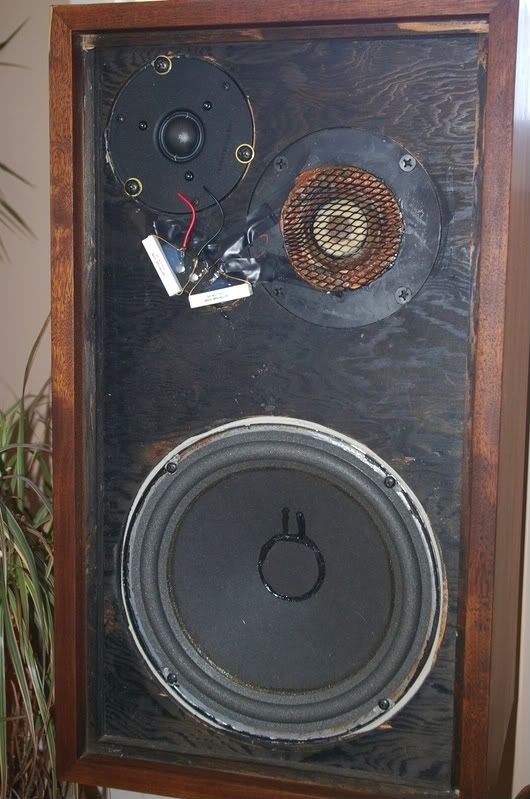
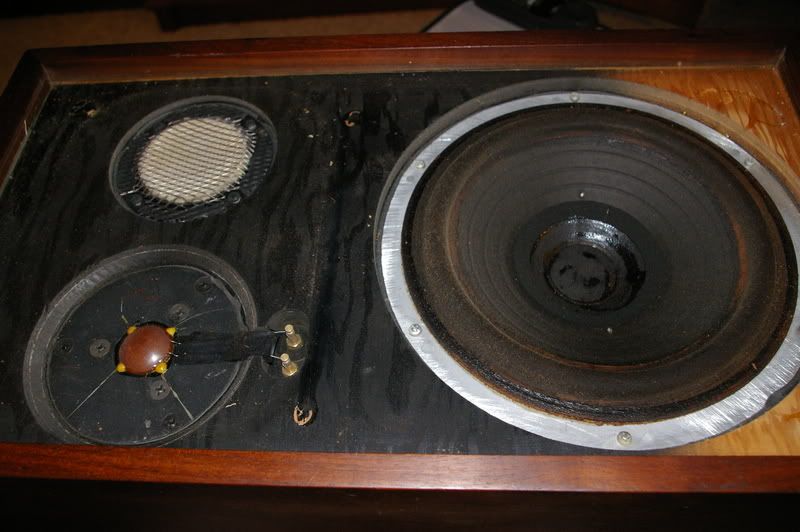
Here are my 2AX original and 5's with the HiVi. Never got to hear the 5's with original tweeters as they were shot. Originals (later smaller grey) have great dispersion.

IMGP1142.jpg

IMGP3962.jpg
 
Your AR2ax's look identical to mine - right down to the unpainted exposed brushed aluminum on the woofer. Very nice! When were yours made?

I guess I am not after to make my AR2ax's the best they can be... I just want to restore them and listen to them for what they are - without any mods. If my caps are dried out and not functioning properly - what exactly will it do the sound, or will it be obvious right way?

I am in the process of cleaning the pots, and I am considering not resoldering the wires back onto the pots, and using wire connectors in case I have to clean the pots again in the future. I am planning on putting a little lubricant on them to hlep prevent any corrision... but, I know it won't cure it completely. How long have you had yours, and have had to go back into them to clean the pots a second or third time?
 
Your AR2ax's look identical to mine - right down to the unpainted exposed brushed aluminum on the woofer. Very nice! When were yours made?

I guess I am not after to make my AR2ax's the best they can be... I just want to restore them and listen to them for what they are - without any mods. If my caps are dried out and not functioning properly - what exactly will it do the sound, or will it be obvious right way?

I am in the process of cleaning the pots, and I am considering not resoldering the wires back onto the pots, and using wire connectors in case I have to clean the pots again in the future. I am planning on putting a little lubricant on them to hlep prevent any corrision... but, I know it won't cure it completely. How long have you had yours, and have had to go back into them to clean the pots a second or third time?

Be careful about putting lubricant on the pots... make sure it is an appropriate electrical-contact lube suitable for audio applications, like FaderLube/ProGold. The kind of lubricant you get in the drugstore won't work. :D

The sound of aging caps may or may not be apparent to your ears, depending on how bad the caps are, and how familiar you are with the "right" sound of those speakers. When the sound usually becomes obvious, is when you replace the caps in one of the speakers, and A/B the recapped and un-recapped speakers. My experience with the 2axs was that the difference was NOT subtle; it was definitely worth the cap replacement! I think after this many years ALL the original caps in those speakers should be in need of replacement, but if by some stroke of luck your caps haven't aged (dried)as much as expected, then you might not experience much improvement when replacing them. The chances of that happening, though, are very slim.
 
Your AR2ax's look identical to mine - right down to the unpainted exposed brushed aluminum on the woofer. Very nice! When were yours made?

I guess I am not after to make my AR2ax's the best they can be... I just want to restore them and listen to them for what they are - without any mods. If my caps are dried out and not functioning properly - what exactly will it do the sound, or will it be obvious right way?

I am in the process of cleaning the pots, and I am considering not resoldering the wires back onto the pots, and using wire connectors in case I have to clean the pots again in the future. I am planning on putting a little lubricant on them to hlep prevent any corrision... but, I know it won't cure it completely. How long have you had yours, and have had to go back into them to clean the pots a second or third time?

Have you read my guide that I linked to? It should answer all your questions about cleaning the pots. You shouldn't have to do them for years (about 7 or 8) if you do it right the first time.

Replace the capacitors - it will bring the speaker back closer to its factory performance. There's not much of a good reason not to, especially if you have the old wax-block caps (as my AR-3a's did).
 
I will be very careful about using the lubricant... I don't want short circuit anything, that's for sure.

I've actually printed out the guide to restoring AR3a's, and have read it several times. I originally planned to buy a pair of AR3a's, but decided to go with the AR2ax's because they are an 8 ohm speaker and are somewhat easier to drive than the 4ohm AR3a's. I've got the pots very clean in my opion, using my trusty ol' Dremmel. The copper shines like a brand new penny! I am working on the stained linen grills and the brass "a" and "AR Inc." badges now, and will move on to the cabinets afterwards.

I will probably leave the wax caps in for now, and test them out. If they sound like 40 year speakers... I will probably replace them. Maybe.

I just scored on a pair of Grommes G101A monoblocks, which produce an outstanding 100/120 wpc - and can drive down to 1.4 ohms continuous. Should do just fine with the AR2ax's... wouldn't you say? No worries there!
 
I could hear a difference when I replaced the wax covered caps with new caps. I love my AR-2ax's. They were my fathers now they are all mine. I hope to someday give them to my baby girl.(if she will take good care of them.)
 
I could hear a difference when I replaced the wax covered caps with new caps. I love my AR-2ax's. They were my fathers now they are all mine. I hope to someday give them to my baby girl.(if she will take good care of them.)

bp35 - I agree, you won't be able to tell if you don't change them. My 2ax sounded just fine to my ears with the old caps and I'm sure yours will too. But as long as I was in there I took care of everything so I don't have to go back in later. If the original wax caps lasted for 30-40 years, the new ones should be good for a long time.

By the way Doc, similar setup as you - Pioneer SX838, Technics SL1300 turn table and the AR2ax speakers on this system. My kids will also inherit the vintage gear. :thmbsp:
 
Well... if it's not broken - don't fix it. I will just have to listen to see what these babies sound like with the original wax covered caps. Actually, the suspense is killing me... I can't wait to actually sit down and listen to them. The tweeter and mid-range were both dead when I got them, so it will be a first for me. I am have a great time restoring them, and sure hope they are just as fun to listen to.
Cheers!
 
I read where a guy applied High Tack Gasket Sealant to the cloth surrounds of his vintage AR speakers, to protect them. Has anyone ever done this their cloth surrounds?
 
I love all the old classic AR speakers. Last year I found a pair of AR-2ax's along with the the original AR stands at an estate sale. They sat in the same spot in the owners house since they were new and look like they just came out of the boxes. Talk about excited. Enjoy your speakers!
 
I read where a guy applied High Tack Gasket Sealant to the cloth surrounds of his vintage AR speakers, to protect them. Has anyone ever done this their cloth surrounds?

This was me. I linked to my pot restoration guide already, where I detail the pot cleaning and sealant application. I actually applied too much in the guide - I only found this out afterward after AK member RoyC pointed it out - but you can still read it for the process.

Here's my guide: http://www.audiokarma.org/forums/showthread.php?t=306818&highlight=acoustic+research+potentiometer
 
I read where a guy applied High Tack Gasket Sealant to the cloth surrounds of his vintage AR speakers, to protect them. Has anyone ever done this their cloth surrounds?

Roy has better solution from work by him and others at CSP. But first make sure it's needed. Press your lips to the cloth surround and suck. If there is good resistance don't chance damaging them by adding any kind of sealant.

Once you add stuuff to surround it is very difficult to remove. Best to do nothing till you are absolutely sure.
 
I have used the high tack gasket sealant and I think it gets to stiff when it drys. There is another member on audiokarma that has another recommendation and I will try it next. Maybe he will chime in here.
 
Back
Top Bottom