


I've always been a big fan of DCM speakers. The overall sound, the breadth and depth of the sound stage, and the uniqueness of the design have attracted me to DCM. The fact that mastermind Steve Eberbach is an active member of online DIY and AV communities helps. I have never met him personally, but he seems like a great guy.
The other thing I like about DCM is that they are able to get incredibly good sound from very very modest components. The drivers use simple, paper cones, inexpensive mylar tweeters, particle board cabinets, etc. The parts taken individual do not nearly add up to the whole once the system is assembled. So, anytime I have a chance to take apart some DCMs, I do it. This time, the TimePiece.
The TimePiece was put together in the 1980s as a simple answer to a simple question, can DCM build an affordable 2-way bookshelf speaker that lives up to the reputation of the TW and TF series.
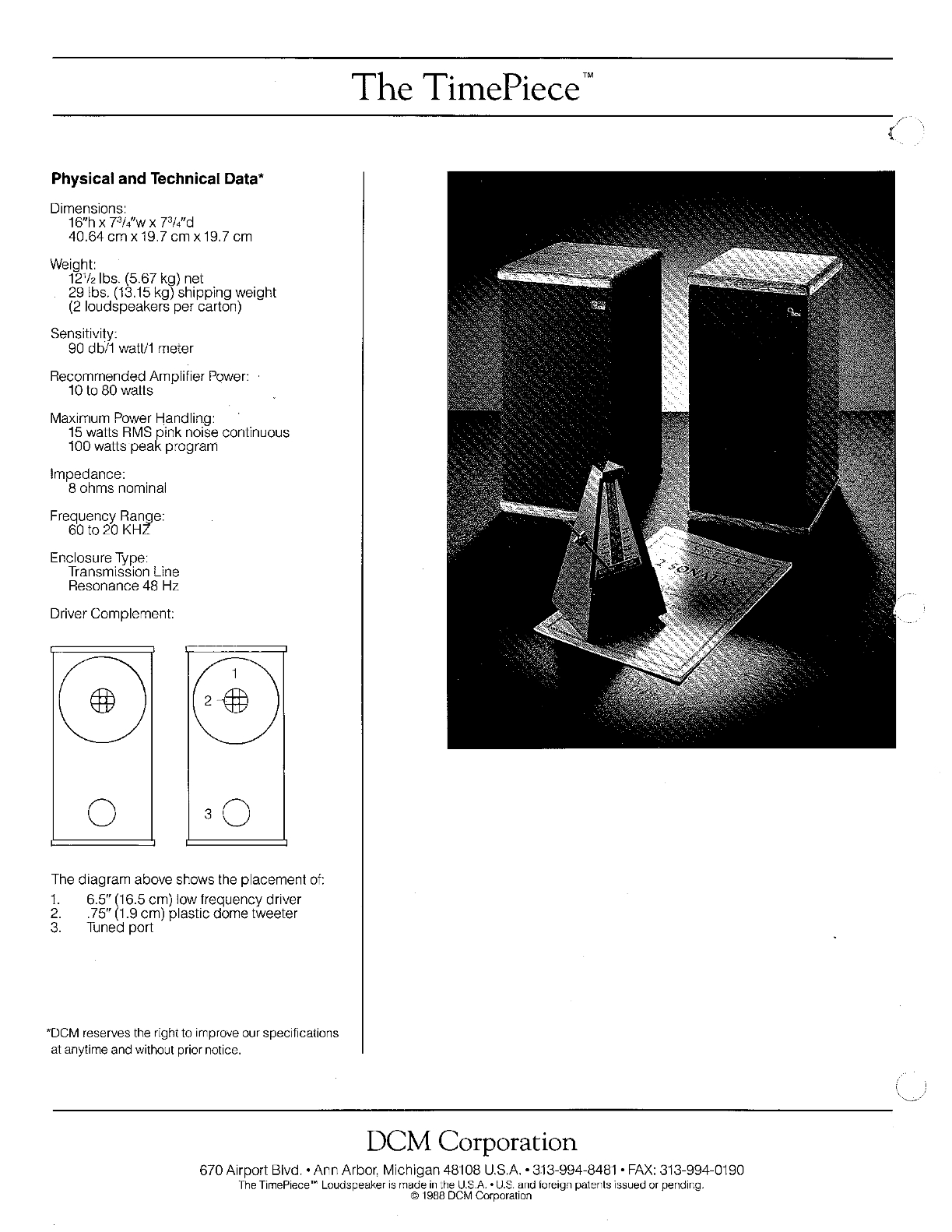
Sure enough, the design is seemingly simple. 6" paper cone woofer, 3/4" mylar dome tweeter placed in front of the woofer and DCMs signature "quasi-transmission line" box design, topped with solid wood caps and wrapped in cloth.
I got this pair of speakers as a basket case project, which I love because then I can't make them worse, no matter what I do to them. One woofer is dead, the headliner fabric has turned to dust, and the wood caps need refinishing. Thankfully the crossovers and grill cloth are salvageable and 3 out of 4 drivers work. So, my mission in this case is to see what makes these speakers tick, find a suitable replacement driver for the stock unit, and reassemble. Easy enough!
First, let's look at these things. I started by removing the wood caps, the cloth, and the headliner dust.

Here the DCM "magic' is barely visible. A front port looks simple enough, the mylar tweeter is mounted on wire mesh on top of the woofer, Model # DCM160Fw126L, which is a Japanese-made very modest looking woofer with a paper pulp cone and treated inverted cloth surround. Again, the parts probably cost DCM about $2 per pair back in 1988, and the system was sold for $250/pair in stores.
Lifting off the mesh you can see the damping material they applied. Two different types of felt to reduce diffraction.
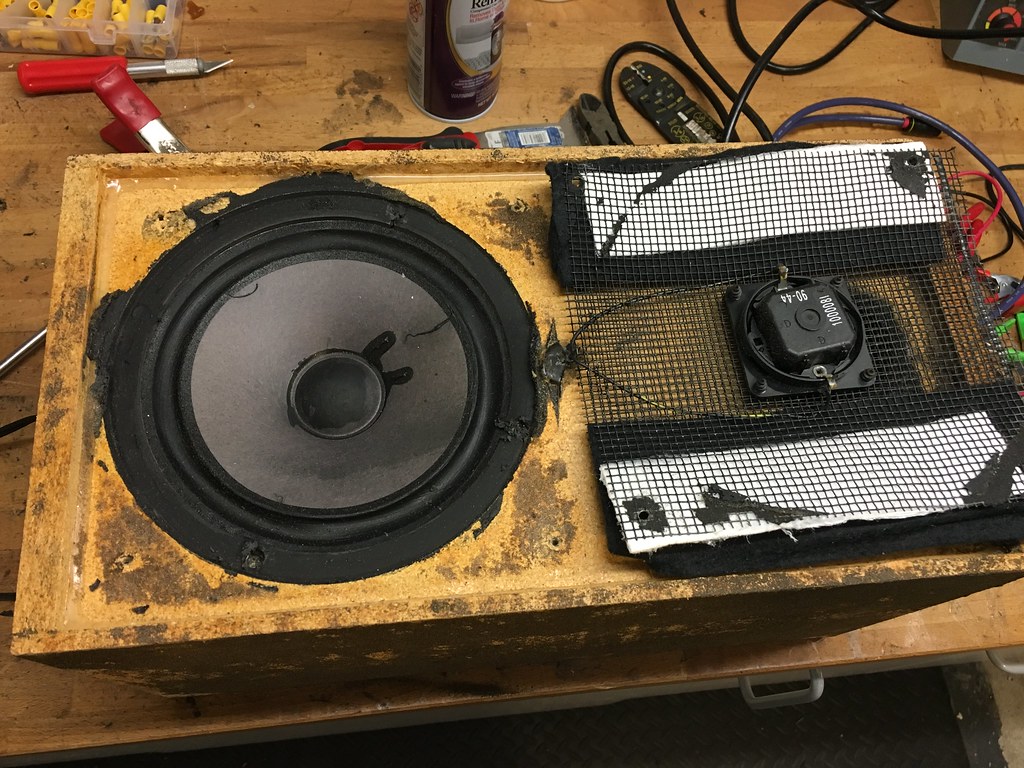
And here is what looks like a very cheap woofer.


As it turns out, this woofer is the same model used on the TF250 and TF275. A ported mini-tower with a much larger enclosure but same driver layout. Interesting.
Now, there's one rule of thumb in speaker design. Ported enclosures usually use a driver with a Qts (Qts is essentially a rating of the total "suspension" of the driver including the physical suspension and the electcromagnetic component) of less than 0.4 or 0.5. Qts is a ratio, so it doesn't have units. MOST of today's drivers that are made for ported boxes have a Qts of 0.30 to 0.35. Sealed enclosures use a driver Qts of between 0.40 and 0.70, and anything above that is usually reserved for infinite baffle applications.
Remembering my mission here is to find a replacement for the blown woofer, I measure the one working example with my DATS program. I'm expecting to see a Qts of about 0.4 for this speaker. Ported enclosures weren't as common in the 80s are they are today, so I could see a manufacturer hedging their bets to make a small inexpensive driver that is "multi-use". But no, this driver has a Qts of 1. ONE! How is that possible? I measured again because sometimes temp and humidity can mess with the Qms which is the physical component of calculating Qts. ONE! Not only that, it has an Fs of 100Hz, despite the documentation stating a -3dB system performance to 60 Hz. And a Vas of only 0.25 cubic feet, which is usually what you'd see out of a 4" midrange (a 6" driver like this should have a measured Vas in the 0.5 to 0.7 Cu Ft range).
So, this woofer is not only not supposed to produce bass under 100 Hz, it does so in an enclosure that doesn't make sense, and at a sensitivity level which doesn't compute either.
Here's where the DCM "magic" starts to come into play. DCM took a driver, that by all accounts has nothing to do with this box, and made it work. I am just now thinking about how they might have done this, but here's some things to note about the enclosure:
1) It's ported. The port is about 5" long and 2" wide
2) The box is small. About 0.28 cubic feet. once you subtract the volume of the port.
3) The box is not really a box! It's 2 boxes in one. Down the middle of the box, running from top to about 3 inches from the bottom is a large partition. So the rear of the box is a separate "chamber" from the front. The port is long enough that it theoretically "exhausts" pressure from half-way up the rear chamber. The box is starting to look like a folded TL design, maybe a quarter-wave?
4) Unlike most ported designs, or even most TL designs, the box is STUFFED with damping material. I mean stuffed. Almost to the point of being aperiodic. In other words, the mass of air moving out the back side of the woofer is slowed down a considerable amount before being compressed through the port and "tuned" to exit the cabinet.
A view behind the woofer:

A view through the crossover mounting hole where you can see the port coming from the front and into the rear "chamber"

So, what does all this mean!!????
I have no idea!
I do know that DCM had a real knack for making exceptional speakers from cheap parts, so I plan to dig deeper. Next part of the analysis will be the crossover design. Much simpler than the TF series crossovers I have recapped in the past, but still complex enough that I want to dig in.
My guess is that DCM found a driver that they could "trick" into producing bass it had no business of producing by employing this TL-style enclosure, then to make the driver feel "happy" in that enclosure, they stuffed it with fiberfill to physically damp the back wave to make the driver "think" it was in an infinite baffle situation, thus negating the resonance effects of the enclosure and the driver's relatively high Fs.
Any other opinions? I find this **** fascinating!
The other thing I like about DCM is that they are able to get incredibly good sound from very very modest components. The drivers use simple, paper cones, inexpensive mylar tweeters, particle board cabinets, etc. The parts taken individual do not nearly add up to the whole once the system is assembled. So, anytime I have a chance to take apart some DCMs, I do it. This time, the TimePiece.
The TimePiece was put together in the 1980s as a simple answer to a simple question, can DCM build an affordable 2-way bookshelf speaker that lives up to the reputation of the TW and TF series.
Sure enough, the design is seemingly simple. 6" paper cone woofer, 3/4" mylar dome tweeter placed in front of the woofer and DCMs signature "quasi-transmission line" box design, topped with solid wood caps and wrapped in cloth.
I got this pair of speakers as a basket case project, which I love because then I can't make them worse, no matter what I do to them. One woofer is dead, the headliner fabric has turned to dust, and the wood caps need refinishing. Thankfully the crossovers and grill cloth are salvageable and 3 out of 4 drivers work. So, my mission in this case is to see what makes these speakers tick, find a suitable replacement driver for the stock unit, and reassemble. Easy enough!
First, let's look at these things. I started by removing the wood caps, the cloth, and the headliner dust.
Here the DCM "magic' is barely visible. A front port looks simple enough, the mylar tweeter is mounted on wire mesh on top of the woofer, Model # DCM160Fw126L, which is a Japanese-made very modest looking woofer with a paper pulp cone and treated inverted cloth surround. Again, the parts probably cost DCM about $2 per pair back in 1988, and the system was sold for $250/pair in stores.
Lifting off the mesh you can see the damping material they applied. Two different types of felt to reduce diffraction.
And here is what looks like a very cheap woofer.
As it turns out, this woofer is the same model used on the TF250 and TF275. A ported mini-tower with a much larger enclosure but same driver layout. Interesting.
Now, there's one rule of thumb in speaker design. Ported enclosures usually use a driver with a Qts (Qts is essentially a rating of the total "suspension" of the driver including the physical suspension and the electcromagnetic component) of less than 0.4 or 0.5. Qts is a ratio, so it doesn't have units. MOST of today's drivers that are made for ported boxes have a Qts of 0.30 to 0.35. Sealed enclosures use a driver Qts of between 0.40 and 0.70, and anything above that is usually reserved for infinite baffle applications.
Remembering my mission here is to find a replacement for the blown woofer, I measure the one working example with my DATS program. I'm expecting to see a Qts of about 0.4 for this speaker. Ported enclosures weren't as common in the 80s are they are today, so I could see a manufacturer hedging their bets to make a small inexpensive driver that is "multi-use". But no, this driver has a Qts of 1. ONE! How is that possible? I measured again because sometimes temp and humidity can mess with the Qms which is the physical component of calculating Qts. ONE! Not only that, it has an Fs of 100Hz, despite the documentation stating a -3dB system performance to 60 Hz. And a Vas of only 0.25 cubic feet, which is usually what you'd see out of a 4" midrange (a 6" driver like this should have a measured Vas in the 0.5 to 0.7 Cu Ft range).
So, this woofer is not only not supposed to produce bass under 100 Hz, it does so in an enclosure that doesn't make sense, and at a sensitivity level which doesn't compute either.
Here's where the DCM "magic" starts to come into play. DCM took a driver, that by all accounts has nothing to do with this box, and made it work. I am just now thinking about how they might have done this, but here's some things to note about the enclosure:
1) It's ported. The port is about 5" long and 2" wide
2) The box is small. About 0.28 cubic feet. once you subtract the volume of the port.
3) The box is not really a box! It's 2 boxes in one. Down the middle of the box, running from top to about 3 inches from the bottom is a large partition. So the rear of the box is a separate "chamber" from the front. The port is long enough that it theoretically "exhausts" pressure from half-way up the rear chamber. The box is starting to look like a folded TL design, maybe a quarter-wave?
4) Unlike most ported designs, or even most TL designs, the box is STUFFED with damping material. I mean stuffed. Almost to the point of being aperiodic. In other words, the mass of air moving out the back side of the woofer is slowed down a considerable amount before being compressed through the port and "tuned" to exit the cabinet.
A view behind the woofer:
A view through the crossover mounting hole where you can see the port coming from the front and into the rear "chamber"
So, what does all this mean!!????
I have no idea!
I do know that DCM had a real knack for making exceptional speakers from cheap parts, so I plan to dig deeper. Next part of the analysis will be the crossover design. Much simpler than the TF series crossovers I have recapped in the past, but still complex enough that I want to dig in.
My guess is that DCM found a driver that they could "trick" into producing bass it had no business of producing by employing this TL-style enclosure, then to make the driver feel "happy" in that enclosure, they stuffed it with fiberfill to physically damp the back wave to make the driver "think" it was in an infinite baffle situation, thus negating the resonance effects of the enclosure and the driver's relatively high Fs.
Any other opinions? I find this **** fascinating!
Last edited:


