• The move to the new server is done. There are some software and database maintenance updates in process. This has us passing the hat around to help out. We appreciate any donations. Seriously, even a dollar helps. The payment page may be found here - https://www.audiokarma.org/support.html

Dead(?) Amp (was Leaking Caps)

jheu02

AK Subscriber
Subscriber
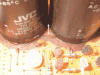
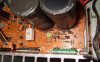
With the server problems, looks like my earlier post got lost. The original question was about leaking caps and positive ID vs dried glue used to hold the large caps in place. Photos uploaded this time, but if I understand correctly, a leaking cap will have a brownish, oily fluid that can smear, whereas, dried glue may be brown but will have to scrape???

If the latter, then the photos show the glue. Now the sad part:

I hooked up the amp to some speakers and a tuner, plugged it in, and.....no sound!:tears:

So now it's trouble shooting time and looking for some advice. I have the book _How To Troubleshoot and Repair Your Stereo System_ by Hershal Gardner so I'm sure that will help, but are there some "usual culprits" to look for first?

Lights came on, but there was no click from the protection circuit, so that could be the culprit, OR, it could just be doing it's job and the problem is in the power supply(?) Function buttons work AFAIK, as the lights switch indications when the various buttons are selected, so the amp's not TOTALLY dead. :scratch2:

As this was a free amp, I feel it will be a great learning experience to see if I can get it working again, but I only have a multimeter for test equipment. I have a little soldering experience, but it's mainly been to do filter mods on tuners.

Will that be good enough to diagnose with and where to start a signal trace?

Thanks again.
 

Attachments

  • caps1.jpg
    caps1.jpg
    70.6 KB · Views: 83
  • caps2.jpg
    caps2.jpg
    67.5 KB · Views: 66
Register to hide this ad
When I have had leaking caps, it's always been a little more explosive. Like batteries. They overheat and then break along the edges and sort of split open. That can be too high voltage or heat. That doesn't happen with audio stuff unless something goes SEVERELY wrong. I am not quite sure what normal cap leaks look like or do.
 
Let us know what amp we are discussing. Also, let us know if you have tried all the normal checkout procedures such as, are the pre amp/amp in jumpers in place, have you checked tape monitor switch to make sure they are in the right position, have you cycled all switches numerous times to work off possible corrosion, is the amp set to the proper input position. A lot of times these problems, like you are experiencing, are something simple. The pictures you sent do show what is often times called "Sansui Glue" though not just used by just Sansui. Over time this glue can be a problem but may not be the source of your problems. Do a search on Deoxit on AK and familiarize yourself with its use. Your problems may be solved by the use of this great product. Give us more info and if you can give us pictures that are a little large in size.
 
KingBubba said:
Let us know what amp we are discussing. Also, let us know if you have tried all the normal checkout procedures such as, are the pre amp/amp in jumpers in place, have you checked tape monitor switch to make sure they are in the right position, have you cycled all switches numerous times to work off possible corrosion, is the amp set to the proper input position. A lot of times these problems, like you are experiencing, are something simple. The pictures you sent do show what is often times called "Sansui Glue" though not just used by just Sansui. Over time this glue can be a problem but may not be the source of your problems. Do a search on Deoxit on AK and familiarize yourself with its use. Your problems may be solved by the use of this great product. Give us more info and if you can give us pictures that are a little large in size.

Amp in question is a JVC AX-44 Integrated, curbside find. Will try all the normal things again, just in case I missed something (though with no "click" shortly after power-on it seems likely a PS or protection circuit prob). Will post larger pics tomorrow. I had reduced them for file upload limits but I guess went a little too far. Will change the res on the camera 'cause the original was around a 1meg shot.

There are no pre-out, main-in RCAs on the back panel, though there is a set of jacks labeled "Remote Control" (out and in for both R and L channels). Could this just be really poor labeling? :dunno: Info on this unit was scant to non-existant on the web. I imagine mid 80s design.
Thanks for the help.
John
 
jheu02 said:
Amp in question is a JVC AX-44 Integrated, curbside find. Will try all the normal things again, just in case I missed something (though with no "click" shortly after power-on it seems likely a PS or protection circuit prob). Will post larger pics tomorrow.<SNIP>

Hooked it up, rechecked tape monitor switches, used jumpers on the remote in/out jacks, checked grounding screws from CB to chassis, etc.

When power on, lights come on for functions, and switch with proper button press, but no lights to the power output LEDs (same screen as functions). No click after power-on. Quiet as a mouse. Not even a little bleed thru, so no signal is getting to the speakers.

As for pics, first, sorry about quality. To get the file size small enough had to edit down to 16 colors and go to 640x480 gifs. Any way around this for better quality on the forum?

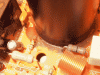
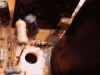
#183 shows detail of resistor and cap near large electrolytics. Could the glue have corroded the one terminal of the resistor? Also, looks like some got on the poly cap.

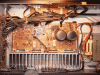
#174 just an overhead nudie. unit was pretty clean inside, no obvious burn marks or anything out of ordinary

#178 other view of resistor and poly cap, base of PS cap

#179 arrow points to what could be a little corrosion between the caps. haven't poked around to see if flaky yet

#185 this end of transformer has some corrosion(?) which can be wiped away, rest of it is clean

Don't have deoxit at the moment, but do have CRC QD Electronic cleaner which has worked fine on other equip I have.

As noted earlier, this was a curbside find, so if I don't get it working, no big deal. But....I'd really like to take back my modded Proton D940 from my 14yr old to use in the bedroom. I swapped out the 280kHz filters for sockets which currently house 150s or 180s (I forget). MUCH better selectivity, and that was the 940's only major drawback for DXing and plucking out college stations amongst the higher power commercial junk.
 

Attachments

  • 2007_0503Image0183.gif
    2007_0503Image0183.gif
    121.5 KB · Views: 14
  • 2007_0503Image0185.gif
    2007_0503Image0185.gif
    99.1 KB · Views: 15
  • 2007_0503Image0179.gif
    2007_0503Image0179.gif
    88.1 KB · Views: 18
  • 2007_0503Image0178.gif
    2007_0503Image0178.gif
    88.1 KB · Views: 14
  • 2007_0503Image0174.gif
    2007_0503Image0174.gif
    106.2 KB · Views: 15
It may be that this unit is part of a "system" and will only operate when connected to the remote control center. I had a friend that had a cassette that he found at a TS and it never would operate though it was in apparent great shape. It also had a remote control input/output?? though it was a proprietary plug not RCA. Good luck.
 
KingBubba said:
It may be that this unit is part of a "system" and will only operate when connected to the remote control center. I had a friend that had a cassette that he found at a TS and it never would operate though it was in apparent great shape. It also had a remote control input/output?? though it was a proprietary plug not RCA. Good luck.

Well, I thought you had hit the proverbial nail on the head with that suggestion. I'm not used to freestanding components (each w/ own plug, etc.) "requiring" use with other components from the same company as a system. Fortunately, that very same curbside also had the matching FX-33 Tuner and the SEA-RM20 Computerized Remote System Controller (RSC).

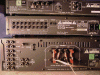
So, I hooked up the amp and RSC via the Remote in and out RCA plugs. All three (amp, tuner, RSC) units also have two 1/8" jacks labelled "Synchro." Looks like it would have the function of the 12v trigger running from my preamp to the power amp for controlling the power-on, but they aren't labelled out and in. Photos showing all three stacked and closeups of jacks/controls.

I hooked up a CDP to the amp, connected the RSC to the amp via the RCA jacks ---> signal from CDP got to RSC thru the amp as evidenced by the EQ showing response to the signal, hoever, no LEDs lit up on power meters of amp, no sound.

Also tried running an 1/8" mono plug between the synchros (all combinations except using two plugs concurrently. Same as before. I could hear a low-level hum/buzz coming from the transformer of the amp, but still nothing on the power meters. What's confusing me a little though is the diagram to the left of tape 2 jacks showing the SEA hooked thru there vs the remote control jacks.:confused:

Ideas???
 

Attachments

  • 2007_0504Image0192.gif
    2007_0504Image0192.gif
    94.7 KB · Views: 3
  • 2007_0504Image0193.gif
    2007_0504Image0193.gif
    93.4 KB · Views: 7
  • 2007_0504Image0194.gif
    2007_0504Image0194.gif
    108.5 KB · Views: 8
  • 2007_0504Image0195.gif
    2007_0504Image0195.gif
    108.2 KB · Views: 8
Since it is a roadside find and is not a favorite, try using a shorting RCA plug, or short a cable yourself, in the remote control in to see if all the remote would do is close or open a switch. It might blow it up, but then again.......
 
KingBubba said:
Since it is a roadside find and is not a favorite, try using a shorting RCA plug, or short a cable yourself, in the remote control in to see if all the remote would do is close or open a switch. It might blow it up, but then again.......

What could this accomplish that hooking it up to the remote wouldn't? The remote/eq works fine (tried it out thru the pre out, main in jacks in my Proton), as does the tuner. My thought is that, if the prior owner blew the output, or some other fault is activating the protection circuit, they figured the amp was dead and decided to get rid of all of the components.

Guess it's time to try and trace the PS path and check voltages.
John
 
Back
Top Bottom