Firstly, the Technics SL-MA1 is an excellent turntable, probably better than the Denon DP-30L II, but is constrained by the fact that p-mount cartridges are getting harder to find, with only one manufacturer currently making them, Audio-Technica. However, in terms of rumble it’s significantly quieter (81dB vs 78dB WRMS), and wow and flutter is also lower (0.012% vs 0.015%, both measured direct from the motor, since that’s the spec Denon have supplied) and the fact that it’s p-mount means that the cartridge will always match perfectly with the tonearm with a resonance of close to 10Hz, and be perfectly aligned without needing adjustment when plugged in. The SL-MA1 is slightly lighter than the DP-30L II though (9 vs 9.5kg), which may mean the DP-30L II resists acoustic feedback slightly better.
I can’t comment on the Technics SL-3000, because I can’t find any information about it anywhere, including vinylengine and the vintage Technics website.
However, I can give some history of why the DP-30L was improved with the better straight tonearm (effective mass roughly 10g) replacing the heavier s-shaped tonearm (eff. mass 16g), to become the DP-30L II. The internals are the same between both models, of course.
In the late-70's and 80’s, many turntable manufacturers upgraded their turntables by replacing their ancient (late-50's design) s-shaped tonearms with superior straight tonearms. They could save mass by eliminating the unnecessary curves, without the tonearm losing rigidity, and by not using the locking ring to clamp the headshell to the tonearm, more mass could be saved by using a single small clamping screw, and an abbreviated headshell which only had enough material to mount the cartridge also reduced mass (the PCL-30 headshell weighs only 3.3g). Lighter tonearms always track better than heavier ones, due to lower inertia.
Many straight tonearms, including the one Denon used to upgrade the DP-30L (s-shaped tonearm, 1978) to DP-30L II (straight tonearm, 1980), were modelled on BSR’s excellent low mass ADC LMF-2, a carbon-fibre tonearm designed to mate with their top-end ADC XLM, ZLM and Astrion high compliance cartridges. The ADC LMF-2 was later made with cheaper aluminium construction for the ADC 1700DD turntable, and the BSR Gen 4 ‘Professional’ (consumer!) hi-fi turntables. BSR were at the time the world’s largest manufacturer of turntables, and used the ADC brand, which they’d bought off Peter Pritchard in the mid-70’s, for their higher-end turntables, although BSR also made some good quality hi-fi turntables. Of course, many came complete with ADC cartridges.
So the almost generic headshells for many straight tonearms are often labelled ADC-type, after the ADC LMH-1 headshell from the LMF-2 tonearm, and they use the ADC headshell plug. However, the manufacturers weren’t good at standardising on straight headshell dimensions, so it’s best to buy a genuine Denon headshell, or an aftermarket copy of that genuine headshell, if at all possible, as they're guaranteed to be the same dimensions, so that overhang can be adjusted correctly.
The Denon headshell which was used on the DP-30L II was the PCL-30 (which also fits the DP-31F, DP-31L, DP-32F, DP-35F, DP-37F and DP-45F turntables, as well as possibly some others), and a generic copy of it used to be available from lpgear.com, but is currently out of stock. The PCL-50 headshell (DP-51F & DP-52F) is apparently similar (I can't confirm that - it came from
http://www.audioinvest.no/denon/index9.htm ), so might also fit, and a replacement for that is available from LP Gear and some other suppliers. The overhang should be set according to the picture below, with the stylus tip 35mm from the back of the headshell.
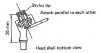
However, several people have complained on LP Gear that their copies of the PCL-30 and PCL-50 headshells didn’t give enough space to mount the wires at the rear of their cartridges. You can see on web pictures that there is limited room between the headshell wire pins and the cartridge body with some larger cartridges, so you may have to resort to some bending of the wire terminals with needle-nosed pliers to get things to fit.



