• The move to the new server is done. There are some software and database maintenance updates in process. This has us passing the hat around to help out. We appreciate any donations. Seriously, even a dollar helps. The payment page may be found here - https://www.audiokarma.org/support.html

Denon DP-59L Q damping coils

michaelcdaws

New Member
Hello,
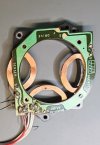
I'm in the process of having new q damping coils produced for my Denon DP-59L turntable. As my coil assy. part number 3468136102 has a direct short, on the center sensor coil it would be great if anyone can assist in providing the "normal" Ohm specifications. So far I'm finding between 40-60 Ohms should be correct, however experience is better than what's on paper. Looking forward to your feedback.
Best regards,
Michael Dawson
 

Attachments

  • IMG_20260120_163434.jpg
    IMG_20260120_163434.jpg
    71.6 KB · Views: 13
Register to hide this ad
You can have an estimation by measuring the wire diameter, wire length (by un-winding the faulty coil) and checking against the specific electrical resistance of copper.
 
Hello catBot,
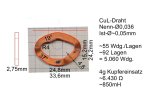
Thanks much for your reply. I have a company that is in the process of rewinding new coils for me. In the attached picture their calculations indicate an ohm reading of 6,430 Ohms. Everything else I have found in research is showing 40-60 Ohms. This is the reason for my question. I want to make sure the new coils have the correct resistance. Best regard,
Michael Dawson
IMG_20260121_225709.jpg
 
Is it possible to compare with the sensor coil that is still good?

However, with ~5000 turns of 0,036mm wire - the coil resistance == 6k4 looks plausible.
 
Is it possible to compare with the sensor coil that is still good?

However, with ~5000 turns of 0,036mm wire - the coil resistance == 6k4 looks plausible.

Hello catBot,
Thanks for your reply. I`m looking forward to see how the replacements work out. Just would feel better if I could check them against know good specs.
 
I'm amazed you found some place that will rewind the coils for a reasonable price. Good luck with your project on a very nice TT.

I'm amazed you found some place that will rewind the coils for a reasonable price. Good luck with your project on a very nice TT.
Hello,
The cost of the replacement coils is not too reasonable, however the turntable is somewhat sentimental for me. And in case someone needs replacement coils in the future we will have a vendor that can provide them.
 
I think measuring it's inductance (at a set frequency) would be a far better means of checking the desired spec of the coil.
 
It's the sensor coil. It generates a voltage and that is pretty much determined by it's inductance (and change in flux but that's a given in this case), not it's resistance.
As long as you get the wire diameter somewhat right (which is very easy to measure and there are within the applicable standards limited wirethicknesses to choose from), it's the inductance to worry about (if you don't want to count the windings, I assume that's the issue here).
The resistance can vary quite a lot on how neat and tightly the coil is wound (especially as another supplier is found), but the ammount of turns (which is directly coupled to the inductance and not resistance) have to be the same as closely as possible.

If the number of windings is known then all you need is the wire thickness. Matching resistance to other existing coils by changing the number of windings (which is pretty much all you can do) would be unwise.

To know the inductance and not knowing the resistance is a whole lot better than knowing it's resistance and not knowing it's inductance. That's why I was a bit amaized to not even reading about inductance in this topic. Like a forgotten elephant in a room if you ask me...
 
Last edited:
To know the inductance and not knowing the resistance is a whole lot better than knowing it's resistance and not knowing it's inductance.
That's true. :)

My point was that the L and the R of the coil (togegher with the input impedance of the following circuitry) define the sensor's frequency response. This could be critical for stability of the closed loop servo such as this damper.
 
Back
Top Bottom