

I picked up a pair of Design Acoustics D-1 bookshelf speakers a while back. There is a bunch of good information scattered around various threads so I figured I would consolidate some of it here and add my own experience and review after listening to them. All credit and much appreciation to the original posters of any information quoted below.
According to this post by user @stickman the D-1 were one of the last speakers designed around 1976 by Design Acoustics founder George Sioles before the company was sold to Audio Technica around 1980. As noted in this post there are previous reports of D-1 speakers which have rear connection plates from the D-2, which is a much different column speaker model. As shown in photos below my D-1 pair also has D-2 connection plates so this was likely standard practice at the factory.
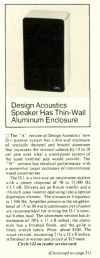
Also as noted by @stickman both a wood cabinet version and an aluminum cabinet version of the D-1 were offered. The below image shows an advertisement found on Page 16 of the December 1976 edition of Hi-Fi Stereo Review Magazine for both versions. According to this ad the wood versions have a walnut veneer and retailed for ~ $115. Adjusted for inflation this is equivalent to ~$665 as of MAY2025 .
Detailed Photos
My particular pair is mismatched (non-sequential serial #s) which is kind of a shame but my ears cannot detect any audible difference between the two.

Walnut veneers are in nice condition. Differences in the shade and pattern of the veneer provide additional evidence that this pair is mismatched.
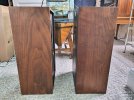
According to this post by user @Nealaz the wood cased D-1 (and likely the aluminum cased version as well) were later modified from the original design in order to compete with a similar Bose model. The modifications included addition of a port on the rear of the speaker. My pair must be earlier production as they are not ported.
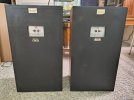
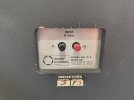
Rear connection plates showing the D-2 label and non-sequential serial #s. Also slightly different inspection tags.

Both speakers in my pair had some kind of mold or fungus on the woofer surround. Luckily after a very gentle cleaning with ~100 cotton swabs dampened with distilled water it came off and only a light staining remains. The surrounds appear to be made from rubber and show no visible signs of degradation. It is possible that the surrounds were replaced at some point.

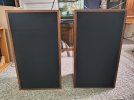
The grilles are in excellent condition; it is also possble that they were refurbished at some point. The D-1 is one of very few speakers that I feel looks better with the grilles on. I feel that the flat cloth grille gives the speakers a very formal and understated appearance.
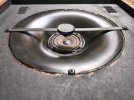
Macro view of the tweeter arrangement. Details of this design are in the previous post by @stickman
Audio Performance Review
Disclaimer: I am not a professional, just someone who enjoys vintage hi-fi equipment and a wide variety of music.
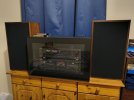
My current setup, used for testing.
As described in the earlier post by @Nealaz the original non-ported design of D-1 had a flat frequency response from 50-15,000 hz. My pair appears to be no exception, even after ~50 years. My preference with speakers and headphones is a flat response; you can then adjust equalizer settings to suit your particular taste. ~95% of my music listening is done with a pair of Sony MDR-V6 headphones for this same reason.
Testing was conducted with a Technics SA-R277 receiver. With a flat equalizer setting all frequencies are present and very balanced, with nothing overpowering. In particular treble is very bright and apparent without being harsh or shrill. When listening to Brown Eyed Girl the clap track has a nice punch to it that is missing from other speakers. No complaints on the midrange. Bass is present but subtle.
My current preferred equalizer settings are +5dB to 63Hz and 160Hz, flat (+0dB) midrange, and +5dB to 63KHz and 12.5KHz. With these settings bass is deep and treble remains bright with no issues. I have not listened to my Advent /3 pair in a long time but these Design Acoustics D-1 are now my favorite pair in my collection.
For the bass-heads out there (myself included): with equalizer adjusted to stupid levels and Technics "loudness" option enabled (or the Sony "Mega Bass" equivalent) the D-1 will put out a seriously impressive amount of low end with no distortion. These are definitely capable of generating an apartment complex noise complaint.
Room considerations: I had these speakers placed with their backs ~9 inches away from a wall and ~2 feet between them. When sitting a few feet away the bass output is extremely flat and muted, even when turned up. When I moved >5 feet away the bass became much more full and natural sounding. It is possible that the other frequencies are also affected in this way and I did not notice. I am sure there is a technical term for this effect. Just something to keep in mind if you plan to put these in a small room; it appears that they need some space to breathe.
Suggested test tracks:
- Brown Eyed Girl - Van Morrison
- Magic Man - Heart
- Tom Sawyer - Rush
- Yellow Line - James Shimoji
- Battletoads House Remix - DJ Berto
Conclusion
A very well designed and built set of vintage bookshelf speakers from the late 1970s. Flat frequency response lets you use equalizer adjustments to suit your own taste. Capable of generating serious levels of bass if desired, but became the favorite speaker in my collection due to the bright and pleasant treble. A definite buy if you come across a pair for sale, just be aware that they may need some space to perform their best.
According to this post by user @stickman the D-1 were one of the last speakers designed around 1976 by Design Acoustics founder George Sioles before the company was sold to Audio Technica around 1980. As noted in this post there are previous reports of D-1 speakers which have rear connection plates from the D-2, which is a much different column speaker model. As shown in photos below my D-1 pair also has D-2 connection plates so this was likely standard practice at the factory.
Also as noted by @stickman both a wood cabinet version and an aluminum cabinet version of the D-1 were offered. The below image shows an advertisement found on Page 16 of the December 1976 edition of Hi-Fi Stereo Review Magazine for both versions. According to this ad the wood versions have a walnut veneer and retailed for ~ $115. Adjusted for inflation this is equivalent to ~$665 as of MAY2025 .
Detailed Photos
My particular pair is mismatched (non-sequential serial #s) which is kind of a shame but my ears cannot detect any audible difference between the two.
Walnut veneers are in nice condition. Differences in the shade and pattern of the veneer provide additional evidence that this pair is mismatched.
According to this post by user @Nealaz the wood cased D-1 (and likely the aluminum cased version as well) were later modified from the original design in order to compete with a similar Bose model. The modifications included addition of a port on the rear of the speaker. My pair must be earlier production as they are not ported.
Rear connection plates showing the D-2 label and non-sequential serial #s. Also slightly different inspection tags.
Both speakers in my pair had some kind of mold or fungus on the woofer surround. Luckily after a very gentle cleaning with ~100 cotton swabs dampened with distilled water it came off and only a light staining remains. The surrounds appear to be made from rubber and show no visible signs of degradation. It is possible that the surrounds were replaced at some point.
The grilles are in excellent condition; it is also possble that they were refurbished at some point. The D-1 is one of very few speakers that I feel looks better with the grilles on. I feel that the flat cloth grille gives the speakers a very formal and understated appearance.
Macro view of the tweeter arrangement. Details of this design are in the previous post by @stickman
Audio Performance Review
Disclaimer: I am not a professional, just someone who enjoys vintage hi-fi equipment and a wide variety of music.
My current setup, used for testing.
As described in the earlier post by @Nealaz the original non-ported design of D-1 had a flat frequency response from 50-15,000 hz. My pair appears to be no exception, even after ~50 years. My preference with speakers and headphones is a flat response; you can then adjust equalizer settings to suit your particular taste. ~95% of my music listening is done with a pair of Sony MDR-V6 headphones for this same reason.
Testing was conducted with a Technics SA-R277 receiver. With a flat equalizer setting all frequencies are present and very balanced, with nothing overpowering. In particular treble is very bright and apparent without being harsh or shrill. When listening to Brown Eyed Girl the clap track has a nice punch to it that is missing from other speakers. No complaints on the midrange. Bass is present but subtle.
My current preferred equalizer settings are +5dB to 63Hz and 160Hz, flat (+0dB) midrange, and +5dB to 63KHz and 12.5KHz. With these settings bass is deep and treble remains bright with no issues. I have not listened to my Advent /3 pair in a long time but these Design Acoustics D-1 are now my favorite pair in my collection.
For the bass-heads out there (myself included): with equalizer adjusted to stupid levels and Technics "loudness" option enabled (or the Sony "Mega Bass" equivalent) the D-1 will put out a seriously impressive amount of low end with no distortion. These are definitely capable of generating an apartment complex noise complaint.
Room considerations: I had these speakers placed with their backs ~9 inches away from a wall and ~2 feet between them. When sitting a few feet away the bass output is extremely flat and muted, even when turned up. When I moved >5 feet away the bass became much more full and natural sounding. It is possible that the other frequencies are also affected in this way and I did not notice. I am sure there is a technical term for this effect. Just something to keep in mind if you plan to put these in a small room; it appears that they need some space to breathe.
Suggested test tracks:
- Brown Eyed Girl - Van Morrison
- Magic Man - Heart
- Tom Sawyer - Rush
- Yellow Line - James Shimoji
- Battletoads House Remix - DJ Berto
Conclusion
A very well designed and built set of vintage bookshelf speakers from the late 1970s. Flat frequency response lets you use equalizer adjustments to suit your own taste. Capable of generating serious levels of bass if desired, but became the favorite speaker in my collection due to the bright and pleasant treble. A definite buy if you come across a pair for sale, just be aware that they may need some space to perform their best.
