

You are using an out of date browser. It may not display this or other websites correctly.
You should upgrade or use an alternative browser.
You should upgrade or use an alternative browser.
difference between 6ca7/el34?
- Thread starter darcyl
- Start date

Rob-F
Likes Vintage Gear and DIY
You seem to be talking about the physical conformation of the tube's elements. What some of us mean by "Winged C" is simply the logo trademark on the glass. There is a "C" for "Svetlana" and a pair of stylized wings at left and right. The importance of this is that the Svetlana EL34 tubes were formerly made in St. Petersburg, Russia. There is also a factory in Saratov, Russia that gained the right to mark their EL34 tubes as Svetlana; but they are not the same tubes, and not as good. So how to tell the real Svetlanas? Only the St.Petersburg ones may use the "Winged C" artwork printed on the glass. Some of us feel they are better than the ones from Saratov. Those are no longer in production. So who actually owns the brand made in Saratov--ones I feel are impostors, so to speak? Why, the New Sensor Corp., whose address is (ready for this?) Electro Harmonix, 47-50 33rd Street, Long Island, New York, 11101. Yep, Russian made tubes, American owned. Surprised? I was!"Wings", the prominent G1 control grid cooling radiator wings in the otherwise empty space above the pentode element stack.
The 6CA7 beam tetrode has a smaller G1 radiator in a smaller space.
Last edited:

Pio1980
AK Member
Right, I knew that. I think I have a quad of the winged 'C' EL34. I had a quad of Sylvania 6CA7 in a Dyna Stereo 70 ca 30 years ago, the EH 6CA7 look like them inside and out.You seem to be talking about the physical conformation of the tube's elements. What some of us mean by "Winged C" is simply the logo trademark on the glass. There is a "C" for "Svetlana" and a pair of stylized wings at left and right. The importance of this is that the Svetlana EL34 tubes were formerly made in St. Petersburg, Russia. There is also a factory in Saratov, Russia that gained the right to mark their EL34 tubes as Svetlana; but they are not the same tubes, and not as good. So how to tell the real Svetlanas? Only the St.Petersburg ones may use the "Winged C" artwork printed on the glass. Some of us feel they are better than the ones from Saratov. Those are no longer in production. So who actually owns the brand made in Saratov--ones I feel are impostors, so to speak? Why, the New Sensor Corp., whose address is (ready for this?) Electro Harmonix, 47-50 33rd Street, Long Island, New York, 11101. Yep, Russian made tubes, American owned. Surprised? I was!

cademan
Lunatic Member
Wow, I learned something in 15 years Lol.6CA7/EL34 is the same tube, a beam pentode with 3 grids. 6CA7 is the american number while EL34 is the european number.
I think someone is trying to rip you off or fool you into thinking that the EL34 is more expensive than the 6CA7, wheras in fact, it is the same tube!
Maybe the seller of the more expensive tube knows that it is a mullard brand compared to a GE brand.
Examples of the same tube:
12AX7/ECC83
6BQ5/EL84
They are not the same but are similar.

Yeah, you can sub one for the other. But, your amp is prolly going to sound different.Wow, I learned something in 15 years Lol.
They are not the same but are similar.

Rob-F
Likes Vintage Gear and DIY
Careful! An EL34 is/was the original version, European, using five electrodes, three of them grids. One of them is called the suppressor grid because it suppresses unwanted radiation from electrons recoiling off the plate. Yes, it was invented, made, and patented by Mullard.6CA7/EL34 is the same tube, a beam pentode with 3 grids. 6CA7 is the american number while EL34 is the european number.
I think someone is trying to rip you off or fool you into thinking that the EL34 is more expensive than the 6CA7, wheras in fact, it is the same tube!
Maybe the seller of the more expensive tube knows that it is a mullard brand compared to a GE brand.
Examples of the same tube:
12AX7/ECC83
6BQ5/EL84
A 6CA7 is an American tube that has, in place of the third (suppressor) grid, a set of beam forming plates. These obviate the need for a suppressor grid. The beam forming plates connect to the same tube pins that were/are used by the suppressor grid; moreover, all its electrical parameters are the same as for the EL34, meaning a 6CA7 can be used as a drop-in replacement for the EL34. It's generally believed that the 6CA7 was invented so as to avoid infringing on Mullard's European patent. I'm old enough to remember this being said at the time the 6CA7 was introduced, I think by Sylvania, although GE made them too.
That doesn't mean they are the same tube; nor does it mean they sound the same. They are different tubes. Some of us will hear a difference, while others of us won't. Like everything in audio, it's subjective, depending on our equipment, listening room, and our ears.
So a tube marked EL34/6CA7 doesn't mean it is both! It can't be: They are made differently, so it must be one or the other. It just means that it can be used as if it were either. Whereas one marked just EL34 is really made like an EL34, with the Suppressor grid; while one marked 6CA7 is really a 6CA7 and has the beam forming plates. I will venture that one marked EL34/6CA7 is probably the 6CA7. But I haven't examined all tubes so marked, so I can't know for sure. If you've gotten this far, you must be an audiophile, and. you are bound to try them both sooner or later, so let us know how they sound to you, OK?
Pio1980
AK Member
Careful! An EL34 is/was the original version, European, using five electrodes, three of them grids. One of them is called the suppressor grid because it suppresses unwanted radiation from electrons recoiling off the plate. Yes, it was invented, made, and patented by Mullard.
A 6CA7 is an American tube that has, in place of the third (suppressor) grid, a set of beam forming plates. These obviate the need for a suppressor grid. The beam forming plates connect to the same tube pins that were/are used by the suppressor grid; moreover, all its electrical parameters are the same as for the EL34, meaning a 6CA7 can be used as a drop-in replacement for the EL34. It's generally believed that the 6CA7 was invented so as to avoid infringing on Mullard's European patent. I'm old enough to remember this being said at the time the 6CA7 was introduced, I think by Sylvania, although GE made them too.
That doesn't mean they are the same tube; nor does it mean they sound the same. They are different tubes. Some of us will hear a difference, while others of us won't. Like everything in audio, it's subjective, depending on our equipment, listening room, and our ears.
So a tube marked EL34/6CA7 doesn't mean it is both! It can't be: They are made differently, so it must be one or the other. It just means that it can be used as if it were either. Whereas one marked just EL34 is really made like an EL34, with the Suppressor grid; while one marked 6CA7 is really a 6CA7 and has the beam forming plates. I will venture that one marked EL34/6CA7 is probably the 6CA7. But I haven't examined all tubes so marked, so I can't know for sure. If you've gotten this far, you must be an audiophile, and. you are bound to try them both sooner or later, so let us know how they sound to you, OK?
Ime, tubes marked both 6CA7/EL34 or vice versa are usually EL34 pentodes.Careful! An EL34 is/was the original version, European, using five electrodes, three of them grids. One of them is called the suppressor grid because it suppresses unwanted radiation from electrons recoiling off the plate. Yes, it was invented, made, and patented by Mullard.
A 6CA7 is an American tube that has, in place of the third (suppressor) grid, a set of beam forming plates. These obviate the need for a suppressor grid. The beam forming plates connect to the same tube pins that were/are used by the suppressor grid; moreover, all its electrical parameters are the same as for the EL34, meaning a 6CA7 can be used as a drop-in replacement for the EL34. It's generally believed that the 6CA7 was invented so as to avoid infringing on Mullard's European patent. I'm old enough to remember this being said at the time the 6CA7 was introduced, I think by Sylvania, although GE made them too.
That doesn't mean they are the same tube; nor does it mean they sound the same. They are different tubes. Some of us will hear a difference, while others of us won't. Like everything in audio, it's subjective, depending on our equipment, listening room, and our ears.
So a tube marked EL34/6CA7 doesn't mean it is both! It can't be: They are made differently, so it must be one or the other. It just means that it can be used as if it were either. Whereas one marked just EL34 is really made like an EL34, with the Suppressor grid; while one marked 6CA7 is really a 6CA7 and has the beam forming plates. I will venture that one marked EL34/6CA7 is probably the 6CA7. But I haven't examined all tubes so marked, so I can't know for sure. If you've gotten this far, you must be an audiophile, and. you are bound to try them both sooner or later, so let us know how they sound to you, OK?
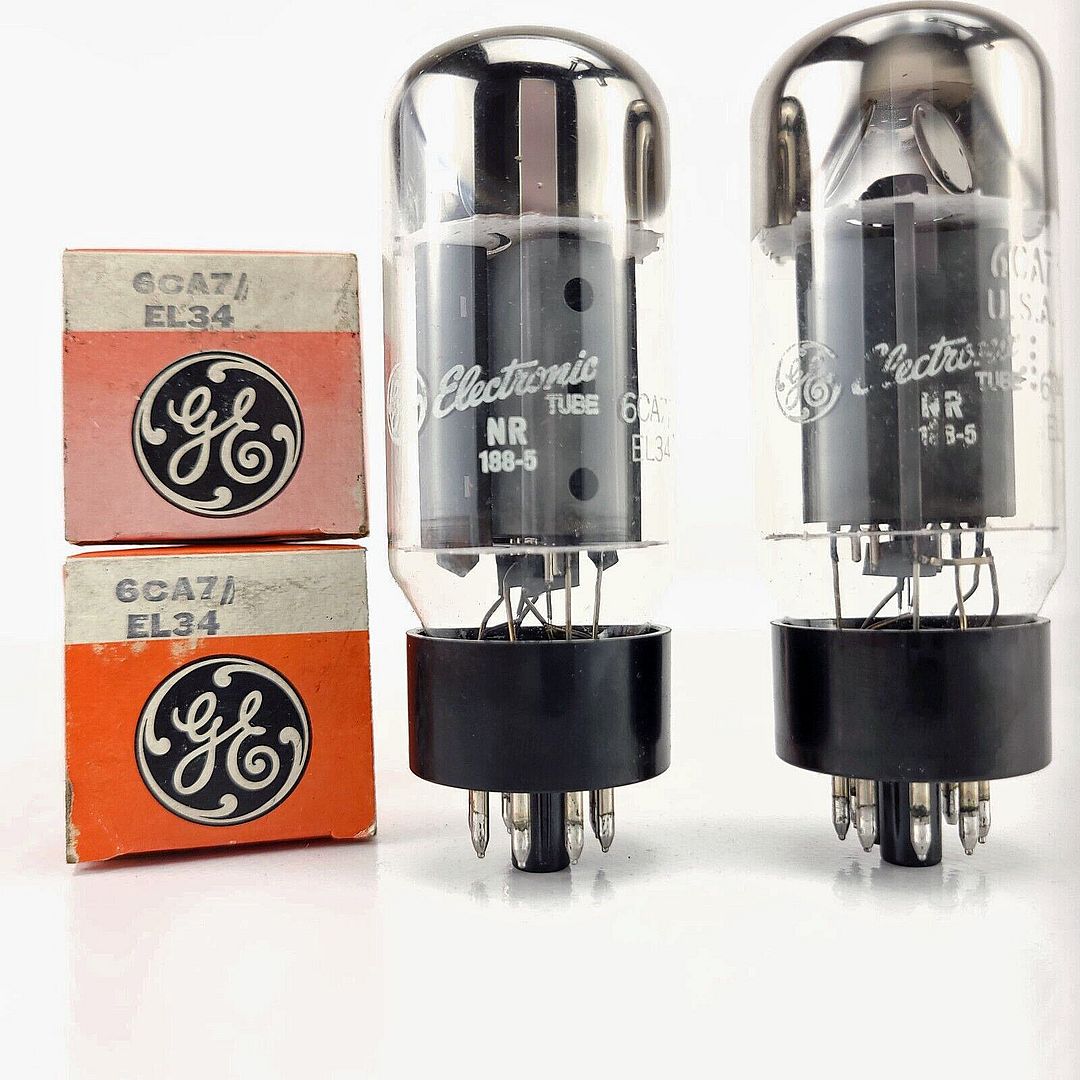
GE tubes labeled 6CA7/EL34 are usually 6CA7s.
gkargreen33
Member
Jim McShane would not sell JJ power tubes, saying they were really poorly-made tubes. Is that still the case?Electrically, they are interchangeable.
Soundwise, it might be a different story. In the old days, the 6CA7 had a "harder" vacuum than the Mullard/Amperex EL34. So, the overdrive and compression were different.
In general, the European-made EL34 sounded warmer and smoother. The US-made 6CA7 sounded cleaner at louder volumes. Maybe it's a tad more sterile, too.
Today, the EH 6CA7 is probably one of the tougher construction and cleaner-sounding 6CA7/EL34 types. The JJ is warmer, more old-school European sound.
The JJ EL34 and E34L are the exception. I've gotten good service from them.Jim McShane would not sell JJ power tubes, saying they were really poorly-made tubes. Is that still the case?
I try to buy them from sellers who test, match, and ferret out the noisy ones.

Ditto for the JJ 6L6GC — every bit as good as any RCA or GE example, over multiple examples in multiple units and applications. Surely can’t say the same for their 7591 though…….
Dave
Dave
I never tried their 6L6GC. Maybe, one day.Ditto for the JJ 6L6GC — every bit as good as any RCA or GE example, over multiple examples in multiple units and applications. Surely can’t say the same for their 7591 though…….
Dave

6CA7 beam tet is a scaled-down 6550, compare them.
yes quite agree. especially if a person looks at the EH fat bottle 6CA7.
Yes, both the original 6550 and 6CA7 were beam tetrodes. In comparison, the original Philips-designed EL34 is a true pentode.yes quite agree. especially if a person looks at the EH fat bottle 6CA7.
However, the 6550 and 6CA7's "harder" vacuum and heavier construction have been credited more with tonal differences compared to the original EL34, rather than the tetrode versus pentode design.