• The move to the new server is done. There are some software and database maintenance updates in process. This has us passing the hat around to help out. We appreciate any donations. Seriously, even a dollar helps. The payment page may be found here - https://www.audiokarma.org/support.html

Diode Question

David_NC

Super Member
I'm looking to do the mod on my Dynaco ST-70 that puts diodes in front of the rectifier tube. I see a big pack of appropriate ones on Amazon for less than $10. Are there a lot of differences between diode brands, as with caps, or are they all similar enough to use whatever is cheap and available?
Also, is there a single type I can have on hand that will work for others? By that, would a 1N5408 (rated at 1000V / 3A) be good as replacements where lower rated 1N400X are spec'ed? I realize that the leads on the higher rated ones are slightly bigger, but I don't see this as being an issue, in most situations. If it is, I can just use one of the many 1N4007's that I have. Would one of the faster UF diodes be a better choice to have on hand?
 
Register to hide this ad
1N4007 is fine. Faster ones could have less noise if used alone, but there is no forward recovery noise with the tube rectifier in series. The 1N4007 has three times the current rating of the 5AR4, and many times the peak current rating.
 
Might want to consider putting a pair in series to get sufficient PIV. 1kv really isn't quite enough, and considering the 5AR4 is good for 1.5kv it doesn't really make a lot of sense to not at least meet that number.
 
So would a 1N5408 be good for just about all uses that call for something smaller, such as a 1N4004? Are there big quality differences between brands?
 
its fine to use a 3 amp diode where a 1 amp is asked for, so long as the leads fit.


I haven't noticed quality differences but its not like I use enough to have any real feel for that. None of them have come out of the bag dead or damaged, and none have failed in service.
 
I'll go with a pack of the 1N5408's, since I'll be able to use it in place of those with lower values. Thanks!
 
Might want to consider putting a pair in series to get sufficient PIV. 1kv really isn't quite enough, and considering the 5AR4 is good for 1.5kv it doesn't really make a lot of sense to not at least meet that number.

That's a little like "belt and suspenders"- it can't hurt- but remember- the diode and the 5AR4 are also going to "share" the voltage somewhat. It's going to be very hard for either to get full voltage... and given that 360v AC can only produce 509V DC per side (which would be a max of 1018v across any diode, if it was the only one in the string)- that's not much over the max rating for the 1N4007, even before the 5AR4 "shares" some of the voltage. In other words- even if the 5AR4 "shares poorly"- if it even shares 5% of the voltage (it likely will "share" quite a bit more than that), the 1N4007 is within spec...

Regards,
Gordon.
 
I get that they should share the load, but if the idea of the diodes is to protect the tube and give some protection in case it shorts, it just seems like for an extra dime it may as well be capable of really protecting the tube. Also makes it so you could make a dummy "tube" that is simply a drop resistor wired up the proper way to make it run as a solid state rectifier with no further mods.
 
should already be enough in the transformer to cover that, but its easy enough to measure and calculate. The bigger problem is the constant high load an ST-70 puts on the rectifier. Idle current is a bit over 200ma on something rated for 250ma. Add signal to that and the current demands go up considerably. Its just a part that gets worked very hard.
 
A brand new valve rectifier could have a PIV leakage current that is similar to a 1N4007 or 1N5408, but I'd suggest the ss diode leakage current will 'rule' for the life of the valve, and hence the reverse (inverse) voltage will drop across the ss diode and not the valve. That also means that if there is a hot-start incident or the valve diode starts going gassy, then the ss diode stops any internal valve arcing opportunity - that is the principal reason for inserting the ss diode in series with the valve diode's anode as a protection device. The 1N5408 diode has a higher inherent leakage current when reverse biased than a 1N4007, so although it may not matter to use that model, there is imho no benefit at all to think that 'bigger is better' when it comes to using a ss diode to protect a valve diode.

When the valve diode (and ss diode) conducts then the valve diode's voltage-current curve dominates the forward voltage drop of the 'rectifier stage', and the soft turn off of the valve diode pretty much suppresses any form of diode induced turn off noise/glitch that can happen if only ss diodes are used. In comparison to an ss diode rectifier stage, the valve diode significantly lowers the peak level of the diode current waveform (and widens the conduction width) and that means that any ss diode added in for protection gets a much easier thermal time as the loss in the ss diode is less (so a 1N4007 should cope with any current requirement from a common valve rectifier - but note that ss diode and valve diode current specs are apples and oranges).

The 360-0-360V secondary of the ST-70 is sufficiently high to highly recommend using 2x 1N4007 in series to manage the PIV for likely variations in mains voltage etc.
 
Most of the time, the tube will see most of the PIV, since it's reverse conduction is nil. But if a few stray ions provide a reverse leakage path, it won't avalanche as an arc, since the current will be limited to the reverse leakage of the SS diode. Voltage has to reach the arc (ionization) voltage plus PIV of the SS rectifier before anything bad can occur. Total PIV required for 360VAC is 360 *1.4 * 2 or 1018V. Assuming a perfect 1N4007 (exactly 1000V), would a 5AR4 arc at 18V reverse voltage?
 
.... would a 5AR4 arc at 18V reverse voltage?
One way to look at it is if the tube goes sufficiently gassy, then it may not support more than 18V at the ss diode PIV leakage current, and so just one 1N4007 may reach its rated PIV at nominal mains input voltage, and assuming the 360-0-360V relates to nominal mains and no-load (given that it my be a loaded spec and so plausible it could be 10% higher than 360V).
 
It has been suggested that if the diode mod is done under the 5AR4 socket, the plate pins after the diodes be paralleled to double the current carrying capacity of the tube while retaining the warm-up delay and series peak resistance the original PA-060 transformer is designed for.
I think this is from @dcgillespie.
 
Yes the rectification PIV is managed by each ss diode in turn, and the valve diodes now being in parallel support about 50% of the nominal continuous peak, and any hot-start surge peak current. Given the diode 'resistance' is lower, the continuous peak current level (now being shared) may be a bit higher than default.

The B+ would be a somewhat higher as the effective valve diode voltage drop would be about 50% - that may be a concern and certainly worth checking on.
 
It has been suggested that if the diode mod is done under the 5AR4 socket, the plate pins after the diodes be paralleled to double the current carrying capacity of the tube while retaining the warm-up delay and series peak resistance the original PA-060 transformer is designed for.
I think this is from @dcgillespie.

Voltage drop in the rectifier will be reduced, by less than half. With this configuration, the diodes see the full PIV so using two in series is mandatory. There are higher voltage ones, much more expensive than two 4007s.
 
With two diodes in series to handle the reverse voltage, it's important that the leakages are near equal so that the diodes share the voltage. To guarantee this, placing 1 to 2 megohm resistors across each diode will force that.
 
I strongly recommend not using any balancing parts like resistors, but rather use modern diodes from the same batch, and solder them together with minimal lead separation so they are at the same die temperature. Sharing is then inherent, and the need to use >1kV rated resistors is sidestepped.
 
If the tube needs these confounded diodes, build with a different tube. Two damper diodes will run circles around a GZ34. If the amp abuses the GZ34, fix that first...series diodes to protect a tube run over ratings is just asking for the next weakest link to break. They Dynaco stuff was well designed to its price point, so the next link is not significantly stronger, and you will be giving it an opportunity to break.
cheers,
Douglas
 
If the tube needs these confounded diodes, build with a different tube. Two damper diodes will run circles around a GZ34. If the amp abuses the GZ34, fix that first...series diodes to protect a tube run over ratings is just asking for the next weakest link to break. They Dynaco stuff was well designed to its price point, so the next link is not significantly stronger, and you will be giving it an opportunity to break.
cheers,
Douglas
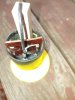
My approach on the amp with PA 060 is the doubled (4x) 1N4007 thru a 50 Ohm/10W sandbox with MOV surge supressors on the primary end.
1109201136.jpg
 
Last edited:
Douglas, the rectifier tube is not being 'run over ratings' - the extra ss diodes are simply an added protection for when the rectifier tube goes gassy and arcs (with a high risk of collateral damage to the PT) - rectifier tubes, like output stage tubes, have a short enough service life to be a concern.
 
Back
Top Bottom