

If you're thinking that this thread will be about a 12" subwoofer driver made from scratch, then you're right!
It started about a year ago, when I was bored. I was thinking of ideas of projects that I could work on in my free time. And then, it came to me. I know enough about speaker drivers, to build one from scratch! And my pencil started drawing a cross-section of a traditional speaker driver.
But what do I make it out of? I tried cardboard, but I used too much tape and it still was falling apart (due to lack of duct tape, my only option was scotch tape). I tried chopped up latex gloves for the surrounds, and it worked out surprisingly well, but the noise of the scotch tape drew me back again.
I came across videos about speakers on YouTube that could hardly compare with dome tweeters, and then this one person seemed to know what he was doing. Apparently, he used foam board that you buy at Michael's to make the subwoofer. He used duct tape for the surrounds, at rubber bands for the suspension. Simply put, he's a genius for making such a beautiful driver.
The driver's excursion was breaking 2 inches, still producing clean, undistorted bass as you can see in his videos.
So, it really is possible to make a very nice driver out of scratch from materials that not only can you find at Home Depot, be even more likely to find at art supply stores!
This inspired me, and I'll take it a little step further by making my own. I'll be using them in my emtpy subwoofer box for 2 12" subwoofers, that my neighbor gladly gave to me for free (they had it in their driveway, and I asked them for it and they said take it).
So, I have the plans and designs for it, and all I need is the funding for materials. I'd like as much feedback as possible, and critisism of my designs to improve them!
Here is a link one of the videos of his subwoofer (he made an 8" and a 12"; this vid is of his 8") http://www.youtube.com/watch?v=oXmVzn5wI1I&feature=channel
You can check out his other vids if you want to know more.
And here's a 3D rendering I made of my subwoofer. This is what it should look like when it's done : )
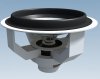
And I had a 2-D cross section, but the image was too big. I'll upload the high-res version of both images when I get a Flickr tomorrow (hopefully).
And BTW, please excuse typos. It's very late at night ATM.
It started about a year ago, when I was bored. I was thinking of ideas of projects that I could work on in my free time. And then, it came to me. I know enough about speaker drivers, to build one from scratch! And my pencil started drawing a cross-section of a traditional speaker driver.
But what do I make it out of? I tried cardboard, but I used too much tape and it still was falling apart (due to lack of duct tape, my only option was scotch tape). I tried chopped up latex gloves for the surrounds, and it worked out surprisingly well, but the noise of the scotch tape drew me back again.
I came across videos about speakers on YouTube that could hardly compare with dome tweeters, and then this one person seemed to know what he was doing. Apparently, he used foam board that you buy at Michael's to make the subwoofer. He used duct tape for the surrounds, at rubber bands for the suspension. Simply put, he's a genius for making such a beautiful driver.
The driver's excursion was breaking 2 inches, still producing clean, undistorted bass as you can see in his videos.
So, it really is possible to make a very nice driver out of scratch from materials that not only can you find at Home Depot, be even more likely to find at art supply stores!
This inspired me, and I'll take it a little step further by making my own. I'll be using them in my emtpy subwoofer box for 2 12" subwoofers, that my neighbor gladly gave to me for free (they had it in their driveway, and I asked them for it and they said take it).
So, I have the plans and designs for it, and all I need is the funding for materials. I'd like as much feedback as possible, and critisism of my designs to improve them!
Here is a link one of the videos of his subwoofer (he made an 8" and a 12"; this vid is of his 8") http://www.youtube.com/watch?v=oXmVzn5wI1I&feature=channel
You can check out his other vids if you want to know more.
And here's a 3D rendering I made of my subwoofer. This is what it should look like when it's done : )
And I had a 2-D cross section, but the image was too big. I'll upload the high-res version of both images when I get a Flickr tomorrow (hopefully).
And BTW, please excuse typos. It's very late at night ATM.


