• The move to the new server is done. There are some software and database maintenance updates in process. This has us passing the hat around to help out. We appreciate any donations. Seriously, even a dollar helps. The payment page may be found here - https://www.audiokarma.org/support.html

DIY ~3kHz conical horns

I added an ''oblate spheroid'' throat section for better driver loading and a smoother transition to a spherical wavefront. That might sound fancy, but there's no real math behind the profile, just some sanding done by eye. :)

dscn0486k.jpg


dscn0487u.jpg


dscn0488p.jpg


I had quickly listened to them on top of Karlson and they were good IMO, although they did not blend as well as the K-Tube. The above fix may help with that, hopefully.

az

Az,

Those look pretty nice. The OS aperture is a fancy way to say that the opening has a "very" gradual expansion rate at the driver, unless I'm missing something (which is certainly possible).

I've been meaning to ask what you think of the K-tube. I should just make a pair to try out, but I'm getting pretty lazy in my old age.
:D

Best Regards,
TerryO
 
Last edited:
Az,

Those look pretty nice. The OS aperture is a fancy way to say that the opening is has a "very" gradual expansion rate at the driver, unless I'm missing something (which is certainly possible).

I've been meaning to ask what you think of the K-tube. I should just make a pair to try out, but I'm getting pretty lazy in my old age.
:D

Best Regards,
TerryO

Thanks Terry. I think that pretty much sums up the OS throat thing, at least that's how I understand it as well. I hear that a related, if not similar, throat expansion profile is called "quadratic throat", as used in the Peavy horn. Somewhat controversial too. :)

K-Tube: I really enjoy the Transylvania Power Company's product, "The Tube". It's asymmetrical dispersion pattern matches that of the Karlson very well. I guess it can also work with other woofer/midrange schemes, but have not tried it yet. It sounds very natural and "images" nicely, without bringing attention to itself. It does not seem to add much gain, if any, like a horn does, so is more of a waveguide I guess. It's not too hard to make, you should try it out; schedule 40 PVC or layered maple veneer work well I hear.

az
 
Thanks Terry. I think that pretty much sums up the OS throat thing, at least that's how I understand it as well. I hear that a related, if not similar, throat expansion profile is called "quadratic throat", as used in the Peavy horn. Somewhat controversial too. :)

K-Tube: I really enjoy the Transylvania Power Company's product, "The Tube". It's asymmetrical dispersion pattern matches that of the Karlson very well. I guess it can also work with other woofer/midrange schemes, but have not tried it yet. It sounds very natural and "images" nicely, without bringing attention to itself. It does not seem to add much gain, if any, like a horn does, so is more of a waveguide I guess. It's not too hard to make, you should try it out; schedule 40 PVC or layered maple veneer work well I hear.

az

I noticed that in a picture of the recent Munich Show that Farber Acoustic Arts used the "K-tube" with their front loaded horns.

From The Absolute Sound (September issue, page46):

"A little light in balance but fundamentally neutral and well balanced, the Farber's had no "whizzer" sound in the treble, despite the flute-like Karlson device."

Best Regards,
Terry
 
Last edited:
Yeah, the Farber is interesting. They call it a coaxial system, the way they set up the K-tube on the horn, which I guess makes sense. The only element that I wonder about is the very long section of unslotted tube, but they likely took this into consideration. It would be easy enough for me to experiment and know for myself; next K-tube I make, I'll use like ~3' unslotted and test various lengths of "stub".

az
 
Update on the assembly:

dscn0489a.jpg


dscn0490u.jpg


dscn0491v.jpg


dscn0492r.jpg


dscn0493g.jpg


I made a 5ga alu adaptor plate as the layers are all glued together now and I cannot use the last one to fasten the compression driver. I also applied some Teak oil over the last few days. It gave the wood an old and dirtier look, which I like. The whole thing weighs a bit over 6lb.

I'll have to make'em work in the coming days, either PLLXO in front of Dayton T-Amp or set up an L-pad with my existing Xovers.

az
 
That looks pretty darn good. What frequency are you anticipating for the crossover? Am I correct in assuming that they'll go on top of the Karlson's?

I have to say your project has been on my mind since you first posted, it's been a real inspiration.
:thmbsp:

Best Regards,
TerryO
 
That looks pretty darn good. What frequency are you anticipating for the crossover? Am I correct in assuming that they'll go on top of the Karlson's?

I have to say your project has been on my mind since you first posted, it's been a real inspiration.
:thmbsp:

Best Regards,
TerryO

Thanks for the encouraging words!

If it sounds good and blends well, I'll run these over the mid-size SK8 I built not long ago. The Fostex FF225WK in there is pretty good, but needs help on top. The Foster phenolic horn used as a super-tweeter makes a good job, but I'd expect to get better performance if I bring in these here horns around 6kHz. I'm hoping for a better top-end, without losing too much of the fullrange magic in the midrange. I already have "generic 8ohm" 3kHz crossovers, which are what I run with the larger K12 and K-Tube; I'll try these as well and see how they sound. I'd be happy if a simple 1st order LP/HP crossover could work at 6khz. I have much experimentation in front of me. I'll probably also try to swap the Selenium D220Ti and these P.Audio on the wood-horns and K-tube to see if any combination is preferable.

I've been reading up on unity horns lately as well. This does not bode well for my wallet and "free time"... :) Actually it might not be that bad wallet-wise; 5" Pyle midrange drivers have been found suitable and 8 units can be had for under 100$. A simple, quality 1" exit CD could be used, around 40-60$, many good options here. The actual build and experimentation factor would be harder and time-consuming. It could be good and fun on top of a Karlson, taking over where its gain bandwidth finishes, ~250-300Hz. I'm getting way ahead of myself here anyway, build season is over here, gonna have to wait for spring (appartment-dweller, have to work on front porch/driveway); some other crazy contraption may strike my fancy before then too. :)
az
 
Last edited:
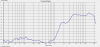
I worked on these over the weekend, mostly the Xover part at this point. The BM-D440 mounted on these horns has a smooth falling response above ~3kHz. I figured the best way to deal with this is to cross-over nominally at 20kHz with a 1µF capacitor to offset the slope. This indeed worked well, as the response is quite flat between ~3kHz and 18.5kHz this way. The Fostex driver in SK8 is also rolled-off first order and I had to fudge around with a few inductors to find the ideal value; I settled on 1.3mH for now, which brings the acoustic roll-off around 3kHz. I'd like to get a steeper roll-off in the cut-band for the tweeters though, as it's not smooth and I feel things could be improved further there. Will have to figure out how to do this and keep the slope compensation I have going.

The sound of this tweeter system is very good. No harshness, easy to listen to and very clear. I listened to some Paradigm Monitor 7 and KEF Q500 in a store over the weekend and they sounded tizzy-fizzy with an overly bright presentation; these CD's/horns eat them hands down IMO.

az
 
Here is the response of the BM-D440 on the wood horn; red trace is with a 28µF capacitor to show "wide-open" response, blue trace is with a 1µF capacitor, which pretty much acts as CD-compensation.

attachment.php


I'll try to get a 2nd order roll-off on top of the blue trace, kneepoint ~5kHz.

az
 

Attachments

  • horn_response.png
    horn_response.png
    24.2 KB · Views: 150
Last edited:
hey zaz - do you have any pictures of the little SK8 Karlson-coupler with the new horn on top? - -a kludged diy 1"ID Farber tube with 5.5" slot and ~11" unslotted portion works well/sounds good - not sure of advantages. Be nice if someone could CNC your horn for a low fee.
 
Yeah, I gotta get some pics of the combo up soon...

I'd love to have me a shop with a lathe to produce these into blocks of wood and have more freedom for different profiles.

I wonder if the super-long stubbed Farber tube moves the acoustic center versus the Transylvania product. I'll have to hack me some new ones... :)

az
 
LuViT = pretty set of horns on top of a pretty set of K-coupler - kant wait til you get into the 15" K-coupler arena
 
Where would you place X15's performance between that of K12 and K15? I know it's hard to compare with different drivers and all, but does it tend to sound closer to one or the other, aside from internal slotted waveguide?

I will also have to figure out how to put the RA and Philips drivers to use if they end-up being permanently displaced form the K's by my latest drivers. :)

IG
 
I'd say in general, X15 with a 15" has about the same LF cutoff as K12 with a 12" and both lose about 1/2 octave against the original K15 model. By using a 15" in the small cabinet, cone excursion may be reduced - but a K12 loaded with a good 3mm xmax 12 can play a pretty realistic drumkit. My Khyboe must have about the same cutoff as X15, probably has less of a graph hole - but that may not make it better. The larger vent eats up some reflector area -- but we've seen X15 built with a large vent. A rectangular vent can be split into two side-gap vents in hopes to get more reflections towards the aperture. Carl thinks his X15 built 28"x20"x~14.5" with a fully curved reflector and sidegap vents is an improvement over his early cabinet of which I've posted pictures. IIRC he used 25 degree baffle. X15 are only about 1-1.2 cubic foot more in bulk than K12. Both are KooL. Might you bend some posterboard to approximate a curved reflector for one of your Karlsonettes?

wish I could be of more help as so much is subjective
 
I still get a general idea I guess. It is indeed hard to convey "how it sounds" what with the differences in build and drivers we use. No fancy graphs will do it too, but they sure look pretty! :)

az
 
I had some time to screw around with the crossovers on these, here the best I could come up with from the parts bin:

woodhorn_Xover.png

I got 1µF CD-compensation capacitor, parallel 7.7ohm swamping resistor in front of that and 2nd order network at ~4kHz in front. The ~1850hz hump could use some notching down the road, but it's not really noticeable, being ~13dB down. I like that the driver extends nicely to 20kHz, I don't really need any extra help up there. With the CD-comp and Xover, I don't need extra pad-down for the woodhorn to be on the same level as the mid-size Karlson under it.

I was not too sure how to size that parallel swamping resistor, so as to provide a more constant impedance load to the 2nd order network, but it turned out that ~8ohm worked better than ~16ohm, which produced more of a hump around 4kHz.

You can see in the pictures how I put small and thin pieces of cotton wool down the throats of the waveguides; this helped smooth out some VHF irregularities. Reversed polarity on the tweeter produces a nicer graph as well as more coherent sound AFAICT. That's possibly since the Xover is 1st order on the Karlson and 2n on the tweeter? Backing the tweeter 4.5" would be perfectly time-aligned before, might still be but I should check with this new Xover.

DSCN0580.jpg

DSCN0583.jpg

az
 
Last edited:
Back
Top Bottom