


JamVal
Addicted Member
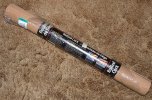
I found a new, sealed roll of cork sheet, 24" x 48" x 2.5mm in Savers last week. My stock rubber mats are about 4 to 5mm thick, so I decided I would sandwich two sheets of the 2.5mm cork which would allow for a 4" diameter 'label' recess on the top layer.
I don't have the proper tools or measuring devices to do the cutting with precision.
If I make more here is the method I will use.
Step 1 was a challenge unrolling the cork sheet without cracking the edges which I didn't realize could happen until I started unrolling it. Fortunately, it was minor and no loss of material.
Step 2 Cut a full width of the cork sheet - 12" x 24".
Step 3 and next challenge is getting the cork sheet flat as it wants to retain the coil set. Sandwiching between two boards with weight on top for a day didn't accomplish much. Spraying lightly with some warm water and sandwiched again for a few hours did the trick.
Step 4. Cut the 12" x 24" sheet in half, yielding two 12" x 12" sheets. Locate the center of each sheet using an LP. Punch a spindle hole in one of the mats and cut a 4" hole in the center of the other.
Step 5. Glue the two mats together, taking great care in getting the spindle hole of the bottom mat concentric with the 4" hole of the top mat. Not concerned with the outer edges being perfectly flush as the final diameter will be cut after glue dries. Sandwich between boards and weight until the glue is dry.
Step 6. Place the sandwiched 12" square cork mat on your turntable platter. Place your stock rubber mat over that. Trace the OD of the rubber mat onto the cork mat. Cut the final diameter with good quality scissors. This cork cuts very easily.

I haven't done a critical listening test between the stock rubber mat and the cork mat yet. At this point I was more concerned about possible wow/flutter due to less than perfect dimensions.
Using the RPM Speed and WOW app I took 6 runs each on the cork mat and the stock rubber mat. I know there are questions about the accuracy of this app, but the results showed no difference between the two mats, consistently .07% to .08% for each.
I don't have the proper tools or measuring devices to do the cutting with precision.
If I make more here is the method I will use.
Step 1 was a challenge unrolling the cork sheet without cracking the edges which I didn't realize could happen until I started unrolling it. Fortunately, it was minor and no loss of material.
Step 2 Cut a full width of the cork sheet - 12" x 24".
Step 3 and next challenge is getting the cork sheet flat as it wants to retain the coil set. Sandwiching between two boards with weight on top for a day didn't accomplish much. Spraying lightly with some warm water and sandwiched again for a few hours did the trick.
Step 4. Cut the 12" x 24" sheet in half, yielding two 12" x 12" sheets. Locate the center of each sheet using an LP. Punch a spindle hole in one of the mats and cut a 4" hole in the center of the other.
Step 5. Glue the two mats together, taking great care in getting the spindle hole of the bottom mat concentric with the 4" hole of the top mat. Not concerned with the outer edges being perfectly flush as the final diameter will be cut after glue dries. Sandwich between boards and weight until the glue is dry.
Step 6. Place the sandwiched 12" square cork mat on your turntable platter. Place your stock rubber mat over that. Trace the OD of the rubber mat onto the cork mat. Cut the final diameter with good quality scissors. This cork cuts very easily.
I haven't done a critical listening test between the stock rubber mat and the cork mat yet. At this point I was more concerned about possible wow/flutter due to less than perfect dimensions.
Using the RPM Speed and WOW app I took 6 runs each on the cork mat and the stock rubber mat. I know there are questions about the accuracy of this app, but the results showed no difference between the two mats, consistently .07% to .08% for each.
Last edited:

