

You are using an out of date browser. It may not display this or other websites correctly.
You should upgrade or use an alternative browser.
You should upgrade or use an alternative browser.
Do i have to mandatory load the tube amp?
- Thread starter toshik
- Start date


Register to hide this ad


ferninando
Lunatic Member
or put 100ohm 10watt Rs across each spkr terminal. same-o-same-o

s-petersen
Scott
There is a small possibility it could oscillate and damage the opt
ferninando
Lunatic Member
I just use 100watt 8ohm dumy loads and never turn on an AMP without them. preamps dont need em.

There is a small possibility it could oscillate and damage the opt
Exactly.
Why not just wire up a couple and use them whenever doing maintenance? I use 16 ohm loads so that I can measure the output power, but as was mentioned above, anything below 100 ohms would work fine.

sKiZo
Hates received: 92644 43.20°N 85.50°W
You need to load tube amps, and you need to provide a PROPER matching load. I suppose you could take a chance using the transformers, but have the fire extinguisher handy ...
Good dummies aren't all that expensive and a good investment. Only suggestion there is to provide plenty of heat sink as they can get hot ... mine are mounted to an old furnace chassis that I've converted to shelving ... plenty of mass for most anything I can throw at them.
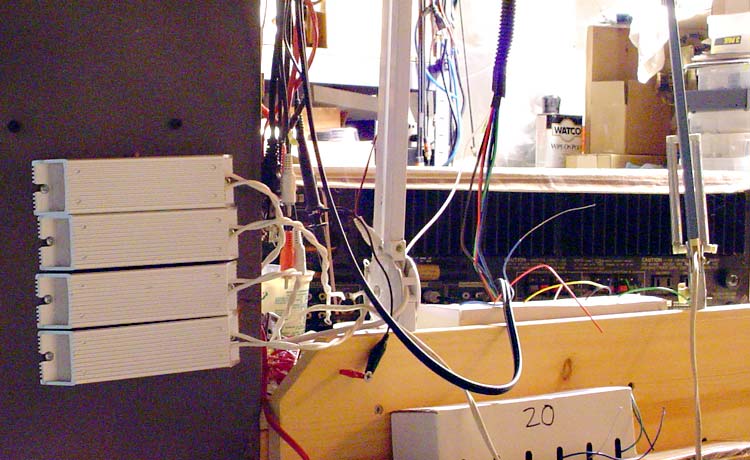
** I work with quad btw, which explains why I need four of em ...
Good dummies aren't all that expensive and a good investment. Only suggestion there is to provide plenty of heat sink as they can get hot ... mine are mounted to an old furnace chassis that I've converted to shelving ... plenty of mass for most anything I can throw at them.
** I work with quad btw, which explains why I need four of em ...

Scuzzer
Fixed Bias
You need to load tube amps, and you need to provide a PROPER matching load.
When putting music through them you are absolutely correct. When just powering them up to check voltages I use some skank 50 ohm/5 watt resistors I have laying around, I also put shorting plugs on the inputs just to make sure there aren't any strange transients hitting the output transformers.

Retrovert
Addicted Member
When the output transformer is unloaded its flux gradually increases, but thus has no place to go. So the voltage climbs, often as high as 2KV to 5KV, which then manifests as back EMF which arcs three places: (1) Flashover arc between output transformer windings, (2) Flashover arc between the plate and other tube elements, and (3) Flashover arc between the tube socket pins, usually plate to heater. The result is the sound of a cash register, as you replace the output transformers and tubes. Even if the arc doesn't kill them the first time, it damages them and results in failure.
This is why large inductive loads, like relays and motors, use flyback diodes to dump the charge before it turns into high voltage kick and blows up whatever device is driving it.
Adding 100Ω to 200Ω or so across the output terminals ensures the amplifier is never fully unloaded, either intentionally or unintentionally when a circuit breaker or fuse in the speaker blows. It has no significant effect on the speakers, being in parallel, and can be left in place. An MOV or TVS isn't the right solution, because it still allows the situation to occur, and MOVs are known to explode.
As long as we're talking protection, adding grid stoppers and screen stoppers prevents arcing in your tubes, but that's a different problem and a separate discussion.
This is why large inductive loads, like relays and motors, use flyback diodes to dump the charge before it turns into high voltage kick and blows up whatever device is driving it.
Adding 100Ω to 200Ω or so across the output terminals ensures the amplifier is never fully unloaded, either intentionally or unintentionally when a circuit breaker or fuse in the speaker blows. It has no significant effect on the speakers, being in parallel, and can be left in place. An MOV or TVS isn't the right solution, because it still allows the situation to occur, and MOVs are known to explode.
As long as we're talking protection, adding grid stoppers and screen stoppers prevents arcing in your tubes, but that's a different problem and a separate discussion.