• The move to the new server is done. There are some software and database maintenance updates in process. This has us passing the hat around to help out. We appreciate any donations. Seriously, even a dollar helps. The payment page may be found here - https://www.audiokarma.org/support.html

Do speaker wires make a difference?

Status
Not open for further replies.
I am skeptical that beyond minimum guage recommendations there is a significant cost/benefit value.

That said, I was running my 6v6 tube amp through 12 feet of 16 guage lampcord. Because I had some some 'audio' quality 12 guage I bought on sale years ago, I swapped it in. Sound better? Maybe. Hard to tell. But I didn't go back!

Your ears will be the final judge.
 
Who is "they"? I see one. Who else ya got?

If you've got nothing more to add, please refer to post # 9 here.

OK, I admit I'm just making an educated guess about boozehound; would you want to bet that he has made any comparisons? as for your added gratuitous comment, refer to my post (#18) just above one of yours :yes:
 
Looks like there is 50% 50% here :yes:

50% say yes
50% say no

I like that Cable Company try a cable idea. As long as you get your money back if you don't like any :scratch2:
Some say it's all about the gauge per foot and that Lamp chord will work just fine, some say expensive $1000 cables make a difference, guys like Michael Fremer from Stereophile mag. Maybe its all psychological. Although when you go to these stereo shows you see them all using these thick honkin cables that cost $$$thousands and not HomeDepot lamp chord.

just sayin :scratch2:
 
I've also wondered that, if you are using $$$thousand dollar cables from external amplifier connectors to external speaker connectors shouldn't the cable continue to it's final destination to really make a difference? Such as the internal speakers themselves and to the internal circuit boards? Where does it stop? Where dose the conversion take place? I'm confused!!! This theory is what lends me to believe that expensive cable doesn't really make a difference, Physics wise.

I mean, If you open your speakers, manufacturers use solid 14-16 gauge silver wire, and the cheapest ****...also amplifier manufacturers use the same thing, yet on the outside we use $$$$thousand stranded copper thicker cable??? Doesn't make sense...Why?

duh :scratch2:
Anyone?
 
Last edited:
Does anyone else find it meaningful that most of the people advocating 12 ga lamp cord haven't done any comparisons?

Twelve gauge isn't lamp cord, unless you have a 2400 Watt lamp. Twelve gauge oxygen free speaker cable is good stuff.
 
I've also wondered that, if you are using $$$thousand dollar cables from external amplifier connectors to external speaker connectors shouldn't the cable continue to it's final destination to really make a difference? Such as the internal speakers themselves and to the internal circuit boards? Where does it stop? Where dose the conversion take place? I'm confused!!! This theory is what lends me to believe that expensive cable doesn't really make a difference, Physics wise.

duh :scratch2:
Anyone?

Good point. Many of us who use heavier speaker cable, have also taken our speakers apart and rewired them with the same kind of cables internally. And your point about circuit boards is well taken. I prefer and use tube amplifiers that have point to point wiring rather than the chintzy thin traces on circuit boards.
 
Isn't this lamp chord? I've always thought this was lamp chord...I keep spelling chord like a musician, ha ha ha
 

Attachments

  • Lightwire.jpg
    Lightwire.jpg
    42.6 KB · Views: 50
Last edited:
In theory the "SAME" cable should continue to the crossover and then you can step it down to the speaker drivers, maybe...Any electricians in the house? When I wired my house the same wire and thickness goes from the ceiling light fixture to the electrical fuse box, no change up...

just sayin :scratch2:
 
Quite a few of the more expensive speakers and speaker brands use "exotic" internal wiring. Whether that's because it sounds better or because their potential buyers expect it I couldn't say.
 
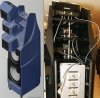
I'm not saying your wrong, I'm trying to understand...but if you look at this picture. These are $13,000 Harbeth 40.1 studio monitors and they are using what appears to be regular 14 or 12 gauge solid component wire.

Don't look fancy to me :scratch2:
 

Attachments

  • post-9296-043419000 1338540748.jpg
    post-9296-043419000 1338540748.jpg
    61 KB · Views: 73
Now if you look inside this $200,000 Wilson speaker you see a different story. They seem to use a different configuration or cable. It appears to be two solid 12 gauge wires strand together. Maybe????

I don't know, :scratch2:
 

Attachments

  • 6_i1.jpg
    6_i1.jpg
    154.4 KB · Views: 75
Quite a few of the more expensive speakers and speaker brands use "exotic" internal wiring. Whether that's because it sounds better or because their potential buyers expect it I couldn't say.

Well I guess you don't know then.
Thanks for sharing
 
Actually I'm surprised that in the history of speaker manufacturing, not one company has sold a speaker cable that is specifically matched with the speakers...

for example:

If I was Tannoy and Tannoy used 12 gauge pure silver wire mined from the depths of Queensland, Australia on the inside of the speaker drivers to achieve that special Tannoy sound, it only makes sense to sell me the exact same cables to attach on the outside, hence completing the chain...No? **** I'd better remove this idea before BOSE see's it...he he he

just sayin :scratch2:
 
Last edited:
It may make a difference depending on your set up and how you use it.

I used the tiny little red wires that came with my Sansui for years and never stopped to think about it.

When I bought my JBL L100Ts they threw in a free pair of Monster cables that you could jump start a car with. I cut one in half and wired it up and the other one is still sitting out in the garage unused.

Lately I have been using some 18 gauge Belkin OFC wire that I got on a clearance sale at Parts-Express.

I can't really say that one sounds any better than the other because I'm not pushing any of my systems to its limits current or distance wise. So far I have never felt that any of my speaker cables are/were causing any shortcomings.

If you have to run long lengths of cable you may want to up the AWG a bit but don't get carried away with the cost. Pure copper is pure copper regardless if they are trying to charge $1000/ft or $1/ft.
 
I run 12AWG and I tried Kimber. I noticed no difference so I stayed with the 12AWG and it's fine.

We often talk about speaker placement being ultra important to get the best sound. Cable placement (for me) is also very important.

I suggest before you outlay some cash on upgraded speaker wire is to ensure that any AC power leads are either kept away from your speaker leads, or if they happen to cross make sure they cross at 90deg. Do not let the AC leads run parallel to your speaker leads, or your interconnects.

It could merely by an exercise of diligent cable positioning that offers some reward. If not then by all means try some upgraded leads and see how you go.
 
OK, I admit I'm just making an educated guess about boozehound; would you want to bet that he has made any comparisons? as for your added gratuitous comment, refer to my post (#18) just above one of yours :yes:
Yes, I see you edited your post after I made mine. Thought better of what you were doing, eh?
 
Status
Not open for further replies.
Back
Top Bottom