• The move to the new server is done. There are some software and database maintenance updates in process. This has us passing the hat around to help out. We appreciate any donations. Seriously, even a dollar helps. The payment page may be found here - https://www.audiokarma.org/support.html

Dry Capacitor

gregmcm

Active Member
AK members often hear that old capacitors should be replaced as they tend to dry out after many years of use in older vintage amps and receivers.
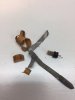
To put a picture to this here is a photo of a small cap I replaced as part of replacing all the caps on the power supply of a Pioneer SX-980. In this case the inside of the cap was completely 100% dried out! Whenever I come into possession of an older I now always replace the power supply capacitors before doing anything else.
 

Attachments

  • Dry Cap.JPG
    Dry Cap.JPG
    26.2 KB · Views: 219
Register to hide this ad
I agree 100%. A failed filter capacitor can do serious damage in a short time. I change them before I change any other caps.
 
Yup--I don't care if the unit was beat to hell and back for 30+ years, or sat NIB for 30+ years--time marches on, and electrolytes dry out--it is what it is--same goes for speaker surrounds--they can stiffen or turn to dust whether used or not.
 
In the case of the SX-980 I'm actually amazed that the unit was actually working given the condition of this particular cap and I'm sure there were others in similar shape. Given the importance of the power supply within any unit and the fact that it may be the most stressed section within a amp or receiver it makes sense that these caps would be the most likely to suffer fatigue and failure AND offer the best bang for the buck when replaced. It would be hard to convince me that keeping original caps maintain the original sound based on my experience at least in the case of the Power Supply caps.
 
Don't underestimate the significance of small signal caps. Granted, large power supply caps take the greatest beating (electrically speaking), but the small signal path caps can have a tremendous impact on sound quality/clarity.
 
It's been a mixed bag in my experience. I recapped a Marantz 2252B. Checked each cap when I took it out with a Peak Atlas ESR70. Every one looked good. Then I picked up a Nikko Alpha 230 power amp. Practically every cap I tested was bad, either low or no value shown on the meter or sky high ESR. I've serviced many units; I just posted these 2 examples, as they are opposite ends of a spectrum.

In short, I think heat and/or circuit design play a crucial role in capacitor lifespan. There are those who will argue that electrolytic capacitors have a limited lifespan, and I have to agree. But in well ventilated, well designed circuits they will last far longer than you'd think.
 
I took 4 of the old capacitors from the SX-980 power supply and cut them open to see what their condition was. For comaprison I also cut open a new capacitor and made a judgement as to the dry condition of the old caps compared to the new cap. Here is a photo showing the four capacitors and my indication of their condition relative to the new capacitor. Would be interesting to know at what point of dryness the capacitor starts to affect performance.

PS: the caps on the power supply board were ELNA with the following markings: CEW85c 7N

4 Dry Caps.JPG
 
Last edited:
Just wondering if you have a vintage amp and the Original filter caps still measure to spec, does this mean that it hasn't fully dried out or has some evaporation taken place ?
I also wonder if there is some kind of sliding scale for this. Evaporation of electrolyte Vs uf measurement.
How were you able to measure 98 % dry and 50 % dry ?
Are the modern day caps less impervious to drying out as the older technology caps ?
 
Just wondering if you have a vintage amp and the Original filter caps still measure to spec, does this mean that it hasn't fully dried out or has some evaporation taken place ?
I also wonder if there is some kind of sliding scale for this. Evaporation of electrolyte Vs uf measurement.
How were you able to measure 98 % dry and 50 % dry ?
Are the modern day caps less impervious to drying out as the older technology caps ?

Awesom, my assessment as to the condition of the old caps was a subjective one based on my observation of the old compared to the new one I used for comparison.
 
Two factors (measurable) that really indicate capacitor performance are the actual capacitance value uF and the ESR (resistance). If either of these is significantly "off", then performance is certainly compromised.
 
I agree with all that's said - but the big caps should at least be checked as well.
I just replaced some 6800\50v caps that both measured out at 2400uf each. Crazy. I could cut them open to look, I suppose.
 
There are those who will argue that electrolytic capacitors have a limited lifespan, and I have to agree. But in well ventilated, well designed circuits they will last far longer than you'd think.

I am one of those who will argue that electrolytic capacitors have a limited lifespan, but agree with your comments regarding their use/abuse in a given design. I have 4 Krell monoblocs (pure class A space heaters) that are still running on their original 30 year-old caps, and they still spec correctly--must be due to those monstrous "industrial" looking heatsinks, and the quality of the build to start with. I really don't relish the idea of over $1K in PS caps to re-do all four.

What concerns me the most are a few of the Chi-Fi tube amps that I have worked on, where the electrolytic caps were being used right at or even above their rated voltages--with no room to install a more suitable cap--I'd give them a lifespan of 5 years--tops.
 
What concerns me the most are a few of the Chi-Fi tube amps that I have worked on, where the electrolytic caps were being used right at or even above their rated voltages--with no room to install a more suitable cap--I'd give them a lifespan of 5 years--tops.
+1 And the quality of the caps in many of those units are of poor quality.

I replaced the halogen bulbs in 2 lamps in my living room with LED's. Less than 2 years later one of them develops flicker. Being curious and a cheap bastard, I took it out to my bench and took it apart. The LED's lit normally when powered by my DC power supply. Inside the bulb was a PCB for the AC to DC converter. 1 cap, a 10 uF 400 volt ChongX brand, measured nothing on the cap tester. Replaced it and the bulb is fine.

So, I must amend my comments about capacitor lifespan to only include good quality capacitors in a well ventilated, well designed circuit.
 
I just remove the covers on all my equipment and spritz them with Vaseline Intensive Care Coco and Shea Butter Capacitor Moisturizer Spray about once a year. They spark a little bit so I unplug them first, if I remember.

:rflmao::rflmao::rflmao:
I've also heard Oil Of Ulan works a treat too ! :biggrin::biggrin::biggrin:
 
When recapping an old unit - 60s or 70s - we are talking about 40 years+ in age. Do you replace capacitors with devices which are as close as possible to the originals or do you replace them with modern high quality devices that were not available back in the day?
My tendency would be towards the latter where I am just trying to do the best job I can for the unit.
The question is, are you trying to end up with a unit which sounds just like it did when new (refurbishment) or are you trying to improve the sound quality (upgrade)?
I'm easy with either viewpoint. I'm just interested in other peoples' thoughts on this.
 
When recapping an old unit - 60s or 70s - we are talking about 40 years+ in age. Do you replace capacitors with devices which are as close as possible to the originals or do you replace them with modern high quality devices that were not available back in the day?
My tendency would be towards the latter where I am just trying to do the best job I can for the unit.
The question is, are you trying to end up with a unit which sounds just like it did when new (refurbishment) or are you trying to improve the sound quality (upgrade)?
I'm easy with either viewpoint. I'm just interested in other peoples' thoughts on this.

I'm no electronics expert, but I guess with technological improvements, the modern assortment of devices allow for better overall performance of the unit. Whether it sounds better or not is up to the individual.
It's good practice to replace capacitors with slightly higher spec ones for which the gurus refer to as having "extra headroom". Filter caps are a good example of this.
 
Back
Top Bottom