• The move to the new server is done. There are some software and database maintenance updates in process. This has us passing the hat around to help out. We appreciate any donations. Seriously, even a dollar helps. The payment page may be found here - https://www.audiokarma.org/support.html

Dual 506 motor smoke

Okke 70s

Super Member
Hello, Is there suppose to come smoke out of my record player? ;)

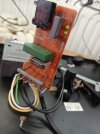
So I took on the job to revive a Dual 506. I believe it is a model 2, although there are minor differences with the service manual. Plugged it in the DBT when it came here. It ran for a minute or maybe 2 and then I noticed a modest plume of smoke coming out of the machine. Immediately switched off and looked inside. Found three suspect capacitors and figured the smoke was from one of those.
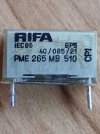
RIFA.jpg
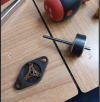
Replaced the caps, got the pitch control back in shape and all the other common cleaning & lubing, new belt etcetera jobs done and tried again. Now I was alert and after less then a minute I smelled smoke again. Then I figured the motor was running to heavy. It has some resistance in it when you turn it. I'm often struggling to determine if an electromotor is suppose to turn so heavy.. Anyway, I took it completely apart, down to the rotor to clean and lubricate again. It still runs a bit heavy to my taste, but you can now clearly feel the 'steps' from the magnets at least. Is that just what it does?
rotor.jpg
Anyway, I just tried again after a minute or so, it started smoking again. I am now fairly certain the smoke comes from the motor, not from the PCB. I have also established that is it configured for the correct 320V by deciphering this sticker from the back of the actual machine. Had to add some info the make sense of it..
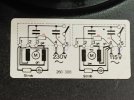
circuit bewerkt.jpg
So why is that motor making smoke? Could it be oil in the wrong place? In transport it has been in all angles. Did anyone have the problem as well with the same or similar model? Any help or thought you got for me is most welcome!
 
Register to hide this ad
230VAC. Right?

Try wiping off all the excess oil and see if the thing still smokes. If it does, the motor is prolly worn out.
 
Still sounds like it's configured for 115 volts.

That schematic is Not very well labeled, Easy to make a mistake.

Otherwise your looking at what sounds like shorted motor windings.

If you cannot figure it out you need expert help before blowing the motor up permanently.

Edit: Yes, Replacing all the capacitors would be a good start.
 
Last edited:
Looking at connection sticker pic, it seems that this is a 115 volts motor and R1 is a dropping resistor that gets connected in series for 230 volts supply. If that resistor has drifted down or the connections are not correct then the motor is receiving wrong voltage.

Regards,
 
Edit: Crap~!

"analogadict" Your right the confusing diagram shows a resistor as the dropping mechanism...

That's bad because if the caps are good the motor windings are shorted.

I've rewound many motors over the years, But never again if I can help it!
 
Last edited:
The schematic on the sticker is showing coils connected in parallel in both situations. Only difference is that R1 gets connected to one end of the parallel connected coils in case of 230 volts supply. It is out of the circuit in case of 125 volts supply.

Regards,
 
Last edited:
Hello, Is there suppose to come smoke out of my record player? ;)

So I took on the job to revive a Dual 506. I believe it is a model 2, although there are minor differences with the service manual. Plugged it in the DBT when it came here. It ran for a minute or maybe 2 and then I noticed a modest plume of smoke coming out of the machine. Immediately switched off and looked inside. Found three suspect capacitors and figured the smoke was from one of those.
View attachment 3824587
Replaced the caps, got the pitch control back in shape and all the other common cleaning & lubing, new belt etcetera jobs done and tried again. Now I was alert and after less then a minute I smelled smoke again. Then I figured the motor was running to heavy. It has some resistance in it when you turn it. I'm often struggling to determine if an electromotor is suppose to turn so heavy.. Anyway, I took it completely apart, down to the rotor to clean and lubricate again. It still runs a bit heavy to my taste, but you can now clearly feel the 'steps' from the magnets at least. Is that just what it does?
View attachment 3824592
Anyway, I just tried again after a minute or so, it started smoking again. I am now fairly certain the smoke comes from the motor, not from the PCB. I have also established that is it configured for the correct 320V by deciphering this sticker from the back of the actual machine. Had to add some info the make sense of it..
View attachment 3824594
So why is that motor making smoke? Could it be oil in the wrong place? In transport it has been in all angles. Did anyone have the problem as well with the same or similar model? Any help or thought you got for me is most welcome!
The 506 has the sm100 motor (16 pole).
There are more Rifa caps in the other board. Those will also crack, stick and smoke. Change them all
If you smell fish, it's a Rifa capacitor
 
Thank you all for your chiming in!

Still sounds like it's configured for 115 volts.

That schematic is Not very well labeled, Easy to make a mistake.

The schematic on the sticker is showing coils connected in parallel in both situations. Only difference is that R1 gets connected to one end of the parallel connected coils in case of 230 volts supply. It is out of the circuit in case of 125 volts supply.
Yes it is an unnecessary confusing diagram, but after due study I fully understand it now and know how to translate it to the PCB. Mine is definitely in 230V configuration. You can actually see it in this picture because the tracks shine thru a bit. You see that brown wire from the power plug go to the one side of R1. On the other side of R1 it runs to the pin most left in the picture. That is pin1, and clearly has all three wires (two black and one green) going to both motor coils and the stroboscope. It really, really is the 230V configuration.

That RIFA is the most probable culprit.

There are more Rifa caps in the other board. Those will also crack, stick and smoke. Change them all
If you smell fish, it's a Rifa capacitor

"Prone to catastrophic failure" is an understatement with those things.. As you can see, they have all been replaced (by exact the same capacities as original). The schematic suggests C3 -in series with the strobe- is not on the same PCB, but it actually is.

I have measured R1 (not under load) and it checks out.

So then something with bad coils?:eek: The odd thing is: I see nothing burned or damaged. The motor does not vibrate, make noise and it doesn't feel hot right after running at all. That gives me some hope it's just muck between the rotor and the stator. So yes, I'm going to open it up again and like polish it up or something.

see if the thing still smokes. If it does, the motor is prolly worn out.

Otherwise your looking at what sounds like shorted motor windings.

You guys have any quick-checks for that sort of thing?
 
Says 2A 250 Volts micro switch, But they can go bad and smoke.

You will need to measure each coils resistance.

It's very low so most cheap meters will have trouble reading it.

What should the resistance be, Not sure. You need the values from a good motor.
 
The 506 has the sm100 motor (16 pole). (...)

Actually, being equipped with the SM100(-1) only applies to the 506-1 & -2. Whereas the initial 506 is still based on the 8-pole SM860(/5), which has a different wiring scheme.

(...) The schematic suggests C3 -in series with the strobe- is not on the same PCB, but it actually is. (...)

Not really. C3 actually isn't shown at all in the wiring scheme(s) depicted above. And what you deem to be C3 in that wiring scheme actually is the strobe lamp, which has an additional series resistor.


Sorry, Thorsten, but that's the wrong one - namely the English version of the service manual for the initial 506. Whereas the OP should rather refer to the combined service manual for the initial 505 and 506-1 instead - i.e., this one: https://dual.de/wp-content/uploads/ServiceManual_505_506-1.pdf Unfortunately there doesn't appear to be a separate service manual version or at least an addendum for the 506-2, on which a few parts were changed compared to the 506-1.


Greetings from Munich!

Manfred / lini
 
Well, it seems pretty obvious that there is at least one source of the smoke. Is that a switch?

Says 2A 250 Volts micro switch, But they can go bad and smoke.

Oh, I like that idea!

So instead of completely taking the motor apart again, I soldered out the switch. Then hooked it up to the ohm meter, switched it in and got all kinds of readings. Then wire-bridged it's place on the PCB and voila! The motor is running for about 15 minutes now without a hint of smoke. Thank you guys! I never would have thought of the switch doing the slow burning.

Now I'm going to have to figure out a way to replace it.
 
Great that you identified the culprit, that switch definitely looked dodgy, but my initial thoughts went in another direction.
I've restored a couple of 505's (-3 and -4), and a little smoke from the big grey resistor is a common "issue" with these, but it is not the resistor that is faulty. If the tt has been standing still quite a lot of dust can accumulate on the resistor and any dust gets burned off when you start the tt (and also during operation). This resistor really gets quite hot. You will probably find that the inside of the cover is dirty from soot that has accumulated over time.
 
Mr Boochie strikes again~~!

Kudos...

The micro switch is Super common, The problem is there are dozens of configurations.

Last one I installed I removed from a microwave circuit board.
 
Actually, being equipped with the SM100(-1) only applies to the 506-1 & -2. Whereas the initial 506 is still based on the 8-pole SM860(/5), which has a different wiring scheme.


Not really. C3 actually isn't shown at all in the wiring scheme(s) depicted above. And what you deem to be C3 in that wiring scheme actually is the strobe lamp, which has an additional series resistor.


Sorry, Thorsten, but that's the wrong one - namely the English version of the service manual for the initial 506. Whereas the OP should rather refer to the combined service manual for the initial 505 and 506-1 instead - i.e., this one: https://dual.de/wp-content/uploads/ServiceManual_505_506-1.pdf Unfortunately there doesn't appear to be a separate service manual version or at least an addendum for the 506-2, on which a few parts were changed compared to the 506-1.


Greetings from Munich!

Manfred / lini
These are sm100 bearings
1787834232551.png
 
(...) Now I'm going to have to figure out a way to replace it.

Unfortunately that won't be quite as easy anymore, as one might think. Problem is, that both of the original, closed Marquardt switch types, that Dual has used on this board over time, namely the 1004.4020 and the 1019.6203, have been discontinued - so for the last version of that board Dual-Fehrenbacher apparently already had to improvise with some sort of open Marquardt 1010 family switch, as one can see in the pic over there: https://www.adapterland.de/images/p...ages/dual_mikroschalterplatine_f_r_cs_505.jpg

And looking at that pic, one may additionally notice, the the blade spring of that 1010 family switch is missing. However, I'm not sure, whether it's missing by accident - or it's missing or respectively has been removed on purpose to reduce the required switching force.

Well, and while I contacted Marquardt roundabout 2 1/2 years ago with the question, whether they could provide data sheets for the 1004.4020 and/or the 1019.6203 in order to assist the Dual community in finding a suitable replacement switch type, they unfortunately haven't replied.

If everything else fails, you could still get the complete board as new old stock replacement part (and apparently equipped with the 1019.6203) from Dualfred, though - see there: Switch Board

Greetings from Munich!

Manfred / lini
 
Hello, Is there suppose to come smoke out of my record player? ;)

So I took on the job to revive a Dual 506. I believe it is a model 2, although there are minor differences with the service manual. Plugged it in the DBT when it came here. It ran for a minute or maybe 2 and then I noticed a modest plume of smoke coming out of the machine. Immediately switched off and looked inside. Found three suspect capacitors and figured the smoke was from one of those.
View attachment 3824587
Replaced the caps, got the pitch control back in shape and all the other common cleaning & lubing, new belt etcetera jobs done and tried again. Now I was alert and after less then a minute I smelled smoke again. Then I figured the motor was running to heavy. It has some resistance in it when you turn it. I'm often struggling to determine if an electromotor is suppose to turn so heavy.. Anyway, I took it completely apart, down to the rotor to clean and lubricate again. It still runs a bit heavy to my taste, but you can now clearly feel the 'steps' from the magnets at least. Is that just what it does?
View attachment 3824592
Anyway, I just tried again after a minute or so, it started smoking again. I am now fairly certain the smoke comes from the motor, not from the PCB. I have also established that is it configured for the correct 320V by deciphering this sticker from the back of the actual machine. Had to add some info the make sense of it..
View attachment 3824594
So why is that motor making smoke? Could it be oil in the wrong place? In transport it has been in all angles. Did anyone have the problem as well with the same or similar model? Any help or thought you got for me is most welcome!
Those bearings look bone dry and varnished.
They are bright copper when clean.
Qtips and isopropyl will do the job.
Since there isn’t a felt, for holding oil, you can add one, I make them out of 1mm sheet felt from the craft store.
Also, you should vacuum impregnate them using an oral syringe and a vacuum cap (hardware store item). Add a vacuum by pulling on the syringe and you will see air bubbles. This is the air leaving the sintered bearings being replaced by oil.
Here’s a picture of my setup. I use the drill bit to jamb the syringe so my fingers don’t get sore.
Takes several hours and 5 or six re-pulls of the syringe until no more bubbles
 

Attachments

  • IMG_2986.jpeg
    IMG_2986.jpeg
    204.4 KB · Views: 12
Back
Top Bottom