• The move to the new server is done. There are some software and database maintenance updates in process. This has us passing the hat around to help out. We appreciate any donations. Seriously, even a dollar helps. The payment page may be found here - https://www.audiokarma.org/support.html

Dual capstans?

  • Thread starter Thread starter Deleted member 89059
  • Start date Start date
D

Deleted member 89059

Guest
Sorry, I am quite new to the entire magnetic tape world, so please excuse my many questions.
Apparently Sony and AIWA made several portable models that had not one, but two capstans and one disc drive motor mechanism for each capstan. That and several home decks.
Now this is supposed to increase smoothness and stability, right? Anyone have some experience with them dual capstans? Any big improvements over the single capstans?

Thank you.

PS. And how does a thin, smooth rod of metal actually pull tape? The pinch roller really creates that much pressure? I always thought the motor drove the tape-up spindle...
 
Register to hide this ad
On a casette deck there are several advantages using "the dual capstan system"
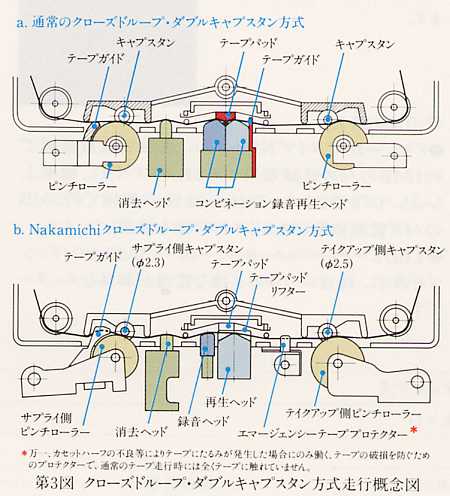
First: the left capstan pulls the tape , thereby minimizing (? spelling) flutter comming from a bad casette shell , next: the dual capstan system creates a really nice tape tension across the heads - some decks actually have a pad lifting thingie (Nacamichi)
This should avoid flutter from the tension between the pad and backside of the tape ....

Compare it to how eartquakes takes place :(

Not many decks use independent capstan motors for dual capstan - the norm is on motor driving both - or one direct driven righthand capstan, and a belt from the righthand capstan to the left

On Reel to reel deck's - the dual capstan is working superb, same on most casette decks .... oldtimers like Tandberg's TDC 300, and Beocord 5000 used the system

Don't hessitate to ask questions here .... we love them :)
 
Yeah I've read about the Dragons having a pad-lift.
So it's time I go get a deck... Saw a "triple head dual capstan" machine yesterday. Maybe I'll go back there a while later.
"Minimizing" is right. And speaking of quakes, Sendai. Really tragic.

Thanks man.
 
Yeah I've read about the Dragons having a pad-lift.
So it's time I go get a deck... Saw a "triple head dual capstan" machine yesterday. Maybe I'll go back there a while later.
"Minimizing" is right. And speaking of quakes, Sendai. Really tragic.

Thanks man.

All my casette decks (2 x denon dmr44hx, Pioneer 676 and 979) are three head, dual capstan thingies - never trouble

.... goshh .. forgot the oldie .. a 76 model AKAI GX-c760d

casett1.jpg


a strange bird - electrical brakes :)


regarding the Japanese tragedy - they have my uttermost sympathy ..... The tube is full of sad pictures here , really sad
 
jan regarding the Japanese tragedy - they have my uttermost sympathy ..... The tube is full of sad pictures here said:
Mine also. If you cannot send funds, PLEASE send your thoughts and energy (Love or whatever YOU call it)
Thanks
 
Innards of the WM-DD9, probably the only dual capstan Walkman made by Sony (AIWA made a couple, too). Note independent drive motors.
2753632ce95859e2598506f9625b17e2.jpg
 
On a casette deck there are several advantages using "the dual capstan system"
First: the left capstan pulls the tape , thereby minimizing (? spelling) flutter comming from a bad casette shell , next: the dual capstan system creates a really nice tape tension across the heads - some decks actually have a pad lifting thingie (Nacamichi)
This should avoid flutter from the tension between the pad and backside of the tape ....

Compare it to how eartquakes takes place :(

Not many decks use independent capstan motors for dual capstan - the norm is on motor driving both - or one direct driven righthand capstan, and a belt from the righthand capstan to the left

On Reel to reel deck's - the dual capstan is working superb, same on most casette decks .... oldtimers like Tandberg's TDC 300, and Beocord 5000 used the system

Don't hessitate to ask questions here .... we love them :)

isolation of the tape media between the two capstans is key to the performance of this design. i just read this today and was fascinated by the mechanics involved.
 
double capstan tape travel, and difference between standar double capstan closed loop and nakamichi's configuration (double capstan as well)

nakamichi-tape-pass.jpg
 
HI,
The Nak Dragon has dual capstans and two independent capstan direct drive motors. All is microprocessor controlled. Maintains extremely fine control of tape tension over the heads. You rarely, if ever, hear the effects of the tape loosing contact with the heads no matter which direction the tape is traveling in playback. In record, the tape always is run left to right. Again, it never looses contact unless the tape is badly deformed. In that case, the tape should be dumped.

The machine does not use pressure pads and does have a lifter for the pressure pad that is built into the cassette shell. This is very good for head life and low flutter operation.

It all works like a charm. I love my Dragon.

Sparky
 
Yes... Thing is I haven't seen one Nak deck around here. But, spotted a couple of NAD decks.
 
Can someone explain the difference in closed loop dual capstans and dual captstans that are not closed loop.
Thanks.
Luke
 
Can someone explain the difference in closed loop dual capstans and dual captstans that are not closed loop.
Thanks.
Luke

Closed loop dual capstan deck, would normally use one belt to drive both capstans - a dual capstan deck (without the "closed loop") may use 2 direct drive motors, electronically controlled.

then again - a dual capstan deck, may be a autoreverse deck, where they spin at different direction - thus having a mechanism, that only engages one pinch roller at the time ..........

Certain background music casette players, used this - allowing 3 Hour music programmes on a casette
 
"Dual capstan" usually mean "dual capstan closed loop".

But some brands did dare to name their autoreverse decks "dual capstan" as they, in fact, had two spinning capstans, though in opposite directions and only one engaged at time. Their specs and preformance are of those "single capstan"

There aren't single capstan autoreverse decks, but there are "dual capstan closed loop autoreverse decks. Like the TEAC R-999X which is sitted next to me now"
 
Wow I have some really nice high end cassette decks DENNON, ONKYO JVC, TEAC and never new the capstans rotate I always thought they just supported the tapes in a solid position and 2 was always better for holding the tapes in place and that the spindles above just rotated the tapes Hey we learn something new everyday. I've always enjoyed cassettes and recording my own music and you could always record way better music than those prerecorded tapes with good quality high bias tapes. I think cassettes are making a comeback slowly, I hurd younger people are showing interest in it and thankfully they're are some really great decks you can still purchase and sellers that really go through them and make sure there in top condition for sale you pay more but your getting a deck that's been serviced for great recording and play back. Really enjoying them more now than I ever have. Nice that we can still buy some great blank tapes to.
 
"Dual capstan" usually mean "dual capstan closed loop".

But some brands did dare to name their autoreverse decks "dual capstan" as they, in fact, had two spinning capstans, though in opposite directions and only one engaged at time. Their specs and preformance are of those "single capstan"

There aren't single capstan autoreverse decks, but there are "dual capstan closed loop autoreverse decks. Like the TEAC R-999X which is sitted next to me now"
Also the ONKYO TA R500 dual capstans outoreverse decks just bought one a month ago in mint condition really nice deck almost CD like sound with TDK and MAXELL high bias tapes.
 
Back
Top Bottom