• The move to the new server is done. There are some software and database maintenance updates in process. This has us passing the hat around to help out. We appreciate any donations. Seriously, even a dollar helps. The payment page may be found here - https://www.audiokarma.org/support.html

Dummy Resistor Load Resistors

ampman

AK Subscriber
Subscriber
Hi,
I am testing power amps and need to power resistors in the range of 100 to 400W I need this wattage at specified ohm values to properly test the output of the amps.

Where can a person find power resistors in 4, 8 & 16 ohm resistance between 100 to 400W range that are within spec? I've bought a number of cheap ones, good ones and even "known good brands" and none are within the 5% or 1% tolerance specified. I have also bought extra and sorted them in an attempt to come up with the needed value but have not been able to this point. I have also tried to build a network using multiple resistors combined in series/parallel to arrive at the necessary values to no avail.

Any ideas?
 
Register to hide this ad
I got mine from Digi-Key, they have a big selection.

I wouldn't worry much about the tolerance, just measure the voltage drop across the resistor to calculate the current.

There have been times at my old job where I had to creep up on a value to determine something like current limit for a power supply. I just put a big variable resistor in parallel.
 
I got mine from Digi-Key, they have a big selection.

I wouldn't worry much about the tolerance, just measure the voltage drop across the resistor to calculate the current.

There have been times at my old job where I had to creep up on a value to determine something like current limit for a power supply. I just put a big variable resistor in parallel.
Resistance can also vary quite a bit with heat, so it's best to snap a reading as soon as power is applied.
 
In the old days we would take 10 watt resistors and wire them in parallet to get the correct impedance and put them in a can of oil to help dissipate the heat. Some folks tried to use wire wound power resistors but those loaded the amplifiers in correctly at high frequencies. They were designed to be used with 60 cycle circuits only.
 
Remember that aluminum chassis mount resistors require an appropriate heat sink to meet their power ratings. It can be sheet metal or an actual heat sink as long as it can dissipate the heat properly. Otherwise, the resistors inside the housing can be less than a quarter of the rating.
 
In the old days we would take 10 watt resistors and wire them in parallet to get the correct impedance and put them in a can of oil to help dissipate the heat. Some folks tried to use wire wound power resistors but those loaded the amplifiers in correctly at high frequencies. They were designed to be used with 60 cycle circuits only.
If it was a large resistor and had large inductance, this might be an issue. I'm unaware of any resistors that would be used in this application that would be a problem.
The AC power across the resistor is volts times amps. That's the rating of interest. The resistor power spec should be derated by 50% or more.
 
Agree on the tolerance not being overly critical. If you really need an accurate power number, measure the actual resistance of the load bank and use that figure for your math.


If you need 4, 8, and 16 I'd probably build it as a couple banks of 8 ohms and series or parallel them as needed to get what you need. Really just depends on what you want to buy vs what you need. My own is a 4x 8 ohm at 100 watt setup, made up of a pair of 16 ohm 50w in parallel per channel. I needed a 4 channel bank for something I was working on, but it allows me to do 2 channels of 4 ohm or 16 ohm at 200w, or a single channel of 8 ohm or 2 ohm at 400w depending on how I jumper things together. Basically nothing I do needs more than 100w at 8 ohm so those extra sets of terminals almost never get used for anything.

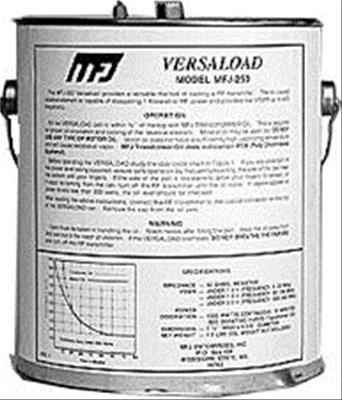
liquid cooling is also an option. My 1kw Heathkit RF dummy load is a 50 watt resistor in a 1 gallon paint can of mineral oil. Won't suffer 1kw forever but it'll do it a heck of a lot longer than it would without the can of oil.
 
Hi,
Thanks for the replies, everyone. I do buy from Mouser, Digi-key, Allied, Newark and others. I have bought the brands mentioned and am testing them using Tektronix Lab grade meters.

I want to test to a component/amplifier's service manual's specification.

My intent is to build a bench test bed that will test to the 0.00x% THD levels using an Audio Precision System 1 analyzer to prove the performance (specs). I will accept the resistor that matches the 1% resistance specified, yet I am seeing 1.5-3% on quality brand resistors. I'm hoping to use mass produced products and not build custom resistor packs as this is not economical.

Maybe the 'measuring and calculating' is the way it has to be done.

@avionic - like the "coffee warmer"...
 
...My intent is to build a bench test bed that will test to the 0.00x% THD levels using an Audio Precision System 1 analyzer to prove the performance (specs). I will accept the resistor that matches the 1% resistance specified, yet I am seeing 1.5-3% on quality brand resistors...
When you measure the resistors do you use a Kelvin connection?
 
In the old days we would take 10 watt resistors and wire them in parallet to get the correct impedance and put them in a can of oil to help dissipate the heat. Some folks tried to use wire wound power resistors but those loaded the amplifiers in correctly at high frequencies. They were designed to be used with 60 cycle circuits only.


The Ham radio guys have used oil cooled dummy loads for ages, and this one is rated from 0 to 400 MHZ :D

They used to be called "Cantenna" IIRC...

(No affiliation, presented for example only)

1715814274875.png
 
In the old days we would take 10 watt resistors and wire them in parallet to get the correct impedance and put them in a can of oil to help dissipate the heat. Some folks tried to use wire wound power resistors but those loaded the amplifiers in correctly at high frequencies. They were designed to be used with 60 cycle circuits only.

I just wanted to confirm that I found this to be the case in my experience as well. I bought one of the 100 Watt resistors from Parts Express that are supposed to be "non-inductive" but I found that measurements started to deviate significantly from another resistor I had especially as the frequency and power increased. I measured the inductance with an LCR bridge and the PE sourced resistor had significantly more inductance than the other china/ebay sourced resistor I had. The PE resistor would show 10x more distortion at say 20 kHz vs the other resistor.
 
Back
Top Bottom