

You are using an out of date browser. It may not display this or other websites correctly.
You should upgrade or use an alternative browser.
You should upgrade or use an alternative browser.
DYI tube amplifier
- Thread starter Hifimex
- Start date
Register to hide this ad

ScottFan355
Super Member
Well it all depends on your budget.

Is that a "do yourself it" amplifier? 

Lavane
Lunatic Member
Are you looking at a build from scratch, or a kit? There are a lot of nice kits.
Dynakit, Tubes4Hifi, etc. There are also blank printed circuit boards and you supply all the other parts. Tubelabs sells some excellent bare PCB's with parts lists. I've built the Tubelabs 300B SET amp using his PCB. He also sells an SE amp board that an be configured to use 6L6's, EL34's, and KT-88's. It can alao be wired triode mode, pentode or ultra linear. He also sells a pcb to build a push pull EL84 amplifier. The Dynakit and Tubes4HiFi amplifier kits are very nice kits. The instructions are excellent. I built the Tubes4HiFi ST-70 8 years ago and I'm very happy with it. I recently built the Dynakit ST-35. It's also a great kit. Both sound very good. Erhard Audio sells a few amp kits as well I think. I've built one of his preamp kits and bought another that was prebuilt.
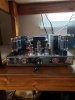

Dynakit, Tubes4Hifi, etc. There are also blank printed circuit boards and you supply all the other parts. Tubelabs sells some excellent bare PCB's with parts lists. I've built the Tubelabs 300B SET amp using his PCB. He also sells an SE amp board that an be configured to use 6L6's, EL34's, and KT-88's. It can alao be wired triode mode, pentode or ultra linear. He also sells a pcb to build a push pull EL84 amplifier. The Dynakit and Tubes4HiFi amplifier kits are very nice kits. The instructions are excellent. I built the Tubes4HiFi ST-70 8 years ago and I'm very happy with it. I recently built the Dynakit ST-35. It's also a great kit. Both sound very good. Erhard Audio sells a few amp kits as well I think. I've built one of his preamp kits and bought another that was prebuilt.


One of the reasons I've avoided tubes is the high voltage they use. I've zapped myself plenty of times carelessly stuffing my hands into my amps, but 120V AC isn't likely to kill you or even be painful unless you make a good connection to it, and dry, unbroken akin isn't particularly conductive. It's been a while since I had a good zap and I'm in a habit of being more aware so I've thought about building a tube amp, but 600V isn't a joke, especially of it's coming off a circuit with a capacitor in it. I'm not going to say don't do it, but go forward with a strong respect for the danger and get very familiar with electrical safety techniques.
Are you looking at a build from scratch, or a kit? There are a lot of nice kits.
Dynakit, Tubes4Hifi, etc. There are also blank printed circuit boards and you supply all the other parts. Tubelabs sells some excellent bare PCB's with parts lists. I've built the Tubelabs 300B SET amp using his PCB. He also sells an SE amp board that an be configured to use 6L6's, EL34's, and KT-88's. It can alao be wired triode mode, pentode or ultra linear. He also sells a pcb to build a push pull EL84 amplifier. The Dynakit and Tubes4HiFi amplifier kits are very nice kits. The instructions are excellent. I built the Tubes4HiFi ST-70 8 years ago and I'm very happy with it. I recently built the Dynakit ST-35. It's also a great kit. Both sound very good. Erhard Audio sells a few amp kits as well I think. I've built one of his preamp kits and bought another that was prebuilt.
View attachment 1854062 View attachment 1854063
Probably a kit. Since I'm not an electrical engineer lol. My experience with electricity is more on the DC side. And I wouldn't even know where to start designing an amp from scratch
Lavane
Lunatic Member
The amplifier kits from Tubes4HiFi or Dynakit are very good with excellent instructions. Both sell versions of the ST-70. Dynakit is most like the original, while the Tubes4HiFi uses an updated driver board with bias adjustments for each output tube. Dynakit also sells several mono block amps as well as the smaller ST-35. If you want lower powered single ended amps there is Bottlehead and a few others that sell nice kits.Probably a kit. Since I'm not an electrical engineer lol. My experience with electricity is more on the DC side. And I wouldn't even know where to start designing an amp from scratch
The amplifier kits from Tubes4HiFi or Dynakit are very good with excellent instructions. Both sell versions of the ST-70. Dynakit is most like the original, while the Tubes4HiFi uses an updated driver board with bias adjustments for each output tube. Dynakit also sells several mono block amps as well as the smaller ST-35. If you want lower powered single ended amps there is Bottlehead and a few others that sell nice kits.
Thanks for the info I will check all those.
Man this hobby can get expensive and very addictive lol.


JMRead
New Member
Hello HFM,
I will probably get a load of stick from the tube aficionados but never mind
You would like to hear the 'valve' sound, there is a very inexpensive way to do that. In the 60's a state of the art valve amp was designed by a Mr Williamson it was the bench mark against which all others were judged. Constructors all over the world are still making them.
Along came a Mr John Linsley Hood who was a electronic engineer at the Windscale nuclear re-processing plant, he was interested in audio and also at the cutting edge of electronics. He designed a very simple Class A transistor amplifier and in 1968 he and other audio friends set up a switched trial, two valve amplifiers one of which was Mr Hoods own DIY and expensively made Williamson, his own Class A transistor amp and three class B transistor ones, one was a commercially made effort.
The conclusion was very interesting the amps fell into two camps on one side the Class B amps and in the other the two valve amps and the Class A transistor. Of these three the Class A transistor and the Williamson sounded better than other valve amp.
The sentence in the article that he wrote that is the most telling is this; "The "Williamson" and the present Class A (transistor) design were both better than the other valve amplifier, and so close in performance that it was almost impossible to tell which of the two was in use without looking at the switch position"
The article can be downloaded here: https://drive.google.com/file/d/1p5k4YgTPAYa-aCtt6DpfE6CCekHOhV6k/view?usp=sharing
Not much danger of electrocution either.
Cheers - J
I will probably get a load of stick from the tube aficionados but never mind
You would like to hear the 'valve' sound, there is a very inexpensive way to do that. In the 60's a state of the art valve amp was designed by a Mr Williamson it was the bench mark against which all others were judged. Constructors all over the world are still making them.
Along came a Mr John Linsley Hood who was a electronic engineer at the Windscale nuclear re-processing plant, he was interested in audio and also at the cutting edge of electronics. He designed a very simple Class A transistor amplifier and in 1968 he and other audio friends set up a switched trial, two valve amplifiers one of which was Mr Hoods own DIY and expensively made Williamson, his own Class A transistor amp and three class B transistor ones, one was a commercially made effort.
The conclusion was very interesting the amps fell into two camps on one side the Class B amps and in the other the two valve amps and the Class A transistor. Of these three the Class A transistor and the Williamson sounded better than other valve amp.
The sentence in the article that he wrote that is the most telling is this; "The "Williamson" and the present Class A (transistor) design were both better than the other valve amplifier, and so close in performance that it was almost impossible to tell which of the two was in use without looking at the switch position"
The article can be downloaded here: https://drive.google.com/file/d/1p5k4YgTPAYa-aCtt6DpfE6CCekHOhV6k/view?usp=sharing
Not much danger of electrocution either.
Cheers - J
Depending on your speakers Bottlehead makes great kits, almost moron proof assembly instructions, great photos and great forum.
I have a few pairs I could use.
Infinity rs4b
Jbl 77 Lancer
Altec capri 887a
Sonics a447
I would like to think 20 to 40w as I know gain on tube amplifiers is bigger than on a s.s.
Hello HFM,
I will probably get a load of stick from the tube aficionados but never mind
You would like to hear the 'valve' sound, there is a very inexpensive way to do that. In the 60's a state of the art valve amp was designed by a Mr Williamson it was the bench mark against which all others were judged. Constructors all over the world are still making them.
Along came a Mr John Linsley Hood who was a electronic engineer at the Windscale nuclear re-processing plant, he was interested in audio and also at the cutting edge of electronics. He designed a very simple Class A transistor amplifier and in 1968 he and other audio friends set up a switched trial, two valve amplifiers one of which was Mr Hoods own DIY and expensively made Williamson, his own Class A transistor amp and three class B transistor ones, one was a commercially made effort.
The conclusion was very interesting the amps fell into two camps on one side the Class B amps and in the other the two valve amps and the Class A transistor. Of these three the Class A transistor and the Williamson sounded better than other valve amp.
The sentence in the article that he wrote that is the most telling is this; "The "Williamson" and the present Class A (transistor) design were both better than the other valve amplifier, and so close in performance that it was almost impossible to tell which of the two was in use without looking at the switch position"
The article can be downloaded here: https://drive.google.com/file/d/1p5k4YgTPAYa-aCtt6DpfE6CCekHOhV6k/view?usp=sharing
Not much danger of electrocution either.
Cheers - J
Great read and ill check this out. I have a friend who is an actual electronics repair guy. So ill ask if he could help
JMRead
New Member
Hello HFM,
"Watts all dis den"
One big con trick by the manufacturers - errrr no sorry two, and a bit
No 1,
Loudspeaker classification by efficiency you might see 86 db with 1 watt at 1 metre (mine and pretty poor) you might see 92 db very efficient. By that reckoning 2 watts at 2 metres.
The 'fall off' (much loved by the manufacturers) by distance is measured in an anechoic chamber, the equivalent of a large field with no wind and no ambient sound. The reflections in most rooms will mean that there is very little fall off if any at all. There is an Android app called Sound Meter which is very good indeed and reacts to sound levels at 0.4 secs. There are iPhone/iPad apps they are not so fast. Give it a try with a good volume on your speakers you will get an average of something in the region of 75 to 80 db. It's all a bit like the brakes and MPG in cars measured on a rolling road, without the seats and no one sitting in them.
No 2
For each increase of volume that our ears can hear we need a 3 db increase, a 3 db increase needs double the power from an amplifier. Ohhhhhhh! sounds really nasty and the manufacturers play up to this one till the (cash) cows come home.
Worst case scenario 86 db speakers
at 1 watt = 86 db
at 2 watts = 89 db Not very good for your ears
at 4 watts = 92 db Even worse
at 8 watts = 95 db Dangerous
Lets say you got 80 db average in your room
at 1 watt = 86 db
at 1/2 watt = 83 db
at 1/4 watt - 80 db
Please do find out what the efficiency of your various speakers are and have a little work out. You'll probably find that you are listening to 1/4 to 1/2 watt most of the time.
No 2.1
Ohhh but you need a lot of power for transients, no you don't a 1/2 way decent amplifier will easily go to twice its output level.
No 2.2
Its slowly becoming apparent that the best power supplies are switch mode ones, really fast and able to put out power that people dreamed of only a few years ago, even the cheap ones £10.00! sound better than the usual but slow transformer and loads of huge capacitors.
Such is life. There's no such thing as a pastime where one doesn't see con tricks thrown at the unsuspecting and gullible.
Cheers - J
"Watts all dis den"
One big con trick by the manufacturers - errrr no sorry two, and a bit
No 1,
Loudspeaker classification by efficiency you might see 86 db with 1 watt at 1 metre (mine and pretty poor) you might see 92 db very efficient. By that reckoning 2 watts at 2 metres.
The 'fall off' (much loved by the manufacturers) by distance is measured in an anechoic chamber, the equivalent of a large field with no wind and no ambient sound. The reflections in most rooms will mean that there is very little fall off if any at all. There is an Android app called Sound Meter which is very good indeed and reacts to sound levels at 0.4 secs. There are iPhone/iPad apps they are not so fast. Give it a try with a good volume on your speakers you will get an average of something in the region of 75 to 80 db. It's all a bit like the brakes and MPG in cars measured on a rolling road, without the seats and no one sitting in them.
No 2
For each increase of volume that our ears can hear we need a 3 db increase, a 3 db increase needs double the power from an amplifier. Ohhhhhhh! sounds really nasty and the manufacturers play up to this one till the (cash) cows come home.
Worst case scenario 86 db speakers
at 1 watt = 86 db
at 2 watts = 89 db Not very good for your ears
at 4 watts = 92 db Even worse
at 8 watts = 95 db Dangerous
Lets say you got 80 db average in your room
at 1 watt = 86 db
at 1/2 watt = 83 db
at 1/4 watt - 80 db
Please do find out what the efficiency of your various speakers are and have a little work out. You'll probably find that you are listening to 1/4 to 1/2 watt most of the time.
No 2.1
Ohhh but you need a lot of power for transients, no you don't a 1/2 way decent amplifier will easily go to twice its output level.
No 2.2
Its slowly becoming apparent that the best power supplies are switch mode ones, really fast and able to put out power that people dreamed of only a few years ago, even the cheap ones £10.00! sound better than the usual but slow transformer and loads of huge capacitors.
Such is life. There's no such thing as a pastime where one doesn't see con tricks thrown at the unsuspecting and gullible.
Cheers - J

jdsalinger
Super Member
Another option. http://www.oddwattaudio.com/owpoddwatt.html
I've built Bruce's Forewatt preamp (twice). I think he really has put a lot of though into his designs.
I think my next build will be the mini-watt built as a dual mono.
I've built Bruce's Forewatt preamp (twice). I think he really has put a lot of though into his designs.
I think my next build will be the mini-watt built as a dual mono.