• The move to the new server is done. There are some software and database maintenance updates in process. This has us passing the hat around to help out. We appreciate any donations. Seriously, even a dollar helps. The payment page may be found here - https://www.audiokarma.org/support.html

Dynaco A25 cap with SEAS Prestige 27TDFC replacement

Taser_This

New Member
I've seen a lot of posts about the Dynaco A25, but not this specific question.

One of my tweeters failed in one of my A25's, so I ordered a pair of SEAS Prestige 27TDFC (H1189) from Madisound since I could not quickly find an original used replacement. I also ordered two 5uf Clarity caps since I wasn't sure if the failure could have been due to a bad cap.

I installed one of the new SEAS 27TDFC (H1189) in the speaker with the bad tweeter. I did not like the result. Everything I liked about the A25 was gone. I then replaced the cap and did not notice a significant change to the speaker's status. In comparing my unmodified A25 with its sister with the new tweeter, the speaker with the new tweeter is not as warm and in my mind there seems to be a hole in the midrange.

Madisound says SEAS recommends the SEAS Prestige 27TFFC (H881) as a replacement for the A25 series Dynaco's. I've read other places that the SEAS Prestige 27TDFC (H1889) is a recommended replacement. In the user comments at the Madisound site, several said they used the 27TDFC (H1889) but there were no comments for the 27TFFC.

The Dynaco A25 came with the SEAS 1.5 inch H 87 tweeter and uses a 5uf cap. The later Dynaco A25 XL uses the SEAS 1 inch H 86 tweeter and a different cap, I think a 8uf (and some other crossover changes.)

Since the replacement tweeter is one inch, similar in size to the A25 XL, should the 8uf cap be used when adding the SEAS 27TDFC to a regular A25?

It seems odd to me the replacement tweeter recommended for both the A25 and the A25 XL could be used in either without accounting for their different original tweeters and crossover caps (and designs.)

1) Would the higher 8uf cap push more midrange to the tweeter vs a 5uf? For those with experience, could restoring the original sound be this simple?

2) Is there a meaningful difference between the 27TDFC and 27TFFC? I thought the 27TDFC more closely matched the spec of the H 87.
 
Last edited:
Register to hide this ad
I've seen a lot of posts about the Dynaco A25, but not this specific question.

One of my tweeters failed in one of my A25's, so I ordered a pair of SEAS Prestige 27TDFC (H1189) from Madisound since I could not quickly find an original used replacement. I also ordered two 5uf Clarity caps since I wasn't sure if the failure could have been due to a bad cap.

I installed one of the new SEAS 27TDFC (H1189) in the speaker with the bad tweeter. I did not like the result. Everything I liked about the A25 was gone. I then replaced the cap and did not notice a significant change to the speaker's status. In comparing my unmodified A25 with its sister with the new tweeter, the speaker with the new tweeter is not as warm and midrange details seemed gone.

Madisound says SEAS recommends the SEAS Prestige 27TFFC (H881) as a replacement for the A25 series Dynaco's. I've read other places that the SEAS Prestige 27TDFC (H1889) is a recommended replacement. In the user comments at the Madisound site, several said they used the 27TDFC (H1889) but there were no comments for the 27TFFC.

The Dynaco A25 came with the SEAS 1.5 inch H 87 tweeter and uses a 5uf cap. The later Dynaco A25 XL uses the SEAS 1 inch H 86 tweeter and a different cap, I think a 8uf (and some other crossover changes.)

Since the replacement tweeter is one inch, similar to the A25 XL, should the 8uf cap be used when adding the SEAS 27TDFC to a regular A25?

It seems odd to me the replacement tweeter recommended for both the A25 and the A25 XL could be used in either without accounting for their different crossover caps (and designs.)

1) Would the higher 8uf cap push more midrange to the tweeter vs a 5uf? For those with experience, could restoring the original sound be this simple?

2) Is there a meaningful difference between the 27TDFC and 27TFFC? I thought the 27TDFC more closely matched the spec of the H 87.
I am very interested in this post. Thinking of upgrading my tweeters - but maybe I should rethink.
 
The 8uf cap (along with the 1.0mh coil (found in the A25XL), produces a lower cross-over point and a steeper roll-off (12db per octave) over the A25's 6 db per octave slope. Because the A25XL has a lower XO, it was necessary to have a deeper slope to keep harmful frequencies away from its resonance frequency. I own 2 pair of A25XL speakers, one has new modified cabinets.

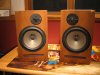
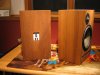
Picture 007.jpg Picture 008.jpg

The suggest tweeter replacement perhaps should be the 27TFFC. I also have this tweeter as the HF driver in my Madisound Cygnet II speakers. Very detailed in this speaker system.

If you are looking to retain the original sound of the A25, might I suggest you go to the famous auction site and buy a replacement H087 tweeter. Keep the XO caps the same value.

'ner
 
I had to replace a dead tweeter in an A25 and looked at upgrading both to the 27TDFCs but after reading that they might kill the classic, easy warm sound the speakers are known for, I got on the Bay and snagged a used H87. Recapped and was back in business. If you are not looking for a different sound, probably not a good idea to use a different tweeter.

I think it has been people looking to make their old A25s sound more like modern speakers on the top end who recommend changing the tweeters.
 
Last edited:
The 8uf cap (along with the 1.0mh coil (found in the A25XL), produces a lower cross-over point and a steeper roll-off (12db per octave) over the A25's 6 db per octave slope. Because the A25XL has a lower XO, it was necessary to have a deeper slope to keep harmful frequencies away from its resonance frequency. I own 2 pair of A25XL speakers, one has new modified cabinets.

View attachment 1749383 View attachment 1749384

The suggest tweeter replacement perhaps should be the 27TFFC. I also have this tweeter as the HF driver in my Madisound Cygnet II speakers. Very detailed in this speaker system.

If you are looking to retain the original sound of the A25, might I suggest you go to the famous auction site and buy a replacement H087 tweeter. Keep the XO caps the same value.

'ner
If I were to replace my existing, working tweeters with 27TFFCs in my recapped A25s, can you describe how the sound would be altered? Would that change make them more like A25XLs?
 
The 27TFFC tweeters I have are in another speaker system and its woofer XOs much higher then the Dynaco, so I have no way to compare. One thing for sure is that they are going to sound different. If you want to preserve the sound of the original A25, there are lots of H087 tweeters for sale.

I personally don't think you have given your other tweeters time to loosen up (hate the word "break-in"), and the new caps need time to homogenize with some current running thru them.

You are not going to get them to sound like the 25XL. If you want that sound, sell the A25s and get some A25XLs.

BTW, have you checked your woofer terminals? There are problems with them, as they like to fall apart and may need repair so they won't short out your amp.
 
The 27TDFC has MUCH less of a resonant response peak compared to the H087- which, with the original 5uf capacitor in the A25, makes it act as if it has a MUCH higher crossover point than with the H087.

For this speaker to work well- the tweeter needs the tweeter to have something along the line of a 2400Hz acoustic crossover point, to seamlessly blend with the woofer response- and the H087 did that, with the original 5uf cap. To make the 27TDFC have similar blending with the woofer as the 087- the cap value needs to be significantly increased. A value of somewhere around 7 to 9uf is appropriate. That changes the crossover point to somewhere in the 2200-2750Hz- which is much better than the effective 4000 Hz or so, it is with the original 5uf capacitor.

That "gap" in frequency response, due to the new tweeter effectively crossing nearly an octave higher than the original, is most likely why there seems to be a "hole" in the response. A larger cap may well fix the problem- and the 27TDFC can easily handle it. I've run these with 10uf caps, along with the woofer from an EPI 100 (which has similar frequency response to the A25 woofer), and they have no issues with dynamic power handling or anything like that, with the 10uf cap. Mind you, I wouldn't run megawatts into it that way- but I would expect the woofer will run out of excursion before the tweeter has issues...

For a fast test of concept in the speaker- you could just parallel a cap of somewhere between 2.2 and 3.3uf with the original 5uf cap. That would tell you if things were going to improve, for you...

BTW: The response shape and efficiency of the 27TDFC and the 27TFFC are pretty much identical in the crossover region. The same crossover cap that works with the 27TFFC should work fine with the 27TDFC.

Regards,
Gordon.
 
Last edited:
The 27TDFC has MUCH less of a resonant response peak compared to the H087- which, with the original 5uf capacitor in the A25, makes it act as if it has a MUCH higher crossover point than with the H087.

For this speaker to work well- the tweeter needs the tweeter to have something along the line of a 2400Hz acoustic crossover point, to seamlessly blend with the woofer response- and the H087 did that, with the original 5uf cap. To make the 27TDFC have similar blending with the woofer as the 087- the cap value needs to be significantly increased. A value of somewhere around 7 to 9uf is appropriate. That changes the crossover point to somewhere in the 2200-2750Hz- which is much better than the effective 4000 Hz or so, it is with the original 5uf capacitor.

That "gap" in frequency response, due to the new tweeter effectively crossing nearly an octave higher than the original, is most likely why there seems to be a "hole" in the response. A larger cap may well fix the problem- and the 27TDFC can easily handle it. I've run these with 10uf caps, along with the woofer from an EPI 100 (which has similar frequency response to the A25 woofer), and they have no issues with dynamic power handling or anything like that, with the 10uf cap. Mind you, I wouldn't run megawatts into it that way- but I would expect the woofer will run out of excursion before the tweeter has issues...

For a fast test of concept in the speaker- you could just parallel a cap of somewhere between 2.2 and 3.3uf with the original 5uf cap. That would tell you if things were going to improve, for you...

BTW: The response shape and efficiency of the 27TDFC and the 27TFFC are pretty much identical in the crossover region. The same crossover cap that works with the 27TFFC should work fine with the 27TDFC.

Regards,
Gordon.
OEM A25 crosses over at 1500 Hz from everything I've read. Isn't that spec important to maintain to work well with the 10" driver's rolloff?
 
OEM A25 crosses over at 1500 Hz from everything I've read. Isn't that spec important to maintain to work well with the 10" driver's rolloff?

Well- it's 1500 Hz, if you take it from the perspective of equal driver output (woofer and tweeter).

The THEORETICAL crossover point of the tweeter- treating it as a perfect Butterworth first order filter, being 3dB down at the defined textbook crossover frequency- is a higher frequency than 1500Hz. But 1500 Hz is about where the woofer and tweeter are at equal volume (somewhere nearer to 6dB down on both).

Adjusting the tweeter cap on the new tweeter to a larger value, will allow it to more closely match the acoustic output of the old tweeter- no matter how the crossover is defined (theoretically or practically)...

Regards,
Gordon.
 
Well- it's 1500 Hz, if you take it from the perspective of equal driver output (woofer and tweeter).

The THEORETICAL crossover point of the tweeter- treating it as a perfect Butterworth first order filter, being 3dB down at the defined textbook crossover frequency- is a higher frequency than 1500Hz. But 1500 Hz is about where the woofer and tweeter are at equal volume (somewhere nearer to 6dB down on both).

Adjusting the tweeter cap on the new tweeter to a larger value, will allow it to more closely match the acoustic output of the old tweeter- no matter how the crossover is defined (theoretically or practically)...

Regards,
Gordon.
Gordon, do you still repair woofers and tweeters? I have a pair of Wharfedale W20’s and a pair of Dynaco A25’s. I am restoring both and would like to use the original drivers if possible. Also, what steps would you recommend to bring them back to original specs? I have two setups - MC30’s and a Marantz 2015. I like the vintage sound. Thanks! David
 
Back
Top Bottom