
• The move to the new server is done. There are some software and database maintenance updates in process. This has us passing the hat around to help out. We appreciate any donations. Seriously, even a dollar helps. The payment page may be found here - https://www.audiokarma.org/support.html

Dynaco A25 modification. What is it for?

mcoluccio

New Member
Hello everyone,

I bought a pair of Dynaco A25's a stoop sale the other day and later noticed that someone had modified the input with a fuse. Does anyone know why someone would have done this? Also, do you think it is ok to remove it from the circuit?

thank you in advance.
Matthew
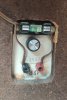
 

Attachments

  • IMG_20191028_082704.jpg
    IMG_20191028_082704.jpg
    52.7 KB · Views: 85
Register to hide this ad
If the drivers are original, there's no real reason to keep the fuse unless you plan on driving the speakers to insane SPL's.
 
If the drivers are original, there's no real reason to keep the fuse unless you plan on driving the speakers to insane SPL's.

OK, Thank you. I haven't opened them up to see if they're original; I'll have a look tonight. I think these are incorrect types of fuses (Slow Burn) to use on speakers anyway.
 
That fuse might hold 3A for 10 seconds and that might be about 75 watts. Seems to be a reasonable selection although most speaker fuses are normal blow and your speakers could use a higher wattage than that.

Prudent use of the system, not overdriving the system and not using a 400 wpc amp would probably eliminate the need for the fuse.
 
Last edited:
That fuse might holed 3A for 10 seconds and that might be about 75 watts. Seems to be a reasonable selection although most speaker fuses are normal blow and your speakers could use a higher wattage than that.

Prudent use of the system, not overdriving the system and not using a 400 wpc amp would probably eliminate the need for the fuse.

Great, thank you for the info!
 
I think a fuse is a good idea. But not slow-blow. Don't know what amp you're using. I don't assume an amp will not fail and take out a speaker at random.
Dynaco later saw fit to increase the power capability and efficiency.
Move to a 1 amp fast and see if it lives. Adjust as needed.
 
The other side of the coin. I suspect that fuse is doing no harm ...... so no real need to remove it.....
 
I guess I am wondering why remove a fuse?
To improve sound quality? To avoid having to buy those expensive audio fuses? To return the speaker to stock configuration?

Some amp manuals talk about adding fuses to the speakers. These fuse blocks are nicely installed and with correct fuse selection may prevent problems with the speakers caused by the amplifier. I'd leave them installed.
 
Fuses in speakers used to be quite common. However, that was probably due to the first generation of transistor amps being prone to failure and putting DC across the speaker. These days transistor amps tend to have more sophisticated protection circuits with less likelihood of speakers ending up with 50V DC across the voice coil. Most modern speakers don't have fuses.
I think a fuse is a good idea. But not slow-blow.
Why not slow-blow? I think a slow-blow fuse will blow before the voice coil is damaged and is less likely to blow on music peaks.
I guess I am wondering why remove a fuse?
Fuses aren't perfect short circuits until blown, at which point they become open circuit. In reality the tiny wire will heat up and become a much higher impedance before it blows. The impedance modulation is what audiophiles worry about and it makes some sense if you've spent a small fortune on speaker cable and don't want to waste it by having a hair-width piece of wire in series with it.
Some speakers used to have the tweeters protected by having a small tungsten filament bulb in series. The idea being that the tungsten would be a very low impedance unless the volume was dangerously loud when the tungsten would heat up, become a much higher impedance and protect the tweeter. I don't know how audible the bulbs were because I never heard any speakers with them in.
Maybe I'll do some experiments... :idea:
 
These old speakers are often used with old receivers that can fail in a hurry. That's why I use fast blow with most of them.
The A25 is not high peak tolerant. It has a fast blow tweeter.
Not a speaker that responds well to fancy cables.
 
The A25 is what it is. So I got the A40XL. Takes more power, has improved efficiency. So makes more noise, much better now.
But I doubt it even knows the difference between 12 and 22 gauge. Still, a good speaker.
 
Fuse is in the ears of the A25 owner.
I'd never used fuse...
Guess tweeter coil will be long gone before fuse acts.
 
Fuses in speakers used to be quite common. However, that was probably due to the first generation of transistor amps being prone to failure and putting DC across the speaker. These days transistor amps tend to have more sophisticated protection circuits with less likelihood of speakers ending up with 50V DC across the voice coil. Most modern speakers don't have fuses.

Good info! That explains why every pair of 60s and early 70s speaks I've come across that still have the directions stapled to the backs of the cabinets directs you to add a fuse to your speaker wire.
 
Back
Top Bottom